In a warehouse, a forklift is a tool for efficiency. On a construction site, a forklift is a tool for survival against the elements.
Using a standard industrial forklift on a job site is a recipe for disaster—tires will shred, chassis will bottom out, and tip-over risks skyrocket. Construction forklifts are built for dynamic environments where the 'floor' changes from mud to gravel to concrete in a single week.
This guide explains the specific requirements of site work, the four primary types of construction forklifts, and how to choose your equipment based on your current construction phase.
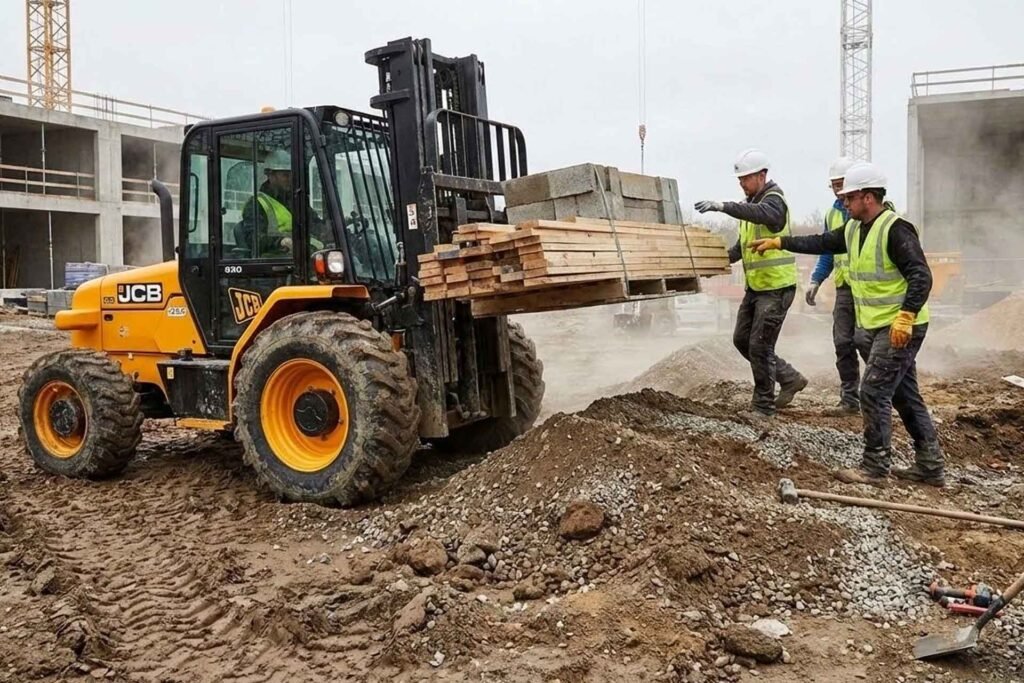
Construction Forklift
1. The 4 Hard Truths of Job Site Material Handling
Before selecting a machine, understand that construction sites demand four things a warehouse does not:
-
Ground Adaptability: The surface evolves. You need a chassis that handles 'raw earth' on Monday and 'compacted gravel' on Friday.
-
Gradeability: Sites are rarely flat. You need high torque and specialized braking for steep ramps and uneven mounds.
-
Placement Flexibility: Often, materials aren't just moved—they must be placed over obstacles, onto scaffolding, or through second-story windows.
-
Co-existence: Forklifts must operate safely alongside cranes, excavators, and ground crews in a high-noise, high-chaos environment.
2. Primary Types of Construction Forklifts
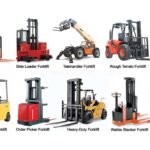
A. Rough Terrain (RT) Forklifts
The 'Workhorse' of the early-stage site. These feature large, tractor-like pneumatic tires and high ground clearance.
-
Best For: Horizontal transport of heavy bulk materials (bricks, lumber, rebar) across unpaved earth.
-
Limitation: Vertical lift only. Cannot reach forward or over obstacles.
-
Drive: Almost exclusively 4WD Diesel.
B. Telehandlers (Telescopic Handlers)
The most critical machine on a modern site. It combines a forklift’s forks with a crane’s boom.
-
The 'Load Chart' Warning: A Telehandler rated for 10,000 lbs can only lift a fraction of that when the boom is fully extended forward. You must audit the Load Chart for your specific reach requirements.
-
Best For: Lifting materials to rooftops, reaching over trenches, and multi-story placement.
C. Truck-Mounted Forklifts (Piggyback)
These 'hitch a ride' on the back of delivery trucks.
-
Best For: Material suppliers who need to unload at sites that have no permanent lifting equipment.
-
Limitation: Lower lift capacity and less stability on extreme slopes compared to dedicated RT models.
D. Heavy-Duty Counterbalance
Massive diesel units used for infrastructure projects (bridge beams, large pre-cast concrete). These require semi-improved surfaces or temporary 'mats' to operate safely.
3. Selecting Equipment by Construction Phase
The most cost-effective way to manage your fleet is to match the machine to the project stage.
| Project Phase | Ground Condition | Key Task | Recommended Equipment |
| 1. Site Prep & Foundation | Raw earth, mud, deep ruts. | Unloading bulk rebar and forms. | Heavy-Duty RT Forklift |
| 2. Structural Framing | Gravel/Dirt; Scaffolding present. | Placing lumber/steel on upper floors. | Telehandler (Primary) |
| 3. Enclosure & Finishing | Semi-paved or concrete slabs. | Moving glass, HVAC, and interior finishes. | Telehandler + Compact Electric Units |
| 4. Completion | Finished pavement/Interior. | Equipment removal and final cleanup. | Compact Industrial Forklift |
4. The 'Invisible' Risks of Site Operation
Construction forklift accidents are significantly higher than warehouse incidents due to four specific factors:
-
The Slope Trap: When loaded, you must drive Forks Uphill whether ascending or descending. Many operators make the fatal mistake of turning on a slope.
-
Dynamic Ground Shift: A site that looks solid can turn into a 'sinkhole' under the 15,000-lb pressure of a loaded RT forklift, especially after rain.
-
The Extension Lever: A Telehandler becomes dangerously unstable as the boom extends. Even a slight 5-degree slope at the base can lead to a tip-over at full extension.
-
Visibility Blind Spots: Unlike a warehouse with fixed aisles, a job site has moving obstacles. Blind-spot cameras and high-decibel alarms are mandatory site requirements.
5. Rent vs. Buy: The Contractor’s Algorithm
Because construction projects have clear start and end dates, the 'Rent vs. Buy' decision is a math problem.
-
Rent If: You have a 3–10 month project, or if the terrain of your next project will be different.
-
Buy If: Your annual utilization exceeds 8 months, or you have multiple overlapping sites.
The Breakeven Formula:
Example: If a Telehandler costs $3,500/month to rent ($28k for 8 months), but a $80k purchased unit only depreciates $10k/year with $5k maintenance, buying saves you $13k per year.
🔧 Your One-Stop Partner for Construction Material Handling
Selecting the right forklift is only half the battle; finding a reliable supplier who understands the brutal reality of the job site is the other. At Maoxiang, we don’t just provide machines; we provide the backbone for your project’s logistics.
Our comprehensive construction lineup is engineered to take you from the first shovel in the ground to the final interior touch-up:
-
For Foundation & Framing: Our heavy-duty Diesel Rough Terrain Forklifts and High-Capacity Counterbalance units handle the mud and the massive loads with ease.
-
For Multi-Story Placement: Our precision Telehandlers provide the reach and stability required for high-altitude material delivery.
-
For Finishing & Indoor Logistics: Our Lithium-powered Electric Forklifts (0.6–5 Tons) offer zero-emission, high-efficiency performance for enclosed spaces and finished floors.
Every Maoxiang machine is built to international standards (CE/ISO) and backed by our expert engineering support for hydraulic systems and maintenance.
Stop juggling multiple vendors. Get the right machine for every phase of your project from a single, trusted manufacturer.