Why Standard Forklifts Fail on Outdoor Job Sites
If you’ve ever tried using a warehouse forklift on a construction site, farm, or gravel yard, you already know the problem:
- Wheels sink into soft soil
- Tires lose traction on loose gravel
- The machine struggles on even mild slopes
- Ground clearance is never enough
A standard forklift is designed for flat, paved warehouse floors. The moment you take it outdoors, its limitations become obvious—and expensive.
On uneven terrain, stability is no longer guaranteed. It becomes a risk.
This is exactly why rough terrain forklifts exist.
But here’s what most guides fail to explain:
Not all rough terrain forklifts are suitable for all job sites—and choosing the wrong type can be just as dangerous as using a standard forklift outdoors.
This guide will help you match your terrain conditions, slope, and load requirements to the right machine.
What Is a Rough Terrain Forklift?
A rough terrain forklift is a heavy-duty industrial truck designed for unpaved, uneven, and outdoor working environments.
It is built specifically to handle:
- Loose soil
- Gravel and crushed stone
- Muddy or wet ground
- Sloped or uneven terrain
The key difference is not just size—it’s ground adaptability and traction control.
Most models feature:
- Large pneumatic tires with deep tread
- Higher ground clearance
- Stronger engines (often diesel-powered)
- Reinforced chassis for stability
But the real difference comes from design type, not just specifications.
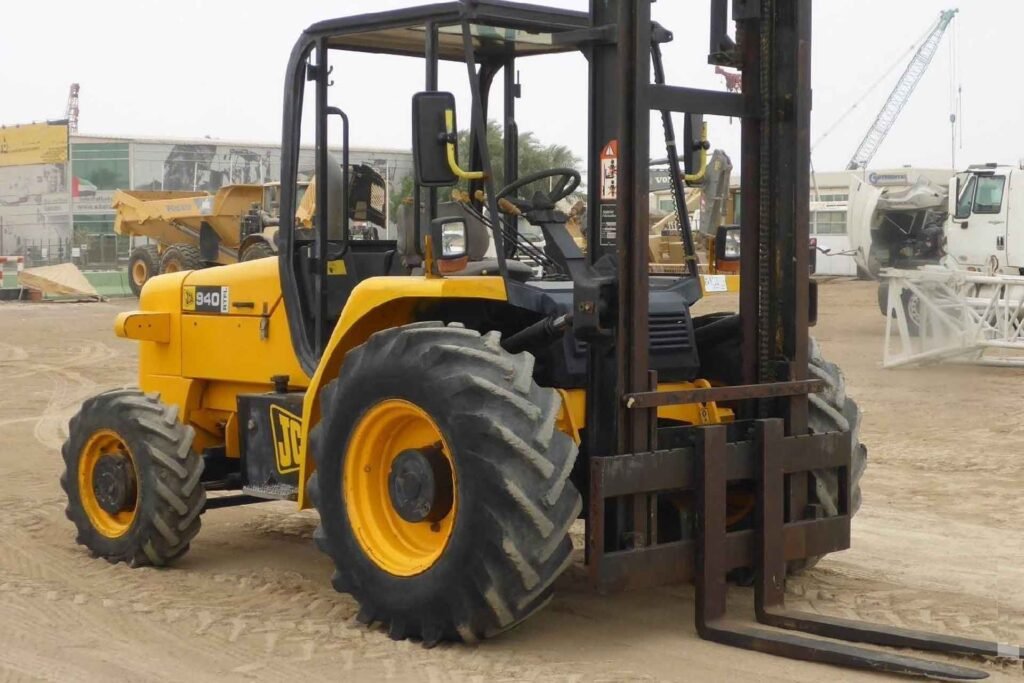
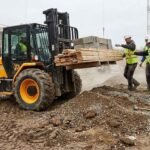
Rough Terrain Forklift
The 3 Main Types of Rough Terrain Forklifts
Most buyers mistakenly treat rough terrain forklifts as a single category. In reality, there are three distinct machines with very different use cases.
1. Straight Mast Rough Terrain Forklift
This is the closest to a traditional forklift.
It uses a vertical mast and front forks for lifting and stacking.
Best for:
- Construction material yards
- Brick, block, and lumber handling
- Repetitive loading and unloading on the same site
Key specs:
- Load capacity: 5,000–15,000 lbs
- Lift height: 15–20 ft
Limitations:
- No forward reach capability
- Limited flexibility for high or distant placement
👉 This is the simplest and most stable rough terrain option.
2. Telehandler (Telescopic Forklift)
This is the most versatile type of rough terrain machine.
It uses a telescopic boom that extends forward and upward.
Best for:
- Construction sites with multi-level structures
- Agricultural lifting and stacking
- Mining and heavy material placement
Key specs:
- Load capacity: 5,500–12,000 lbs
- Lift height: 19–55 ft
Advantages:
- Can place materials over obstacles
- Reaches heights and distances standard forklifts cannot
Trade-off:
- Higher cost
- Larger turning radius
- More complex operation
👉 If your job site involves height + distance placement, this is usually the best option.
3. Truck-Mounted Forklift
This type is mounted on the back of a truck or trailer and travels with it.
It is designed for mobile delivery operations.
Best for:
- Remote construction sites
- Material delivery without unloading equipment
- Agricultural and rural logistics
Advantages:
- No need for separate forklift transport
- Can unload immediately upon arrival
Limitations:
- Lower lifting capacity
- Reduced lift height
- Less stable than standalone machines
Simple Selection Rule
- Horizontal lifting & stacking → Straight mast
- Height + reach + flexibility → Telehandler
- Mobile delivery operations → Truck-mounted
Key Specifications That Actually Matter on Job Sites
Choosing a rough terrain forklift is not about “big tires and strong engine.” It’s about matching terrain conditions to machine limits.
1. Tires and Ground Type
Most rough terrain forklifts use large pneumatic tires (12–18 inch diameter).
But tire choice depends on your ground:
- Compacted soil / gravel → Standard pneumatic tires
- Soft mud / sand → Wide flotation tires
- Mixed terrain → Reinforced or puncture-resistant options
👉 If your site changes with weather, tire selection becomes critical.
2. Ground Clearance
Typical clearance: 10–18 inches
A simple rule:
Measure the tallest obstacle on your site (rocks, debris, uneven edges) and add at least 4 inches.
That becomes your minimum required clearance.
3. Slope (Gradeability) — The Most Ignored Risk Factor
This is where most accidents and misjudgments happen.
Most rough terrain forklifts are rated:
- 20%–40% slope (unloaded)
But here’s the critical detail:
Loaded operation reduces safe slope capacity significantly.
And even more important:
A forklift rated for a slope does NOT mean it is safe to turn on that slope.
Slope calculation:
(Vertical rise ÷ horizontal distance) × 100 = slope %
Example:
- 2 ft rise over 20 ft distance = 10% slope
Golden Safety Rule on Slopes:
- Always travel slowly
- Never turn on a slope
- Keep load facing uphill
- Uphill travel → load uphill
- Downhill travel → reverse with load uphill
4. 2WD vs 4WD
- 2WD: Better for hard compact surfaces, lower cost
- 4WD: Essential for mud, sand, and wet terrain
👉 If your site becomes muddy in rain, 4WD is not optional.
Safety Risks Specific to Rough Terrain Forklifts
Unlike warehouse forklifts, outdoor machines face dynamic environmental risks.
1. Tipping on Slopes (Most Dangerous Risk)
Common causes:
- Turning on a slope
- Carrying load downhill incorrectly
- Excessive speed on incline
👉 Most serious accidents occur during slope operation—not lifting.
2. Soft Ground Collapse
Even “solid-looking” ground may not support the machine.
Warning signs:
- Footprints sink visibly
- Ground feels unstable under walking
If this happens, forklift operation becomes high risk.
3. Limited Visibility in Work Sites
Job sites include:
- Workers
- Excavators
- Trucks
- Material piles
Visibility is constantly blocked and changing.
4. Irregular Loads
Construction materials are often:
- Long (pipes, timber)
- Uneven (bricks, debris)
- Unstable stacking shapes
👉 Attachments like clamps or extensions are often necessary.
Where Rough Terrain Forklifts Are Used
Construction Sites
- Material unloading (cement, steel, bricks)
- Structural lifting (especially telehandlers)
- Temporary equipment movement
Agriculture
- Fertilizer and feed handling
- Large hay bale transport
- Farmyard logistics
Mining & Quarry Operations
- Equipment transport on unpaved roads
- Material handling in remote zones
Lumber & Material Yards
- Outdoor stacking and loading
- Irregular long material handling
Remote Logistics
- Sites without loading docks
- Temporary infrastructure projects
Rent vs Buy: A Critical Decision for Rough Terrain Equipment
Unlike warehouse forklifts, rough terrain machines are often project-based equipment.
Renting Makes Sense When:
- Short-term construction projects (3–12 months)
- Seasonal agricultural work
- Uncertain long-term demand
Buying Makes Sense When:
- Continuous outdoor operations
- Multiple ongoing projects
- Dedicated logistics or material business
Simple Break-Even Calculation:
- Monthly rental: $2,500–$5,000
- Purchase price: $25,000–$80,000
Example:
- $40,000 ÷ $3,500/month ≈ 11 months
👉 If usage exceeds ~12 months, buying is usually more economical.
How Rough Terrain Forklifts Fit Into a Complete Equipment System
A job site rarely uses only one type of machine.
While rough terrain forklifts handle outdoor uneven ground work, indoor or paved-area operations still require different equipment.
For example, in mixed projects, electric counterbalance forklifts from Maoxiang (0.6–5 ton, lithium-powered, CE-certified) are often used for warehouse storage, loading bays, and indoor handling—complementing rough terrain machines for a complete workflow.
Final Takeaway
A rough terrain forklift is not just a stronger forklift.
It is a terrain-specific engineering decision.
To choose correctly, you must evaluate:
✔ Ground type (soft, mixed, or compacted)
✔ Maximum slope conditions
✔ Load type and stability
✔ Required lift height and reach
✔ Whether the machine is needed permanently or temporarily
The right machine makes your site productive.
The wrong one becomes a safety risk.