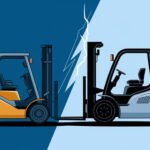
You're looking at two electric forklifts with nearly identical specs — same capacity, same brand, same lift height. One is three-wheel, one is four-wheel. The price difference is $3,000–$5,000. The salesperson says 'it depends on your application.'
That's not wrong. But it's not helpful either.
Here's what actually determines the answer: your aisle width and your maximum load. Those two numbers — combined with your floor surface and shift pattern — resolve the three-wheel vs four-wheel question for about 90% of operations. This guide walks you through exactly how.
The One Difference That Matters Most: Turning Radius
Everything else being equal, turning radius is the single most important difference between three-wheel and four-wheel electric forklifts. Not stability. Not price. Not load capacity. Turning radius — because it determines whether the forklift can physically do its job in your facility.
Here are the actual numbers for standard 3-ton electric counterbalance forklifts:
| Configuration | Turning Radius | Minimum Aisle Width Needed |
|---|---|---|
| 3-wheel electric | 59–68 inches (150–173 cm) | 8–10 feet |
| 4-wheel electric | 78–92 inches (198–234 cm) | 11–13 feet |
That gap — roughly 2–3 feet of aisle width — is the difference between a forklift that works in your facility and one that constantly struggles to maneuver, clips racking, or forces operators to do multi-point turns that slow everything down.
The practical test: Go measure your narrowest aisle right now. Not your average aisle — your narrowest one, because that's where the constraint bites.
- Under 10 feet: Three-wheel is the right choice. A four-wheel forklift will struggle here.
- 10–11 feet: Borderline. Get the exact turning radius spec for any four-wheel model you're considering and compare it to your measured aisle.
- 12 feet and above: Both configurations work. Move on to the other criteria below to decide.
Most buyers skip this measurement and end up either buying a four-wheel forklift that's awkward in their aisles, or a three-wheel unit that creates stability concerns they didn't anticipate. Fifteen minutes with a tape measure prevents both mistakes.
How Three-Wheel Forklifts Actually Work (And Why It Matters)
A three-wheel electric forklift has two front drive wheels and a single rear steering wheel. That single rear wheel is what enables the tight turning radius — it can pivot sharply in a way that a four-wheel chassis physically cannot.
The tradeoff is that the entire rear of the truck pivots on one contact point. This changes how the forklift handles in several ways that affect real-world operation:
The steering feel is different. Three-wheel forklifts are more responsive — sometimes described as 'twitchy' by operators used to four-wheel machines. The rear end swings wider during turns than the turning radius alone suggests, because the single rear wheel tracks differently than a two-wheel rear axle. New operators need time to develop spatial awareness of where the rear of the truck is going during tight maneuvers.
The stability triangle is smaller. A three-wheel forklift's stability is defined by a triangle connecting the two front wheels and the single rear wheel. A four-wheel forklift has a larger stability rectangle. This geometric difference is real — but its practical significance is frequently overstated, which we'll address directly in the next section.
Floor contact is different. One rear wheel means all the rear weight of the forklift presses through a single point. On perfectly flat concrete, this is fine. On uneven surfaces, cracked floors, or outdoor terrain, a single rear contact point is less forgiving than two rear wheels distributing the load.
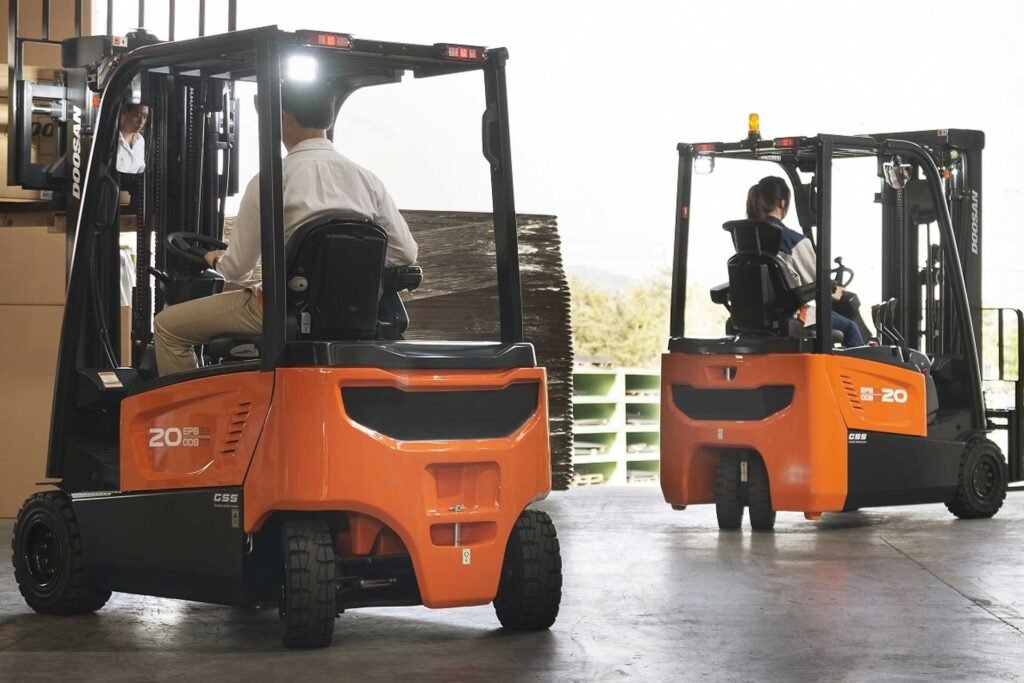
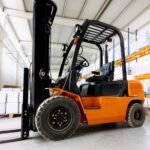
3 Wheel Electric Forklift vs 4 Wheel Forklift
The Stability Question: What's Real and What's Exaggerated
'Four-wheel forklifts are more stable' is technically true. Whether that difference matters for your operation is a different question — and most articles don't help you answer it.
Here's when the stability difference actually matters:
It matters when you combine high lift height + heavy load + turning simultaneously. This is the scenario where the three-wheel stability triangle is genuinely tested. If your operation regularly involves lifting loads near the forklift's rated capacity to heights above 15 feet while navigating turns, the four-wheel configuration's larger stability footprint is a meaningful safety advantage.
It matters on slopes and ramps. Four-wheel forklifts handle inclines more predictably than three-wheel units. If your facility has ramps between floor levels, or if you regularly load and unload on angled dock plates, four-wheel is the safer choice.
It matters on uneven or damaged floors. Older warehouse facilities with cracked concrete, expansion joints, or uneven surfaces create more instability risk for three-wheel forklifts than for four-wheel units. If your floor has seen better days, factor this in.
It does NOT particularly matter for:
- Standard pallet movement at low to medium heights on flat floors
- Loads well below the forklift's rated capacity
- Straight-line travel and standard rack-to-dock operations
- The majority of general warehousing tasks in a typical distribution or manufacturing facility
The honest assessment: for standard indoor warehouse operations on flat concrete floors with loads in the normal working range, a properly operated three-wheel forklift is safe and stable. The stability concern becomes real and specific in the scenarios above — not as a general rule that applies to every operation.
Floor Surface: The Criteria That Gets Ignored Most Often
This is the factor that buyers most consistently overlook, and it causes some of the most frustrating post-purchase problems.
Three-wheel forklifts need flat, well-maintained floors.
That single rear wheel concentrates a significant amount of the forklift's rear weight through one small contact patch. On a smooth, level concrete floor, this works perfectly. On floors with:
- Significant cracks or settlement
- Expansion joints with meaningful height differences
- Old epoxy coating that's peeling unevenly
- Any outdoor or semi-outdoor surface
...the single rear wheel creates noticeable rocking and instability that operators feel acutely — particularly at height. The forklift isn't unsafe in a dramatic sense, but it's uncomfortable enough that operators become reluctant to lift high, which defeats the purpose.
Four-wheel forklifts tolerate imperfect floors far better. Four contact points distribute weight more evenly and provide more consistent stability on surfaces that aren't perfectly flat. For mixed indoor/outdoor use, or for facilities with older flooring, four-wheel is the more forgiving configuration.
Before buying a three-wheel forklift, walk your facility and honestly assess your floor condition. If you have any doubt, four-wheel is the safer operational choice.
Load Capacity: Where Three-Wheel Has a Natural Ceiling
Three-wheel electric forklifts are most commonly available in capacities from 0.6 tons up to about 3 tons (roughly 1,500–6,500 lbs). Some manufacturers offer three-wheel configurations up to 3.5 tons, but selection thins out above 3 tons.
Four-wheel electric counterbalance forklifts span a much wider range — from 1 ton up to 5 tons and beyond in standard configurations, with heavy-duty variants going higher.
The practical implication: If your maximum load requirement is above 3 tons, the three-wheel vs four-wheel question may resolve itself by availability. Most operations in this weight range end up with four-wheel configurations by default.
For operations in the 1.5–3 ton range — which covers the majority of general warehousing — both configurations are widely available and fully capable.
Price Difference and What to Do With It
For equivalent capacity and specification, three-wheel electric forklifts typically cost $2,000–$5,000 less than four-wheel equivalents. The savings come from simpler rear axle design, fewer components, and slightly lower material cost.
Whether that price difference is meaningful depends on what you do with the question.
If your aisle width requires three-wheel: The price difference is irrelevant — you're buying the three-wheel because it's the right tool. The savings are a bonus.
If your aisle width accommodates both: Now the $2,000–$5,000 becomes a real decision variable. Some ways to think about it:
- $3,000 difference ÷ $2,000 annual fuel savings = 1.5 years to recover through operating cost differences (there aren't significant operating cost differences between three and four-wheel electric — they use similar energy and have similar maintenance profiles)
- $3,000 difference represents roughly one or two significant repair jobs — the kind that happen to any forklift eventually
- For a fleet of five forklifts, the difference is $10,000–$25,000 — meaningful enough to factor into budget planning
The honest conclusion: if both configurations work in your facility, the price difference alone isn't a strong enough reason to choose three-wheel over four-wheel. Let your floor condition, load profile, and operator experience level drive the decision — and treat the price difference as a secondary factor.
Operator Experience: The Factor Nobody Talks About
This might be the most underappreciated variable in the three-wheel vs four-wheel decision, particularly for operations with high operator turnover or frequent new hires.
Four-wheel forklifts handle more like a conventional vehicle. The steering response, the turning behavior, and the spatial awareness required are closer to what most people's intuition expects from a wheeled vehicle. Most operators adapt to a four-wheel forklift relatively quickly.
Three-wheel forklifts require a specific adjustment. The rear end swings more dramatically during turns. The steering is more responsive and requires lighter inputs. In tight aisles — exactly the environment where you'd choose a three-wheel forklift — the consequences of misjudging where the rear of the truck is going are immediate: clipped racking, damaged goods, or a minor collision.
During the adaptation period — which varies by operator but typically runs two to four weeks of regular use — incident rates in tight spaces are meaningfully higher on three-wheel forklifts than on four-wheel units.
What this means practically:
- For facilities with experienced, stable operator teams: three-wheel works well once the team is calibrated
- For facilities with high operator turnover or frequent temporary workers: four-wheel reduces training burden and adaptation-period risk
- For any facility running both configurations: keep operators on the same type where possible rather than switching between three and four-wheel regularly
This isn't an argument against three-wheel forklifts. It's an argument for factoring operator experience into the decision alongside the physical and economic criteria.
The Specific Scenarios, Resolved
Scenario 1: Narrow-aisle warehouse, aisles 8–10 feet wide, flat concrete floor, loads under 3 tons, experienced operators → Three-wheel electric. This is exactly the environment three-wheel forklifts are designed for. The tighter turning radius is the primary value, and the conditions support it.
Scenario 2: Standard warehouse, aisles 12+ feet wide, flat floor, mixed load sizes up to 4 tons → Four-wheel electric. With adequate aisle width, the four-wheel configuration's superior stability, floor tolerance, and ease of operation outweigh the price premium.
Scenario 3: Older facility, uneven floors, aisles 10–11 feet, moderate loads → Four-wheel electric. The floor condition tips this toward four-wheel despite the borderline aisle width.
Scenario 4: Mixed indoor/outdoor operation, loads up to 3.5 tons → Four-wheel electric with pneumatic tires. Three-wheel configurations are not appropriate for outdoor or uneven terrain use.
Scenario 5: High-throughput e-commerce fulfillment, narrow aisles, high operator turnover, loads under 2.5 tons → This is genuinely borderline. Three-wheel gives you the aisle maneuverability; four-wheel gives you faster operator onboarding. Lean toward four-wheel if turnover is genuinely high and training cost is a real operational burden.
Scenario 6: Food processing or pharmaceutical facility, flat floors, tight spaces, strict indoor air quality requirements → Three-wheel electric if aisles are narrow, four-wheel electric if aisles are standard. Either way, electric is mandatory for the air quality requirement.
Scenario 7: Budget-constrained operation, aisles 11+ feet, standard loads → Three-wheel electric saves $2,000–$5,000 upfront with no operational downside in this aisle width. Reasonable choice if capital is the binding constraint.
Quick Decision Table
| Your Situation | Recommended Configuration |
|---|---|
| Aisle width under 10 feet | Three-wheel |
| Aisle width 10–11 feet | Evaluate turning radius specs carefully; lean four-wheel |
| Aisle width 12 feet and above | Either works; use other criteria |
| Flat indoor concrete floor | Three-wheel viable |
| Uneven, cracked, or outdoor floor | Four-wheel |
| Maximum load under 3 tons | Either configuration available |
| Maximum load 3–5 tons | Four-wheel (better selection and stability) |
| Frequent ramp or slope operation | Four-wheel |
| High operator turnover | Four-wheel (faster adaptation) |
| Stable, experienced operator team | Either works |
| Mixed indoor / outdoor use | Four-wheel with pneumatic tires |
| Budget is primary constraint, aisle allows | Three-wheel saves $2,000–$5,000 |
What to Confirm Before You Buy Either Configuration
Whichever direction your analysis points, these are the specifications to verify before signing:
Turning radius in inches or centimeters — not just 'compact' or 'narrow aisle.' Get the number and compare it to your measured aisle width with a 12-inch safety margin on each side.
Rated capacity at your actual load center distance — the nameplate capacity assumes a standard 24-inch load center. If your loads are bulky and the center of gravity sits further forward, actual safe capacity is lower. Ask for the full load chart.
Floor pressure per wheel — relevant for older facilities where floor loading limits may be a factor.
Battery configuration options — whether lead-acid or lithium-ion, confirm the battery and charger are included in the quoted price. Many suppliers quote the truck separately.
Certification — CE certification for European markets. Confirm it covers the specific model, not just the manufacturer's product line generally.
Maoxiang Electric Forklifts: Both Configurations, Full Capacity Range
Hebei Maoxiang Technology Co., Ltd. manufactures CE-certified electric counterbalance forklifts in both three-wheel and four-wheel configurations, across the 0.6–5 ton capacity range.
Whether your facility analysis points to three-wheel for tight aisles or four-wheel for mixed-surface operation and heavier loads, Maoxiang's electric range covers both — with lithium-ion as the primary battery focus, battery specifications built to customer duty cycle requirements, genuine customization across mast height, tire type, and cab configuration, and competitive pricing that reflects Chinese manufacturing efficiency without compromising on international certification standards.
Global shipping supported. Contact Maoxiang for a configuration-specific quote based on your aisle width, load profile, and shift pattern.
The Bottom Line
Three-wheel and four-wheel electric forklifts are not better or worse than each other. They're optimized for different physical environments.
Measure your narrowest aisle. Identify your heaviest real load. Assess your floor condition honestly. Factor in your operator team's stability and turnover rate. Those four inputs resolve the decision for the vast majority of operations — without needing to wade through abstract comparisons of stability triangles and turning geometries.
If your aisles are narrow and your floors are flat: three-wheel. If your aisles are standard and your operation is mixed: four-wheel. If you're genuinely on the boundary: four-wheel is the more forgiving choice, and the price premium is modest enough that it's rarely the wrong call.