Choosing the wrong forklift for your warehouse doesn't just mean you paid too much. It means you're paying the wrong price every single day — in wasted aisle space, reduced storage capacity, slower throughput, or compliance risk from equipment that wasn't designed for indoor use.
A counterbalance forklift running 12-foot aisles in a warehouse that could support 8-foot aisles is costing you two rows of racking. A diesel forklift running indoors is creating air quality and compliance problems that an electric unit eliminates entirely. A single walkie stacker trying to cover both dock work and high-bay storage is doing neither job well.
The right indoor forklift configuration isn't about finding 'the best forklift.' It's about matching the right type — or combination of types — to your specific aisle widths, ceiling height, load profile, and operational workflow. This guide gives you that framework, along with specific configuration recommendations by warehouse size.
Why Indoor Forklift Selection Is Different From General Forklift Selection
Outdoor and mixed-use equipment decisions involve terrain, weather, and range. Indoor warehouse forklift decisions are driven by four constraints that don't apply — or apply very differently — in outdoor contexts.
Constraint 1: Aisle Width
Indoor warehouse aisle width is the single biggest driver of forklift type selection. Unlike outdoor yards where you can maneuver freely, warehouse aisles are fixed by your racking layout. The forklift has to fit the aisle — not the other way around.
- Standard aisles (11–13 feet): Counterbalance forklifts work
- Narrow aisles (8–10 feet): Reach trucks required
- Very narrow aisles (5–7 feet): VNA turret trucks with guidance systems
Get this wrong and you either damage racking constantly, or your operators do multi-point turns that slow every single pick-and-put cycle throughout the entire shift.
Constraint 2: Floor Condition
Indoor forklifts use solid or polyurethane tires — not pneumatic tires designed for uneven terrain. This makes them faster and more maneuverable on smooth concrete, but completely unsuitable for outdoor surfaces. It also means floor quality matters more than most buyers realize, particularly for high-lift equipment operating above 20 feet.
Constraint 3: Air Quality
In an enclosed warehouse environment, combustion engine emissions — carbon monoxide from propane, diesel particulates — accumulate rather than disperse. This creates genuine health risks for operators working full shifts, mandatory ventilation requirements, and in food, pharmaceutical, or cold storage environments, outright regulatory barriers to internal combustion equipment.
This is why indoor warehouse forklifts are almost universally electric. Not primarily for environmental reasons — for operational and compliance reasons.
Constraint 4: Noise
Electric forklifts are dramatically quieter than LPG or diesel equivalents. In an enclosed warehouse with multiple forklifts running simultaneously, noise levels have real effects on operator communication, fatigue, and safety. The noise advantage of electric equipment is more significant indoors than in any other operating environment.
These four constraints collectively explain why the indoor warehouse forklift market is overwhelmingly electric, and why the type selection decision centers on aisle width and operational function rather than fuel type.
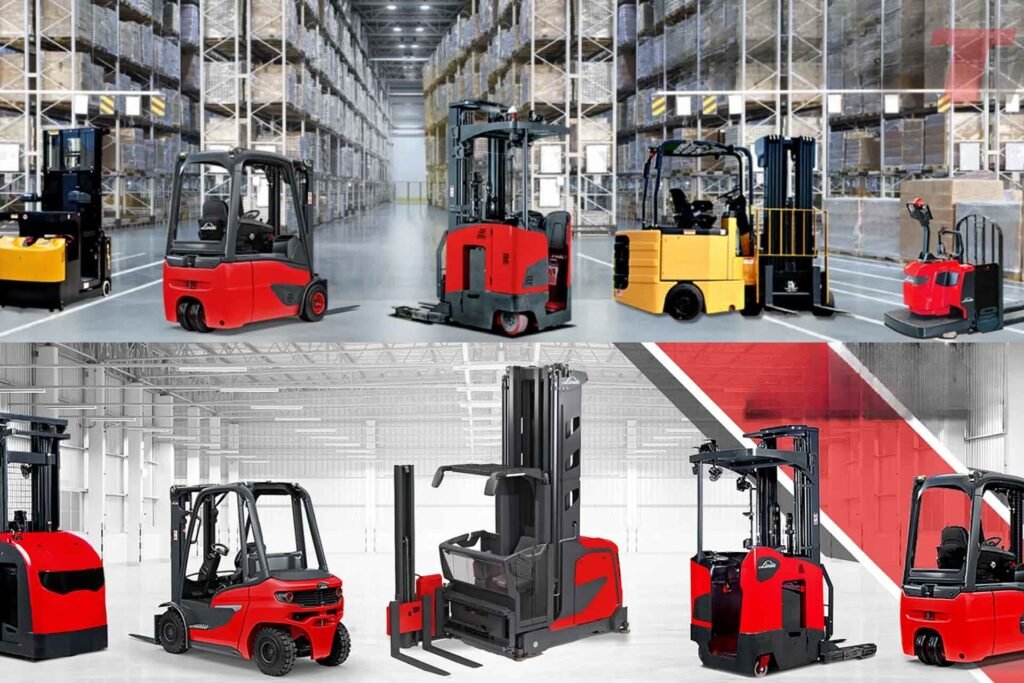
warehouse forklift types
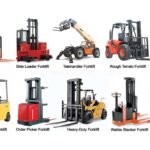
The 5 Types of Indoor Warehouse Forklifts
Type 1: Electric Counterbalance Forklift
The most versatile indoor forklift — and the right starting point for most operations.
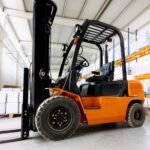
The electric counterbalance forklift is the standard sit-down truck that most people picture when they think 'forklift.' Heavy battery pack under the seat acts as the rear counterweight, forks at the front, operator seated in a cab. Available in three-wheel and four-wheel configurations, with capacities from 0.6 tons to 5 tons in standard warehouse configurations.
What it does better than any other indoor type:
- Loading and unloading trucks at dock doors
- Moving loads between facility areas over longer distances
- Handling varied load sizes and weights in a single operation
- Transitioning between indoor and outdoor paved areas (with pneumatic tires)
- Supporting a wide range of attachments for specialized load handling
Aisle width requirement: 11–13 feet for standard four-wheel models. Three-wheel electric models reduce this to 9–11 feet while maintaining most of the counterbalance truck's versatility.
Lift height: Typically 15–25 feet in standard mast configurations. High-mast variants reach 30 feet but begin to lose the versatility advantage over reach trucks at that height.
Where it doesn't work well: In narrow-aisle racking systems below 10 feet of aisle width. Trying to run a standard counterbalance forklift in a narrow-aisle warehouse either requires wider aisles (losing storage density) or creates constant racking damage and operator frustration.
The honest assessment: The electric counterbalance forklift is the backbone of most warehouse operations. Almost every warehouse needs at least one for dock work alone. The question isn't usually whether to have counterbalance forklifts — it's whether counterbalance forklifts are the only type you need, or whether your storage operations also require reach trucks or order pickers.
Type 2: Reach Truck (Electric Narrow-Aisle Forklift)
The specialist for high-bay narrow-aisle storage — irreplaceable in that specific role.
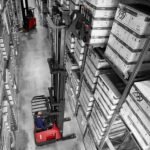
A reach truck uses forward-projecting stabilizer legs and a pantograph mechanism that extends the forks into the racking while the truck body stays in the aisle. This design eliminates the need for the truck to enter the racking bay, enabling operation in aisles as narrow as 8 feet and lift heights up to 40–45 feet.
What it does that no other indoor type can match:
- Operating in 8–10 foot aisles without racking damage
- Lifting pallets to 30–40 feet safely and efficiently
- Maximizing pallet positions in high-ceiling warehouses
- Double-deep storage when configured with extended-reach pantograph
Aisle width requirement: 8–10 feet, depending on model and pallet dimensions. This is the primary reason reach trucks exist — they unlock storage density that counterbalance forklifts cannot achieve.
Lift height: 25–45 feet. This is the other primary reason reach trucks exist — heights that counterbalance forklifts cannot safely reach.
Where it doesn't work well:
- Dock work and truck loading — reach trucks are not designed for this
- Outdoor or mixed-surface operation — solid polyurethane wheels and low ground clearance make this impossible
- Loads above 4,500 lbs — most reach trucks top out here
- Facilities with older, uneven floors — high-lift operation requires floor flatness ratings that older concrete often doesn't meet
Critical pre-purchase requirement: Floor flatness. Before buying a reach truck for operation above 20 feet, measure your floor's F-number rating. High-bay reach truck operation (above 30 feet) typically requires FF ≥ 100. Discovering a floor flatness problem after delivery is an expensive correction.
The honest assessment: If your warehouse has narrow aisles and high racking, a reach truck is not optional — it's the only equipment that does the job correctly. If your warehouse has standard 12-foot aisles and racking below 20 feet, a reach truck adds cost and operational complexity without meaningful benefit over a counterbalance forklift.
Type 3: Order Picker
The specialist for piece-picking operations — essential for e-commerce and high-SKU environments.
An order picker raises the operator platform along with the forks, allowing the operator to work at the height of the specific shelf position being picked. Unlike every other forklift type where the operator stays at ground level, the order picker takes the operator to the product rather than bringing the product to the operator.
What it does that no other indoor type can match:
- Individual item picking from shelving at heights of 20–35 feet
- Efficient case and piece picking across multiple shelf levels in a single operator trip
- High-accuracy picking in operations where individual SKU selection is the core workflow
Aisle width requirement: 8–10 feet, similar to reach trucks. Order pickers are narrow-aisle equipment.
Lift height: 20–35 feet for the operator platform, which determines the maximum shelf height the operator can reach.
The safety reality that purchase decisions must account for: Order pickers have among the highest operator injury rates of any forklift type. The operator is elevated on an open platform — fall protection is not optional. OSHA requirements around fall arrest systems on order pickers are clear and legally mandatory. Budget for full-body harnesses and anchor points as system costs, not optional accessories. This affects both your purchase budget and your ongoing operating cost.
Where it doesn't work well:
- Whole-pallet operations — order pickers are for piece and case picking, not pallet movement
- Operations with low SKU counts or full-pallet picking — a reach truck handles pallet-level retrieval more efficiently
- High operator turnover environments — the elevated operating position requires meaningful training and has a steeper learning curve than ground-level equipment
The honest assessment: If your operation involves picking individual items or cases from shelving at multiple heights — e-commerce fulfillment, retail distribution, pharmaceutical warehousing — order pickers are the right tool and meaningfully more efficient than alternatives. If your operation is primarily full-pallet in and full-pallet out, you don't need order pickers.
Type 4: Electric Walkie Stacker
The right tool for small warehouses and light-duty stacking — often the most cost-efficient solution for operations that don't need full forklift capability.
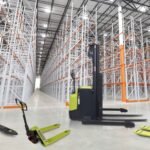
An electric walkie stacker combines a powered pallet jack with a hydraulic mast, enabling lift heights of 8–16 feet at a price point significantly below full forklift equipment. The operator walks alongside or behind the machine rather than riding.
What it does well:
- Stacking pallets to first and second shelf levels in smaller facilities
- Moving and placing loads in operations with moderate throughput
- Covering the full range of tasks in small warehouses without the cost and complexity of multiple forklift types
Aisle width requirement: 6–8.5 feet for straddle stackers (which must straddle the pallet with outrigger legs). Counterbalanced stacker variants need 8–10 feet but handle non-standard pallet sizes more flexibly.
Lift height: 8–16 feet. Above 16 feet, stacker options become limited and the price-to-capability ratio versus compact forklifts becomes unfavorable.
Load capacity: 1,500–3,300 lbs for most models. Above 3,300 lbs consistently, a forklift is the more appropriate tool.
Where it doesn't work well:
- High-cycle operations above 30–40 pallet moves per day — walk-behind operation becomes a throughput bottleneck
- Loads above 3,000 lbs regularly — operating near rated capacity consistently creates safety margin and equipment wear issues
- Dock work — walkie stackers are not designed for truck loading and unloading
- High-bay racking above 16 feet
The honest assessment: Walkie stackers are underutilized as a cost-efficient solution for small and medium warehouse operations. Many operations that believe they need a full forklift can be served equally well by an electric stacker at 30–50% of the cost. The limitation is throughput and capacity — when either exceeds the stacker's range, a forklift becomes necessary.
Type 5: Electric Powered Pallet Jack (Walkie and Rider)
The horizontal transport specialist — essential in virtually every warehouse as a supporting device.
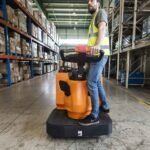
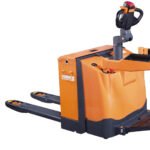
The electric powered pallet jack lifts pallets just enough to clear the floor — typically 6–8 inches — and moves them horizontally. No mast, no stacking capability, no lift height. Its entire value is efficient horizontal pallet movement with minimal operator fatigue.
Two main configurations:
Walkie electric pallet jack ($3,000–$6,000): Operator walks behind the machine. Suitable for shorter distances and moderate frequency.
Rider/stand-on electric pallet jack ($6,000–$12,000): Operator stands on a rear platform and rides. Dramatically more efficient for longer travel distances within large facilities.
Where powered pallet jacks are essential:
- Staging areas at dock doors before and after loading
- Moving pallets between facility zones on flat, connected floors
- Supporting pick-and-pack operations where product needs to be moved to packing stations
- Any operation involving frequent short-distance pallet movement that doesn't require lift height
Where they don't replace other equipment:
- Any application requiring pallets to be placed on shelving — pallet jacks cannot do this
- Operations requiring travel over ramps or significant floor transitions — control and braking limitations make this a safety concern
The honest assessment: Almost every warehouse needs powered pallet jacks regardless of what other equipment it runs. They are the workhorses of dock staging and internal horizontal transport. The question is never really 'do I need powered pallet jacks?' — it's 'how many, and do I need the walkie or rider configuration based on my travel distances?'
Indoor Forklift Configuration by Warehouse Size
This is the section most buying guides don't provide — specific configuration recommendations based on your actual warehouse scale. These are starting points, not fixed answers. Your specific ceiling height, SKU count, throughput requirements, and layout will refine these recommendations.
Small Warehouse (Under 50,000 sq ft, Racking Below 20 Feet)
Typical profile: Single-level operation or low-rise racking, fewer than 1,000 pallet positions, standard or slightly narrow aisles, moderate throughput, limited operator headcount.
Core configuration:
- 1–2 electric counterbalance forklifts (1.5–3 ton, cushion tire) for dock work and general handling
- 1–2 electric powered pallet jacks for staging and internal movement
Add if needed:
- 1 electric walkie stacker if you have racking between 8–16 feet and narrow aisles — this may replace the need for a counterbalance forklift in the storage area if loads are light enough
- Rider pallet jack if operators are regularly traveling more than 100 feet between pick faces and staging areas
Likely don't need:
- Reach trucks (ceiling height and aisle width usually don't justify them at this scale)
- Order pickers (SKU count and pick frequency usually don't justify the investment)
Budget range: $25,000–$80,000 for a complete small warehouse configuration depending on equipment tier and battery choice.
Medium Warehouse (50,000–200,000 sq ft, Racking 20–30 Feet)
Typical profile: Mix of narrow and standard aisles, 1,000–5,000 pallet positions, meaningful pick operation alongside full-pallet storage, multiple dock doors, higher throughput requiring more equipment.
Core configuration:
- 2–4 electric counterbalance forklifts (2–4 ton) for dock receiving, shipping, and any standard-aisle areas
- 2–4 reach trucks for high-bay narrow-aisle storage areas
- 2–4 electric powered pallet jacks (rider configuration) for internal transport and staging
Add if needed:
- 1–3 order pickers if you have a meaningful piece or case picking operation alongside pallet storage
- Additional powered pallet jacks for busy dock staging areas during peak periods
Important planning consideration: At this warehouse scale, the counterbalance forklifts and reach trucks typically operate in different physical zones — counterbalance forklifts at the docks and in wider transit aisles, reach trucks in the narrow-aisle storage bays. These zones should be defined in your facility layout and operator assignments should reflect the equipment type each operator is certified on.
Budget range: $150,000–$500,000 for a complete medium warehouse configuration, depending on equipment count, lift heights required, and battery technology choices.
Large Distribution Center (Over 200,000 sq ft, Racking 30–45 Feet)
Typical profile: Full separation of functional zones (receiving, storage, picking, shipping), 5,000+ pallet positions, high-bay racking approaching ceiling height, significant pick operation, multiple operator teams running multiple shifts.
Core configuration:
Receiving and shipping zones:
- 4–8 heavy-duty electric counterbalance forklifts (3–5 ton) for truck loading and unloading at dock doors
- 4–8 rider electric pallet jacks for staging and short internal transport
High-bay storage zone:
- 4–10 high-reach reach trucks (capable of 35–45 feet) for put-away and retrieval
- Dedicated narrow-aisle layout with 8–10 foot aisles optimized for reach truck operation
Pick zone:
- 4–10 order pickers for piece and case picking from shelving
- 2–4 low-level order pickers or rider pallet jacks for full-pallet picks at ground level
Internal transport:
- Multiple rider pallet jacks for movement between zones across large floor areas
Shift and battery planning: At this scale, multi-shift operation is common. Lithium-ion batteries across all equipment types are strongly recommended — the elimination of battery room infrastructure (lead-acid requires ventilated battery rooms that consume valuable warehouse floor space), the opportunity charging capability that supports multi-shift operation, and the reduced maintenance burden across a large fleet all justify the upfront premium.
Budget range: $500,000–$2,000,000+ for a complete large distribution center equipment fleet, depending on equipment count, automation integration, and battery technology.
Lead-Acid vs Lithium-Ion: Why the Battery Choice Matters More Indoors
In outdoor applications, battery technology is primarily an operating cost question. Indoors, it's also a space and infrastructure question — and that changes the calculation.
The indoor-specific problem with lead-acid:
Lead-acid batteries off-gas flammable hydrogen during charging. Regulations require dedicated, ventilated battery rooms for charging lead-acid forklift batteries. In a warehouse where every square foot of floor space has storage value, a battery room is a real cost — not just a capital cost for construction, but an ongoing opportunity cost of the storage capacity you could have used that space for.
For a medium warehouse with 10 forklifts on lead-acid batteries, a properly ventilated battery room typically occupies 400–800 square feet. At $8–$12 per square foot per year in industrial rent, that's $3,200–$9,600 in annual rent for a room that exists only to charge batteries.
Lithium-ion batteries require no dedicated battery room. Charging happens at the point of use — a charging outlet near the equipment's operating area, plugged in during breaks and shift changes. That 400–800 square feet goes back to storage.
The multi-shift calculation:
For warehouses running two or three shifts — common in e-commerce fulfillment and large distribution operations — lead-acid batteries require either battery swaps between shifts (with the associated infrastructure and labor cost) or enough batteries per truck to cover all shifts with full charge-cool cycles. Lithium-ion's opportunity charging capability eliminates this: plug in during the 30-minute shift change, recover enough charge to run the next shift, repeat.
The maintenance labor calculation:
Lead-acid batteries require watering (adding distilled water to each cell), equalization charging, and terminal cleaning. Across a fleet of 20 forklifts, this maintenance adds up to hundreds of hours of technician time per year. Lithium-ion requires none of this. At any warehouse scale above 10 units, the labor savings from lithium-ion battery maintenance elimination become a meaningful cost factor.
Bottom line for indoor warehouse operations: For new warehouse equipment purchases in 2026, lithium-ion is the correct default choice for multi-shift operations, large fleets, and any facility where floor space has meaningful value. Lead-acid remains defensible for single-shift small operations with constrained capital budgets and short ownership horizons.
Three Things Most Buyers Overlook Before Purchasing
1. Measure Your Actual Aisle Widths — Don't Trust the Layout Drawing
Layout drawings show nominal aisle widths. Actual aisle widths are frequently narrower — due to racking installation tolerances, column positions, floor striping, and general accumulated clutter near rack ends. The difference between a nominal 10-foot aisle and an actual 9.5-foot aisle can determine whether a specific reach truck model operates safely or requires constant caution.
Before finalizing any equipment specification, measure your actual narrowest aisles with a tape measure. Not the drawing. The physical space.
2. Assess Your Floor Before Selecting High-Lift Equipment
For any equipment operating above 20 feet — reach trucks, high-reach order pickers — floor flatness is a pre-purchase requirement, not a post-purchase discovery.
Have your floor professionally measured for F-number rating before specifying high-lift equipment. If remediation is needed, get quotes and include the cost in your total project budget. Discovering the floor problem after the reach trucks arrive is a significantly more expensive sequence of events.
3. Factor Operator Certification Into Your Total Cost
Different forklift types require separate OSHA operator certifications. An operator certified on a counterbalance forklift is not automatically qualified to operate a reach truck or order picker — each class of equipment requires specific training and evaluation.
For a warehouse introducing multiple equipment types simultaneously, operator certification across all types is a real cost: training time, lost productivity during training, and potentially external training program fees of $150–$300 per operator per equipment class. For a 20-person operator team being certified on three equipment types, this can add $9,000–$18,000 to your implementation cost — a line item that rarely appears in equipment budget calculations but reliably appears on the implementation invoice.
Why Electric Counterbalance Forklifts Are the Foundation of Every Configuration
Regardless of warehouse size or operational complexity, the electric counterbalance forklift appears in every configuration recommendation above. This isn't a coincidence — it reflects the role the counterbalance forklift plays as the most versatile indoor material handling tool available.
It handles dock work that reach trucks and order pickers cannot do. It manages heavy loads that walkie stackers cannot handle. It covers varied tasks and varied load dimensions that specialized equipment handles poorly. It works in both standard and moderately narrow aisles. And in its electric configuration, it meets indoor air quality and noise requirements without compromise.
For most warehouse operations, the practical question isn't whether to have electric counterbalance forklifts — it's how many, what capacity range, and whether to add specialized types alongside them for specific operational requirements.
Maoxiang Electric Counterbalance Forklifts for Indoor Warehouse Operations
Hebei Maoxiang Technology Co., Ltd. manufactures CE-certified electric counterbalance forklifts from 0.6 to 5 tons — the full capacity range that covers indoor warehouse applications from light-duty order fulfillment through heavy dock receiving and shipping operations.
For small warehouse configurations: Maoxiang's 1–2 ton electric counterbalance forklifts cover general warehouse handling and dock work at competitive price points that make complete small warehouse equipment configurations financially practical without compromising on international certification standards.
For medium and large warehouse configurations: Maoxiang's 2–5 ton range covers the heavy dock work component of larger warehouse configurations — the counterbalance forklifts that handle trailer loading and unloading while reach trucks and order pickers manage the storage and picking zones.
Lithium-ion as standard focus: Given the indoor-specific advantages of lithium-ion over lead-acid — no battery room requirement, opportunity charging for multi-shift operation, zero battery maintenance — Maoxiang's engineering focus on lithium-ion platforms is directly aligned with what indoor warehouse operations need in 2026.
Customization for warehouse-specific requirements: Cushion tires for smooth indoor concrete, specific mast heights for your racking configuration, cab options for operator comfort in temperature-controlled environments — Maoxiang builds to customer specification rather than forcing every application into a fixed catalog configuration.
Price advantage across fleet configurations: For warehouses purchasing multiple units — which most medium and large operations do — the per-unit price advantage of Maoxiang versus European or American-branded equivalents compounds across the fleet. A 5-unit counterbalance forklift purchase at $5,000–$8,000 less per unit represents $25,000–$40,000 in avoided capital cost that stays in your operation.
Global shipping supported. Contact Maoxiang for fleet configuration pricing based on your warehouse scale, capacity requirements, and shift pattern.
Quick Reference: Indoor Forklift Type Selection
| Your Primary Need | Right Equipment Type | Aisle Width | Lift Height |
|---|---|---|---|
| Dock receiving and shipping | Electric counterbalance forklift | 11–13 ft | 15–25 ft |
| High-bay narrow-aisle storage | Reach truck | 8–10 ft | 25–45 ft |
| Piece and case picking at height | Order picker | 8–10 ft | 20–35 ft |
| Light stacking, small warehouse | Electric walkie stacker | 6–8.5 ft | 8–16 ft |
| Horizontal pallet transport | Electric powered pallet jack | 5–6 ft | Ground level only |
| Maximum storage density | VNA turret truck + guidance system | 5–7 ft | 35–50 ft |
The Bottom Line
Indoor warehouse forklift selection is a configuration problem, not a product selection problem. The right answer for your operation isn't a single forklift type — it's the right combination of types, matched to your aisle widths, ceiling height, load weights, operational workflow, and warehouse scale.
Start with the four indoor constraints: aisle width, floor condition, air quality requirements, and noise environment. These constraints almost universally point to electric equipment and define which types are physically possible in your facility.
Then match equipment type to operational function: counterbalance forklifts for dock work and general handling, reach trucks for high-bay narrow-aisle storage, order pickers for piece picking, walkie stackers for light-duty small warehouse operations, and powered pallet jacks as the horizontal transport backbone of every configuration.
Finally, size your fleet to your warehouse scale — and don't buy specialized equipment for operational requirements you don't actually have. A small warehouse trying to run reach trucks it doesn't need is paying for complexity that adds no value. A large distribution center trying to cover high-bay picking with counterbalance forklifts is paying in throughput inefficiency every single shift.
Match the equipment to the operation. That's the entire job.