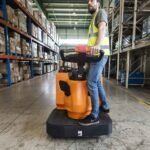
Forks work perfectly for pallets. But not everything comes on a pallet.
Paper rolls shift and roll. Large appliances can't be safely forked from below without damage. Barrels have no flat base to stack on a standard pallet. Compressed bales of cotton or recycled material are too soft and irregular for conventional forks to handle cleanly.
When your cargo doesn't fit the fork-and-pallet model, a clamp attachment is usually the answer. But 'usually' isn't 'always' — the wrong clamp on the wrong cargo in the wrong application damages goods, reduces your forklift's effective capacity, and creates safety risks that didn't exist before you installed the attachment.
This guide helps you determine whether you need a forklift clamp, which type fits your specific cargo, what installing one actually does to your forklift's performance, and how to calculate whether the investment makes financial sense for your operation.
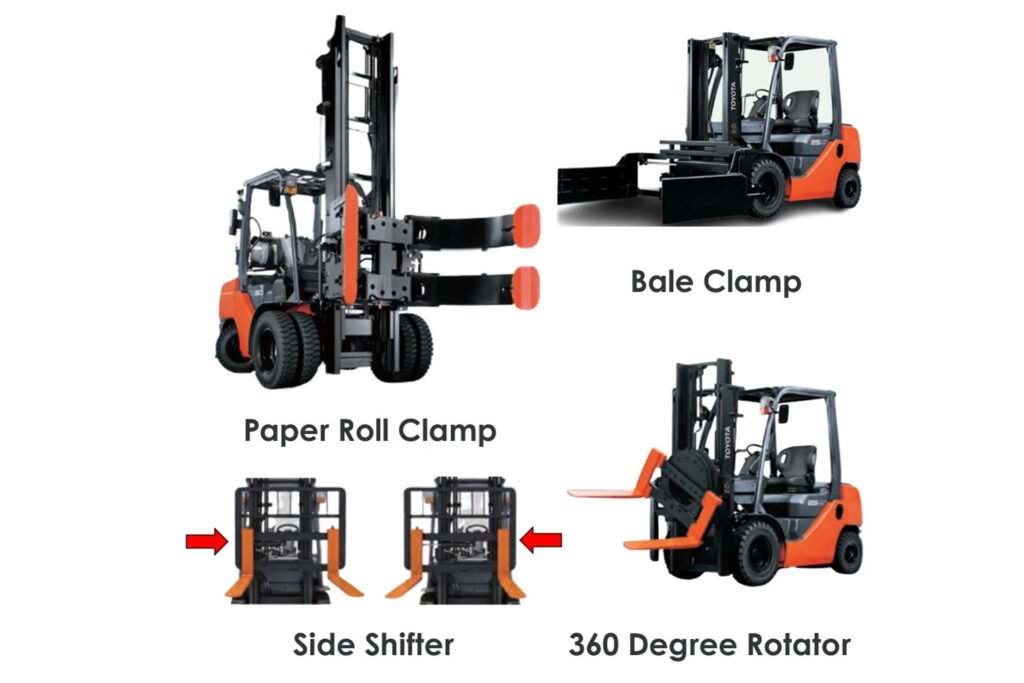
Forklift Clamp Attachment
The Core Logic: When Forks Aren't the Right Tool
Before choosing a clamp type, answer a more fundamental question: does your operation actually need one?
You should consider a forklift clamp attachment when your cargo meets one or more of these conditions:
Your cargo's shape makes pallet handling impractical. Cylindrical loads like paper rolls or steel coils, round drums, and irregularly shaped industrial goods don't sit stably on standard pallets. Getting them onto a pallet requires additional restraints, blocking, and bracing — all of which add time, cost, and handling steps that a properly matched clamp eliminates entirely.
Your cargo is too large or heavy for standard pallet dimensions. Large appliances, furniture, and oversized industrial components often exceed standard pallet load capacity or footprint. Forcing them onto pallets creates stability problems and damages both the pallet and the cargo.
Fork insertion damages the cargo. Sliding forks under a stack of cartons from ground level puts concentrated stress on the bottom layer. In food, beverage, and consumer goods operations, this causes bottom-layer damage that either becomes a quality control problem or a customer complaint. A carton clamp grips from the sides, distributing pressure more evenly across the cargo face.
Pallet elimination offers meaningful cost savings. Pallets aren't free. Purchasing, managing, repairing, storing, and replacing pallets is an ongoing operational cost that compounds across large volumes. When clamp technology enables reliable palletless handling, the accumulated savings can justify the clamp investment within months.
Your cargo needs to be rotated or repositioned during handling. Rotating clamps can turn cargo during transport — tilting containers to pour out contents, flipping loads for processing, or repositioning items that need to be placed in a specific orientation. Standard forks cannot do any of this.
If none of these conditions apply to your operation — if your cargo comes on standard pallets, moves reliably with forks, and the pallet cost is not a significant operational factor — you probably don't need a clamp attachment. Adding one adds cost, reduces effective forklift capacity, and introduces maintenance requirements without delivering proportional benefit.
The 6 Main Forklift Clamp Types — Selected by Cargo, Not by Name
Most buying guides list clamp types alphabetically or by product category. That's the wrong starting point. The right starting point is your cargo. Here's how to match them.
If Your Cargo Is Paper Rolls, Film Rolls, or Steel Coils: Roll Clamp
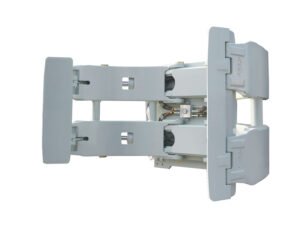
Paper Roll Clamp
A roll clamp uses two curved, contoured arms that extend outward and then close around a cylindrical load, gripping it from both sides simultaneously. The curved profile of the arms matches the circular cross-section of the roll, distributing clamping force across a wider contact area rather than concentrating it at two points.
What makes roll clamp operation technically demanding:
Clamping pressure control is everything. Apply too little pressure and the roll slips during transport — a potentially catastrophic safety failure with a heavy paper roll. Apply too much and you crush and deform the roll surface, creating defects that render the material unusable in printing and packaging applications.
Modern roll clamps for high-value paper and film applications include hydraulic pressure-limiting systems that allow operators to set and maintain specific clamping forces appropriate to the material. For dense steel coils, higher pressures are standard. For lightweight, high-value printing paper, precise low-pressure control is critical.
The rotation question: Many roll clamps include a 360-degree rotation capability, allowing operators to stand rolls upright, lay them horizontal, or position them at any angle. This is essential in paper mills and printing operations where rolls need to be oriented differently for storage versus processing.
Industries: Paper mills, printing operations, packaging material manufacturers, steel service centers (for coil handling), plastic film producers.
Capacity range: 2,000–20,000 lbs depending on configuration.
If Your Cargo Is Stacked Cartons or Boxed Goods:
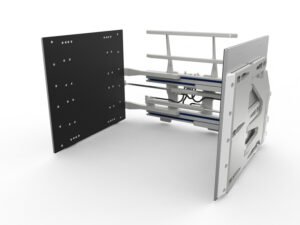
Carton Clamp
A carton clamp uses two large flat platens that close from both sides to grip a stack of cartons, enabling the entire stack to be moved without a pallet underneath. In consumer goods warehousing and retail distribution, this is the clamp that enables palletless operations at scale.
The efficiency case is real and significant:
In a high-volume distribution center handling 500 pallet-equivalents per day, eliminating pallets through carton clamping can save $7,500–$12,500 per day in pallet costs alone — before accounting for the labor saved in pallet management, the floor space recovered from pallet storage, and the elimination of pallet return logistics.
The damage risk is also real and frequently underestimated:
A carton clamp exerts significant lateral force on the cargo stack. If that force exceeds the structural strength of the outer cartons — which varies significantly between a corrugated box of appliances and a thin-walled box of breakfast cereal — the result is crushed corners, collapsed stacks, and damaged goods.
The variables that determine damage risk include:
- Carton wall thickness and material quality
- Stack height and stability
- Moisture content of the corrugated material (wet corrugated is dramatically weaker)
- Operator skill in setting and controlling clamping pressure
- Speed of clamp closure
Controlling damage requires three things: A clamp with precise, adjustable hydraulic pressure control; written operating procedures that specify pressure settings for each cargo type handled; and operator training that goes beyond basic clamp operation to include damage recognition and pressure adjustment judgment.
For operations where cargo damage is a significant financial or customer satisfaction issue, the pressure control system on the clamp is as important a specification as the clamping capacity.
Industries: Consumer goods, food and beverage, home appliances, furniture, retail distribution, fast-moving consumer goods (FMCG) warehousing.
Capacity range: 3,000–10,000 lbs depending on platen size and configuration.
If Your Cargo Is Drums, Barrels, or Cylindrical Tanks: Drum Clamp
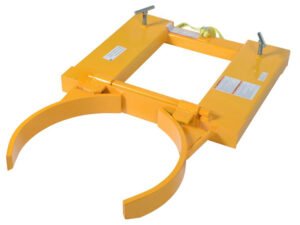
drum clamp
Drum clamps are purpose-built for handling cylindrical containers — 55-gallon drums, IBC totes, industrial barrels — that are awkward to handle with standard forks and dangerous to handle incorrectly.
Two fundamentally different design approaches:
Top-rim clamps grip the drum from the top rim, allowing the forklift to lift single drums vertically. These are suitable for light to medium-weight drums and work well when drums need to be picked individually and placed precisely.
Side-gripper clamps use padded or contoured arms that grip the drum body from the side, distributing force across a larger contact area. These are better suited for heavy drums and for applications where rim contact could cause deformation or seal damage.
The hazardous materials dimension:
In chemical, petroleum, and pharmaceutical operations, drums often contain hazardous or flammable materials. Drum clamps used in these environments require specific considerations:
- Clamp materials must be compatible with any chemicals that may be on the drum exterior
- In potentially explosive atmospheres, the clamp and its hydraulic system may need ATEX or similar explosion-proof certification
- Grip must be absolutely secure — a dropped drum of hazardous material is a serious incident
Never assume a standard drum clamp is appropriate for hazardous material handling. Verify certification requirements with your safety officer and the clamp manufacturer before purchasing.
Industries: Chemical processing, petroleum distribution, food and beverage (liquid ingredients), pharmaceutical manufacturing, hazardous waste handling.
Capacity range: 500–4,000 lbs per drum, with multi-drum clamps handling 2–4 drums simultaneously.
If Your Cargo Is Compressed Bales of Fiber, Recycled Material, or Cotton: Bale Clamp
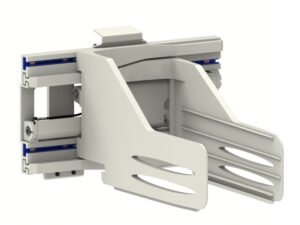
Bale Clamp
Bale clamps handle highly compressed packages of soft, irregular material — cotton, wool, recycled paper, cardboard, textile waste — that cannot be reliably palletized because the bale surface is too uneven and compressible to support fork insertion from below.
The clamp uses two large, wide-face platens that grip the bale from both sides. The wide contact area distributes clamping force to prevent the platen edges from cutting into the bale material while maintaining enough grip to lift and transport safely.
The specific challenge with bales:
Bale density and dimensions are highly variable even within a single commodity. A cotton bale from one supplier may have significantly different compression characteristics than one from another. Clamp pressure settings that work perfectly for one batch may need adjustment for the next.
Operations handling multiple bale types should invest in clamps with easy-to-adjust, clearly calibrated pressure controls and establish documented settings for each material type. Operators who adjust pressure by feel rather than by specification create inconsistent results and damage risk.
Industries: Cotton gins and textile mills, paper and cardboard recycling, waste management and materials recovery, fiber processing.
Capacity range: 1,000–6,000 lbs per bale.
If Your Cargo Is Concrete Blocks or Building Masonry: Block Clamp
Block clamps are designed for construction materials handling — concrete masonry units, paving blocks, retaining wall blocks — enabling an entire layer or multiple layers of blocks to be handled in a single lift rather than unit by unit.
The efficiency gain is dramatic. Moving a full pallet of concrete blocks with a standard forklift requires the blocks to be palletized first. A block clamp grips an entire layer directly, enabling rapid transfer from delivery truck to storage or from storage to work area without palletizing.
The outdoor context:
Block clamps are primarily used in outdoor construction and building materials environments — masonry yards, precast concrete facilities, construction sites. This means the forklift carrying the clamp needs to be appropriate for outdoor terrain: typically a rough terrain or heavy-duty LPG/diesel counterbalance forklift, not an indoor electric unit.
Industries: Concrete products manufacturing, building materials distribution, masonry supply, precast concrete.
Capacity range: 3,000–15,000 lbs depending on block type and layer configuration.
If Your Cargo Needs to Be Rotated During Handling: Rotating Clamp
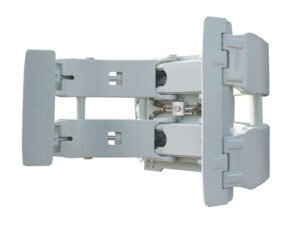
360° Rotating Paper Roll Clamp for Forklift
Rotating clamps combine standard clamping function with 360-degree hydraulic rotation, allowing cargo to be tilted, inverted, or repositioned during transport. This enables operations that would otherwise require separate equipment or manual repositioning.
Typical applications:
- Inverting containers to empty contents into processing equipment
- Rotating machinery or large components for installation or maintenance access
- Repositioning goods that need to be placed in a specific orientation that differs from how they were stored
- Dumping bulk materials from large containers
The weight distribution consideration:
When a rotating clamp inverts or tilts a load, the center of gravity shifts significantly. Operators need specific training on load stability during rotation, and the forklift's stability triangle must be adequate for the loads being handled in their most off-center orientations.
Industries: Food processing (container emptying), chemical manufacturing, industrial equipment handling, bulk material processing.
What a Clamp Attachment Does to Your Forklift — The Numbers Most Buyers Miss
This is the section that changes purchasing decisions more than any other. Installing a clamp attachment does not simply add a capability to your forklift — it changes the forklift's performance profile in ways that affect what equipment you need to buy.
Effective Load Capacity Drops — Sometimes Dramatically
Every attachment mounted on the forklift's carriage adds weight to the front of the machine and increases the load center distance — the horizontal distance from the front face of the forks to the center of gravity of the load. Both of these factors reduce the forklift's effective safe lifting capacity.
The magnitude of this reduction depends on the clamp's weight and the load center it creates:
| Clamp Type | Typical Clamp Weight | Approximate Capacity Reduction |
|---|---|---|
| Light side shifter with clamp | 200–400 lbs | 10–15% |
| Standard carton clamp | 600–1,200 lbs | 15–25% |
| Heavy roll clamp | 1,000–2,000 lbs | 20–35% |
| Large bale clamp | 800–1,500 lbs | 15–30% |
The practical consequence: If you need to handle 4,000 lb loads with a carton clamp that causes a 25% capacity reduction, you need a forklift rated at approximately 5,300 lbs — not 4,000 lbs. Buying a 4,000 lb forklift and then installing a clamp that reduces its effective capacity to 3,000 lbs means you're operating over capacity every time you handle your target load.
Before purchasing any clamp attachment, calculate your required effective capacity: divide your maximum load weight by (1 minus the expected capacity reduction percentage) to determine the minimum forklift capacity you need. Get the clamp manufacturer's specification for actual weight and load center impact — don't estimate.
Hydraulic System Requirements Increase
Clamp operations — opening, closing, rotating — require hydraulic flow and pressure from the forklift's auxiliary hydraulic circuit. Older forklifts may have auxiliary hydraulic systems that are undersized for the clamp you want to install, resulting in:
- Slow clamp response that reduces operational efficiency
- Insufficient clamping force at the working pressure the forklift can provide
- Hydraulic system overheating in intensive use
Before purchasing a clamp for an existing forklift, provide the forklift's hydraulic specifications (flow rate in gallons per minute and operating pressure) to the clamp manufacturer and confirm compatibility. For new forklift purchases that will include clamp attachments from day one, specify the hydraulic requirements of the intended clamp and ensure the forklift's hydraulic system is sized accordingly.
Overall Machine Dimensions Change
A carton clamp or bale clamp significantly increases the overall width of the forklift's front end when the arms are in the open position. This affects:
- Minimum aisle width required for safe operation
- Ability to pass through doorways and under overhead structures
- Turning radius in confined spaces
Measure your narrowest operational clearance and compare it to the clamp's open-arm width specification before purchasing. A clamp that's too wide for your facility is useless regardless of its other specifications.
Operator Certification Requirements Apply
OSHA's powered industrial truck standard explicitly covers forklift attachments. Operating a forklift with a clamp attachment requires training specific to that attachment type — not just general forklift operation certification. Operators need to understand:
- How the clamp changes the forklift's load capacity and stability
- Correct pressure settings for different cargo types
- How to recognize signs of inadequate clamping before and during transport
- Emergency procedures if a load shifts during handling
Introducing clamp attachments without specific operator training is both an OSHA compliance failure and a genuine safety risk.
The Palletless Operation Economic Case
For operations that use clamp attachments to eliminate pallets from their handling workflow, the financial case deserves careful calculation — because it's often more compelling than it initially appears.
Pallet costs are larger than most operations track:
| Cost Category | Typical Annual Cost Per 1,000 Pallets in Circulation |
|---|---|
| Initial purchase (at $20/pallet, 3-year lifespan) | $6,667 |
| Repair and maintenance | $2,000–$4,000 |
| Management labor (tracking, sorting, staging) | $3,000–$6,000 |
| Storage space (at $8/sq ft/year for empty pallet storage) | $2,000–$5,000 |
| Loss and disposal | $1,000–$3,000 |
| Total annual pallet cost | $14,667–$24,667 |
For a medium-sized distribution center managing 5,000 pallets in active circulation, annual pallet costs can run $75,000–$120,000 before accounting for the labor involved in pallet return logistics and supplier coordination.
Against this, the clamp investment:
A high-quality carton clamp with pressure control: $4,000–$12,000. Installation and hydraulic adaptation: $500–$2,000. Operator training: $500–$1,500.
Total clamp investment: $5,000–$15,500.
For a high-volume operation eliminating 1,000+ pallets annually from its workflow, the investment recovery period is often under six months. For lower-volume operations, the calculation is less clear-cut — run your own numbers using the pallet cost framework above before committing.
Damage Risk: The Cost That Undermines the Business Case If Ignored
Clamp attachments improve efficiency when used correctly. They create new cost problems when used incorrectly. The most significant new cost is cargo damage — and it deserves direct treatment rather than a footnote.
The scenarios where damage is most likely:
Carton clamps on lightly packaged goods are the highest-risk combination. Consumer goods like breakfast cereals, bottled beverages, and bagged snack foods have packaging designed to protect the product during normal retail handling — not to withstand the lateral clamping forces of a forklift attachment. When the packaging fails under clamping pressure, the resulting damage is rarely limited to one carton. A stack that shifts or collapses mid-transport can cause a cascade of damage.
What damage actually costs:
- Direct product loss at wholesale cost
- Customer claims and chargebacks (often at retail value, not wholesale)
- Return shipping and processing costs
- Relationship damage with customers who experience recurring damage issues
- In food applications, potential food safety concerns if packaging integrity is compromised
How to control damage risk:
Pressure control systems are non-negotiable for sensitive cargo. If you're handling anything with packaging that could be damaged by excessive clamping force — consumer goods, food, pharmaceutical products — the clamp specification must include a calibrated, adjustable hydraulic pressure system. Variable pressure clamps cost more than fixed-pressure alternatives. For sensitive cargo, the premium is essential.
Written operating procedures for each cargo type. Document the specific pressure setting, approach method, and travel speed for each category of cargo handled. Operators who work from documented procedures produce more consistent results and cause less damage than operators who work from experience and judgment alone.
Regular pressure system calibration. Hydraulic pressure systems drift over time. A clamp calibrated for 800 PSI at installation may be delivering 950 PSI six months later if the pressure-limiting valve has drifted. Include pressure system verification in your quarterly maintenance schedule.
Cargo condition inspection before clamping. Wet, already-damaged, or poorly stacked cargo should not be handled with a clamp. Establish operator guidelines for rejecting loads that don't meet the condition requirements for safe clamping.
Buying a Clamp: The Specifications That Actually Matter
Generic buying guides say 'consider capacity and compatibility.' Here are the specific numbers you need before any purchase conversation.
Your maximum cargo weight at working load center distance. Not just the cargo weight — the cargo weight at the actual center of gravity distance from the clamp face. For a deep carton stack, the load center may be 30–36 inches from the clamp face. The clamp's rated capacity at this distance is what matters, not its maximum capacity at a standard 24-inch load center.
Your cargo's dimensional range. Maximum and minimum dimensions the clamp needs to handle. For a carton clamp, this means maximum stack width and depth. For a roll clamp, maximum and minimum roll diameter. Clamps have fixed operating ranges — verify your cargo fits within them with appropriate margin.
Your forklift's hydraulic specifications. Auxiliary circuit flow rate (gallons per minute) and pressure. Your forklift's hydraulic system must meet or exceed the clamp's minimum requirements. Get these numbers from your forklift's technical documentation, not from memory or estimation.
Your operational clearances. Narrowest aisle, lowest overhead clearance, and any doorways or structural constraints the forklift and clamp combination must pass through. Compare these to the clamp's open-arm width and overall height specifications.
Certification requirements for your application. Hazardous materials? Food contact? Explosive atmosphere? Each of these may require specific certifications on the clamp itself. Identify these requirements before contacting suppliers — retrofitting certifications after purchase is expensive and sometimes impossible.
Rent or Buy: The Clamp-Specific Calculation
Unlike forklifts themselves, where the rent-vs-buy calculation involves complex TCO modeling, clamp attachments have a more straightforward decision framework.
Buy when: Your cargo type requiring the clamp is a permanent feature of your operation. If you're a paper distributor and you'll always handle paper rolls, a roll clamp is core infrastructure. Rental rates for specialty clamps in long-term use quickly exceed purchase cost.
Rent or trial when: You're handling a new cargo type temporarily, or you want to verify that a specific clamp type works for your application before committing to purchase. Some suppliers offer short-term rental specifically as a try-before-buy arrangement — worth asking about before purchasing an expensive specialized clamp.
Rent when: Seasonal demand spikes require temporary clamp capability. A consumer goods warehouse handling dramatically higher carton volumes during holiday season may benefit from renting additional carton clamps rather than purchasing clamps that will sit idle for nine months of the year.
The Decision Framework: Do You Need a Clamp?
Work through this sequence before contacting any supplier:
Step 1: Can your cargo be reliably palletized and handled with standard forks without damage, stability issues, or excessive handling steps? If yes, you probably don't need a clamp.
Step 2: If not, which cargo characteristic creates the problem — shape, size, fragility, or palletization cost? Match that characteristic to the clamp type in the guide above.
Step 3: Calculate your required forklift capacity with the clamp installed. Does your current forklift provide adequate effective capacity after the attachment's capacity reduction? If not, equipment upgrading is part of the cost.
Step 4: Verify hydraulic compatibility with your existing forklift. If you're buying a new forklift and clamp together, specify both as a system.
Step 5: Run the palletless operation economic calculation if your application involves high pallet volumes. The savings may be larger than expected and may substantially shorten the investment recovery period.
Step 6: Assess cargo damage risk honestly. If your cargo is sensitive to clamping force, budget for a pressure-controlled clamp and operator training — not the cheapest available option.
Where Maoxiang Fits
Hebei Maoxiang Technology Co., Ltd. manufactures CE-certified electric counterbalance forklifts from 0.6 to 5 tons — the forklift platform on which clamp attachments are most commonly installed in indoor and mixed-use warehouse environments.
For clamp-equipped configurations, Maoxiang offers:
Hydraulic system sizing for attachment use. When customers specify that a forklift will be used with a clamp attachment, Maoxiang's configuration process includes hydraulic system verification to ensure auxiliary circuit flow and pressure meet the attachment's operational requirements. This prevents the performance and reliability problems that occur when clamps are installed on forklifts with undersized hydraulic systems.
Capacity-appropriate base forklift selection. Given that clamp attachments reduce effective lifting capacity by 15–35%, selecting the correct base forklift capacity for the intended application requires working backward from the actual load requirement. Maoxiang's 0.6–5 ton range provides the capacity options needed to ensure the forklift-plus-clamp combination covers your actual load requirements with appropriate safety margin.
Attachment compatibility across the product range. Maoxiang's electric counterbalance forklifts are compatible with standard international clamp attachment interfaces, enabling customers to source clamp attachments from specialist attachment suppliers and integrate them with Maoxiang base units.
Competitive fleet pricing. For operations equipping multiple forklifts with clamp attachments — a common scenario in distribution centers transitioning to palletless operations — the per-unit price advantage of Maoxiang versus European or American-branded equivalents compounds across the fleet, leaving more capital available for the clamp attachments and operator training that make the system work.
Global shipping supported. Contact Maoxiang for forklift configuration pricing that accounts for your specific clamp attachment requirements.
Quick Reference: Clamp Selection by Cargo Type
| Cargo Type | Recommended Clamp | Key Specification |
|---|---|---|
| Paper rolls, film rolls | Roll clamp | Pressure control system; rotation capability |
| Steel coils | Heavy-duty roll clamp | High capacity; impact-resistant arms |
| Stacked cartons, boxed goods | Carton clamp | Adjustable pressure control; platen size |
| 55-gallon drums | Drum clamp (side or top) | Grip type matched to drum weight |
| Hazardous material drums | Certified drum clamp | ATEX or equivalent certification |
| Cotton, fiber, recycled bales | Bale clamp | Wide-face platens; pressure adjustability |
| Concrete blocks, masonry | Block clamp | Layer capacity; outdoor-rated forklift required |
| Loads requiring rotation | Rotating clamp | Rotation capacity; operator training requirement |
| Mixed cargo types | Multipurpose clamp | Verify all cargo types fall within operating range |
The Bottom Line
A forklift clamp attachment is not a universal upgrade — it's a solution to a specific problem. When your cargo genuinely doesn't fit the fork-and-pallet model, the right clamp dramatically improves operational efficiency and can generate meaningful cost savings through palletless operations.
When the problem doesn't actually exist — when your cargo handles well on standard pallets with standard forks — a clamp adds cost, complexity, reduced forklift capacity, and maintenance requirements without proportional return.
The questions that determine your decision are not about clamp features. They're about your cargo: its shape, its weight, its fragility, and the real cost of the pallet system you're currently using to handle it. Answer those questions honestly, run the capacity reduction calculation for your specific clamp and forklift combination, and the right decision becomes clear.