The Heavy-Duty Standard for 5,000–8,000 lb Forklifts
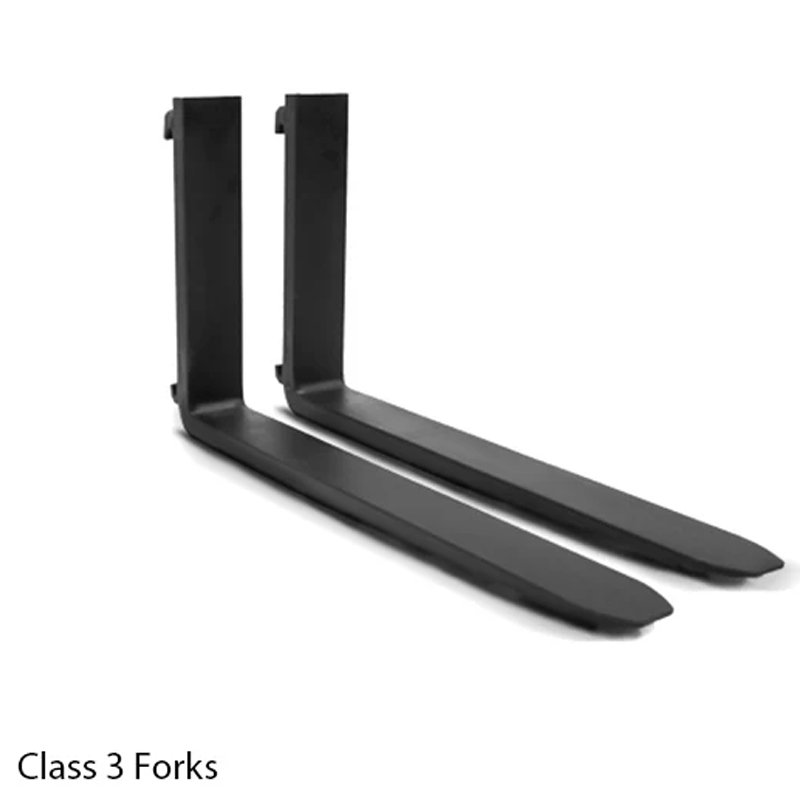
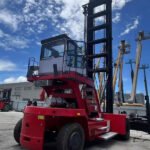
If your forklift is rated at 5,000 lb to 8,000 lb capacity, you’re running ITA Class 3 forks. This is the most common class for standard heavy-duty warehouse forklifts, rough terrain forklifts, container handlers, and outdoor yard equipment.
Class 3 forks have a thicker cross section and higher load rating than Class 2, but they mount on the same basic ITA hook carriage system. The difference is in the material: Class 3 forks use heavier steel to handle the stress of daily lifting at or near maximum capacity.
This page covers Class 3 forks (standard heavy-duty) and Class 4 forks (extra heavy-duty for 9,000-11,000 lb forklifts). If you’re unsure which class fits your machine, use the compatibility check below.
ITA (Industrial Truck Association) classifies fork carriages by the horizontal channel opening that the fork’s upper hook locks into. Each class corresponds to a specific mounting height range and capacity range.
Fork Class
Mounting Height Range
Typical Forklift Capacity
Cross Section (Standard)
Class 1
12-16 inches
2,000 – 3,500 lb
1.25 × 4 inch
Class 2
16-20 inches
3,500 – 5,000 lb
1.5 × 4 inch
Class 3
20-25 inches
5,000 – 8,000 lb
1.75 × 4 inch or 2 × 4 inch
Class 4
25-30 inches
9,000 – 11,000 lb
2 × 5 inch or 2.5 × 5 inch
Class 5
30-35 inches
12,000+ lb
2.5 × 6 inch+
Class 3 is the most common heavy-duty class — used on standard 5,000-8,000 lb counterbalance forklifts, most rough terrain models, and many container handling forklifts.
Class 4 is the step up — used on larger forklifts that handle heavy steel, concrete, and shipping containers at full capacity.
Class 3 Fork Specifications — Standard Options
Specification
Standard
Heavy-Duty
Carriage Class
ITA Class 3
ITA Class 3
Mounting Height
20-25 inches (508-635 mm)
20-25 inches
Fork Cross Section (H×W)
1.75 × 4 inch (45 × 100 mm)
2 × 4 inch (50 × 100 mm)
Capacity Per Pair
5,500 lb (2,495 kg)
6,800 lb (3,085 kg)
Fork Lengths Available
36″, 42″, 48″, 60″, 72″, 84″, 96″
48″, 60″, 72″, 84″, 96″
Carriage Width
42 inch (1067 mm) standard
45 inch (1143 mm) or custom
Material
4142 Alloy Steel — Drop Forged
4142 Alloy Steel — Drop Forged
Heat Treatment
Full-length induction hardened
Full-length induction hardened
Surface Hardness
38-42 HRC
38-42 HRC
Core Hardness
26-30 HRC
26-30 HRC
Safety Factor
3:1 (load tested)
3:1 (load tested)
Finish
Orange powder coat
Orange powder coat
Class 4 Fork Specifications — For Larger Forklifts
Specification
Standard
Carriage Class
ITA Class 4
Mounting Height
25-30 inches (635-762 mm)
Fork Cross Section (H×W)
2 × 5 inch (50 × 125 mm)
Capacity Per Pair
9,000 lb (4,080 kg)
Fork Lengths Available
48″, 60″, 72″, 84″, 96″
Carriage Width
45-48 inch
Material
4142 Alloy Steel — Drop Forged
Heat Treatment
Full-length induction hardened
Safety Factor
3:1 (load tested)
Finish
Orange powder coat
Note: Class 4 forks require a forklift with a Class 4 carriage. They are not interchangeable with Class 3. Measure your carriage opening before ordering.
Fork Length Guide — Standard vs Custom
Length
Best For
Recommended For
42 inch
Single standard pallet
Class 3 only
48 inch
Single pallet + clearance — the most commonly ordered Class 3 length
Class 3 and Class 4
60 inch
Double pallet handling, medium-length loads
Class 3 and Class 4
72 inch
Lumber, pipe, double pallets, oversized crates
Class 3 and Class 4
84 inch
Long materials, truck trailer deep access
Class 3 and Class 4
96 inch
8 ft loads, specialized applications
Class 3 and Class 4
Custom lengths are available. Tell us your exact requirement and we’ll manufacture to spec.
Compatibility Check — How to Know if You Need Class 3 or Class 4
Step 1: Measure your carriage mounting height. This is the vertical opening between the top and bottom carriage bars where the fork hooks engage.
20-25 inches = Class 3
25-30 inches = Class 4
Step 2: Check your forklift’s rated capacity.
Forklift Rated Capacity
Likely Class
Recommended Fork Class
3,000 – 4,500 lb
Class 2
Class 2 (different page)
5,000 – 8,000 lb
Class 3
Class 3
9,000 – 11,000 lb
Class 4
Class 4
12,000+ lb
Class 5
Custom spec
Step 3: Measure your existing fork shank thickness.
1.75 inch thick = Class 3 standard
2.0 inch thick = Class 3 heavy-duty or Class 4
2.5 inch thick = Class 4 or Class 5
Construction: Class 3 Fork Quality Benchmarks
Not all Class 3 forks are the same. The spec sheet may say “Class 3 forks 48 inch 5,500 lb” but the manufacturing quality varies significantly between suppliers.
Drop forged, not flame cut. Drop forging compresses the steel grain structure to follow the fork’s shape — especially through the heel curve where forks experience the most stress. Flame-cut forks (cut directly from steel plate) cut across the grain at the heel, creating a crack initiation point.
A drop-forged Class 3 fork at 5,500 lb capacity has a genuine 3:1 safety factor. A flame-cut fork with the same 5,500 lb marking may fail at under 12,000 lb — well below the rated 16,500 lb minimum for a 3:1 margin.
Full-length heat treatment, not just the heel. Some manufacturers only induction harden the first 6-8 inches from the heel. This leaves the fork tip soft. Under heavy point loads, a soft tip bends permanently. Our Class 3 forks are hardened the full length of the blade, from heel to tip.
Manufacturing Method
Heel Strength
Tip Strength
Typical Life in Daily Use
Drop forged + full-length hardened
Excellent (3:1 safety factor verified)
Excellent
8-12 years
Drop forged + heel-only hardened
Excellent
Poor — tip bends under load
3-5 years
Flame cut + heel-only hardened
Poor — grain interrupted at heel
Poor
1-3 years
4142 alloy steel, not 1045. 4142 has chromium content for deeper, more uniform hardening. 1045 is cheaper but has lower fatigue resistance and shallower hardening depth. In daily use at 5,000+ lb loads, 1045 Class 3 forks develop micro-cracks at the heel 2-3x faster than 4142.
Class 3 Forks vs Class 2 — When to Upgrade
Factor
Class 2 Fork
Class 3 Fork
Forklift capacity required
Up to 5,000 lb
5,000 – 8,000 lb
Mounting height
16-20 inches
20-25 inches
Shank thickness
1.5 inch
1.75 – 2.0 inch
Best for
Warehouse, light duty
Yard, construction, heavy duty
If your forklift has a Class 3 carriage, do not install Class 2 forks. The fork hooks are smaller and can disengage from the carriage under load under certain conditions. Always match the fork class to the carriage class.
Inspection Threshold: When to Replace Class 3 Forks
Per OSHA and ANSI/ITSDF B56.1 standards, forklift forks must be replaced when:
Wear exceeds 10% of original thickness at the heel (the most common reason for replacement)
Heel crack of any length — immediate replacement
Blade deflection (bend) — more than 0.5% of fork length
Tip wear that reduces fork length by more than 10%
Visible heat damage — discoloration from contact with hot materials
For a standard Class 3 fork with 1.75 inch shank thickness: replace when heel thickness measured at the wear point drops below 1.575 inches (10% wear threshold).
We carry replacement Class 3 forks in all standard lengths for quick delivery.
Why Buy Class 3 Forklift Forks from Hebei Maoxiang?
Manufactured in-house. We forge, heat treat, and finish our forks in the same facility as our forklifts. No outsourcing, no distributor markup.
Full-length hardened. Every fork — Class 3 or Class 4 — is induction hardened the full blade length, not just the heel.
Drop forged 4142 steel. No flame-cut forks. No mild steel substitutes.
Load tested. Every pair is tested to 3:1 safety factor before shipment. Test certificate available on request.
CE certified. Complies with EN 1757-3 and ISO 2328 fork carriage standards.
Custom options available. Need a non-standard length, cross section, or coating? Tell us the spec.

Reviews
There are no reviews yet.