The Warehouse Standard for 3,500–5,000 lb Forklifts
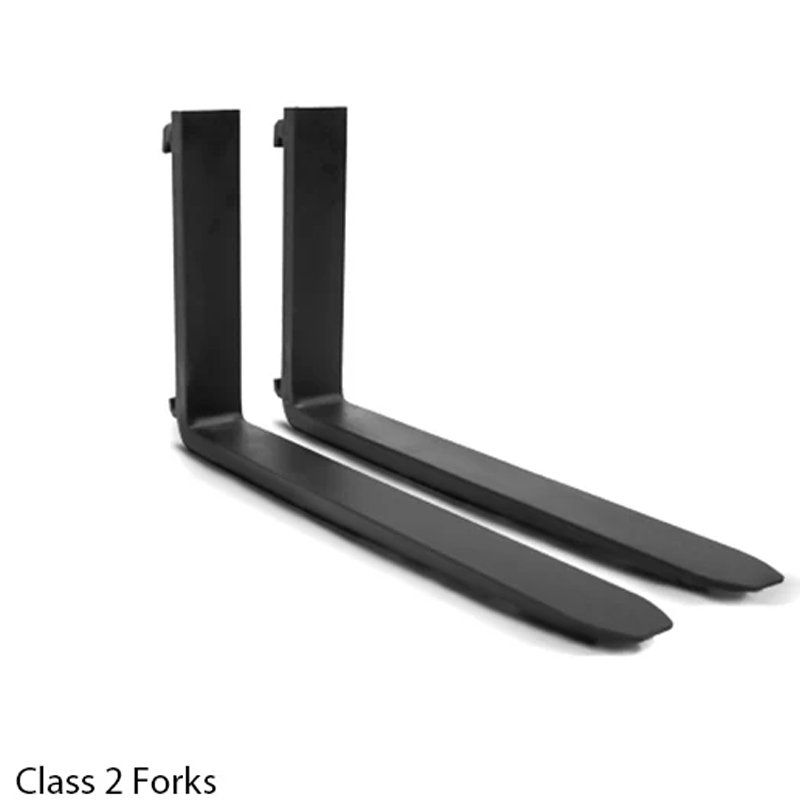
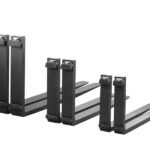
If you’re running a standard warehouse forklift — 3,000 lb to 5,000 lb capacity, indoor operations, pallet handling, loading docks — your forks are almost certainly ITA Class 2. It’s the most common carriage class in the world for indoor forklifts, and for good reason: the 1.5 inch shank thickness provides plenty of strength for daily warehouse work without the extra weight of Class 3 forks.
Class 2 forks are lighter than Class 3, which means your forklift’s capacity is less de-rated by the fork weight itself. For indoor warehouse work where loads rarely exceed 4,000-5,000 lb, Class 2 is the correct and optimal specification.
This page covers Class 2 forks (standard warehouse) and Class 1 forks (light-duty for smaller forklifts). If your forklift has a 5,000-8,000 lb rating, see our Class 3 page.
Lumber, pipe, long crates — verify Class 2 capacity at extended load center
Where Class 2 Forks Are Used
Class 2 forks are the default for indoor material handling. Typical applications:
Warehouse and distribution centers — standard pallet handling, order picking
Loading docks — truck and container loading/unloading
Retail back rooms — smaller forklifts in tight spaces
Cold storage and refrigerated warehouses — standard Class 2 is compatible with cold-rated forklifts
Manufacturing floor — moving raw materials and finished goods within the plant
Class 1 applications (smaller scale) — light manufacturing, small warehouses, narrow aisle operations
Class 2 vs Class 3 — Which Fork Do You Need?
This is the most common fork class question we get. The answer is determined by your forklift’s carriage, not your preference.
Factor
Class 2 Fork
Class 3 Fork
Forklift capacity
Up to 5,000 lb
5,000 – 8,000 lb
Mounting height
16-20 inches
20-25 inches
Shank thickness
1.5 inch
1.75-2.0 inch
Fork weight (48″) per pair
~120 lb
~170 lb
Best environment
Indoor warehouse
Outdoor / yard / heavy duty
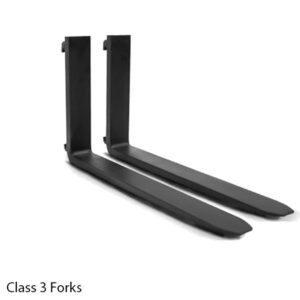
If your forklift has a Class 2 carriage, use Class 2 forks. Installing Class 3 forks on a Class 2 carriage won’t fit — the hooks are too large for the mounting opening.
If your forklift has a Class 3 carriage, use Class 3 forks. Class 2 forks on a Class 3 carriage can disengage under load because the hooks are undersized for the carriage opening.Not sure? Measure the vertical opening between the top and bottom carriage bars. 16-20 inches = Class 2. 20-25 inches = Class 3.
For a detailed breakdown of fork construction, heat treatment, and quality benchmarks — including the difference between drop-forged and flame-cut forks — see our Class 3 Forklift Forks – Hebei Maoxiang Technology Co., Ltd. . The same manufacturing standards apply to Class 2 forks.
Inspection Threshold — When to Replace Class 2 Forks
Per OSHA and ANSI/ITSDF B56.1 standards, replace forklift forks when:
Heel wear exceeds 10% of original shank thickness (most common reason)
Any heel crack detected — immediate replacement required
Blade bend exceeds 0.5% of fork length
Tip wear reduces fork length by more than 10%
Visible heat damage or surface cracks
For a standard Class 2 fork with 1.5 inch shank thickness: replace when heel thickness drops below 1.35 inches.
Before ordering Class 2 forks, confirm three measurements on your current forklift:
1. Carriage mounting height Measure from the top of the upper carriage bar to the top of the lower carriage bar. Should be 16-20 inches for Class 2.
2. Carriage width Measure the horizontal distance between the inside edges of the carriage side brackets. Standard Class 2 width is 42 inches.
3. Existing fork shank thickness Measure the thickest part of your current fork at the shank. 1.5 inches = standard Class 2.
Why Buy Class 2 Forklift Forks from Hebei Maoxiang?
Drop forged 4142 alloy steel — not flame cut from plate. Every fork is drop-forged for continuous grain flow through the heel, then induction hardened the full blade length.
Load tested — every pair is tested to 3:1 safety factor before shipment. Test certificate available.
CE certified — complies with EN 1757-3 and ISO 2328.
Factory direct pricing — no distributor markup. We manufacture the forks and the forklifts in the same facility.
Custom lengths and coatings available — specify your requirement.
Reviews
There are no reviews yet.