Warehouse space costs money every single day. In most major markets, industrial rents have risen 30–50% over the past five years and show no sign of reversing. When you can't afford to expand your footprint, the only way to store more inventory is to use your existing space more efficiently.
A reach truck does one thing better than any other forklift: it extracts more storage capacity from the same four walls. By shrinking your aisle width from 12 feet down to 8 feet and pushing your racking from 20 feet up to 35–40 feet, the same warehouse can hold 25–35% more pallets. At typical industrial rents, that's the equivalent of several thousand dollars per month in avoided expansion cost — per facility.
But a reach truck is not a universal upgrade. Buy one without the right floor, the right racking, or the right operators, and it creates problems that are expensive to fix. This guide gives you the full picture: what reach trucks actually do, where they deliver real value, and the four things you must confirm before buying one.
What a Reach Truck Is — and Why It's Different From a Counterbalance Forklift
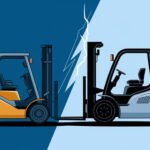
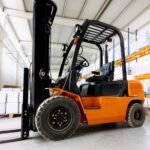
Most people understand forklifts through the counterbalance model: a heavy weight at the rear offsets the load on the front forks, and the entire truck drives up to the rack to pick or deposit a pallet.
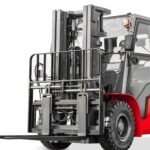
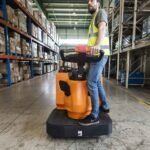
A reach truck works differently in one critical way. Instead of a rear counterweight, it uses two forward-projecting stabilizer legs at the base. The forks are mounted on a pantograph mechanism — a hydraulic scissor-like arm — that extends forward into the racking while the truck body stays in the aisle.
In plain terms: the forks go into the rack. The truck doesn't have to.
That single design difference produces every other advantage reach trucks have over counterbalance forklifts. Because the truck body stays in the aisle, the aisle only needs to be wide enough for the truck — not wide enough for the truck to turn and face the rack. That's where the aisle width savings come from. And because reach truck masts don't need to accommodate a bulky rear counterweight, they can be built taller — which is where the lift height advantage comes from.
Understanding this mechanical principle matters because it also explains the limitations, which we'll get to shortly.
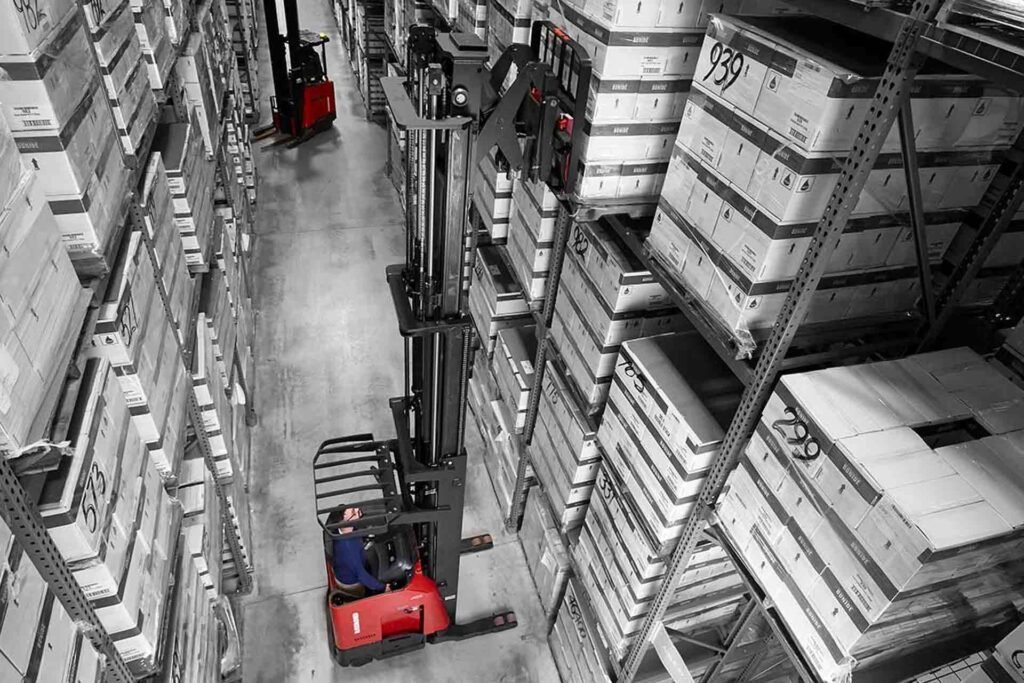
Reach Truck
What Reach Trucks Are Actually Used For
Reach trucks have a specific job. They are not general-purpose material handling equipment.
High-bay narrow-aisle warehousing is the core application. Distribution centers, third-party logistics facilities, e-commerce fulfillment warehouses, and manufacturing plants that need to store a large number of SKUs in a limited footprint. Anywhere that pallet density and vertical storage are the primary operational priorities.
Racking retrieval and placement at height is where reach trucks are irreplaceable. Placing and retrieving pallets at 25, 30, or 35 feet requires the precision and lift height that reach trucks provide. A counterbalance forklift simply cannot reach these heights safely or effectively in most standard configurations.
Cold storage facilities use reach trucks extensively because cold storage space is extremely expensive to build and operate. Maximizing pallet positions within a fixed cold envelope is a direct cost reduction, and reach trucks are the tool that makes high-density cold storage viable.
What reach trucks are not used for:
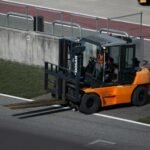
- Loading and unloading trucks at dock doors (counterbalance forklifts do this better)
- Moving loads across long distances between buildings or between outdoor areas
- Any outdoor or rough-surface application
- Very heavy loads above 4,500 lbs (most reach truck models top out here)
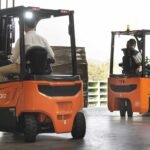
A well-run warehouse often uses both reach trucks and counterbalance forklifts — reach trucks for high-bay storage operations, counterbalance units for dock work and yard movement. They are complementary tools, not substitutes for each other.
The Real Numbers: What a Reach Truck Actually Delivers
Vague claims about 'increased storage density' and 'improved space utilization' don't help you make a decision. Here are the actual numbers.
Aisle width reduction:
| Equipment | Minimum Aisle Width |
|---|---|
| Counterbalance forklift | 11–13 feet |
| Reach truck | 8–10 feet |
That 3-foot reduction per aisle adds up fast. In a warehouse with 20 rack rows, eliminating 3 feet from each aisle frees up 60 feet of floor space — enough for two to three additional rack rows depending on rack depth. On 40-foot deep racks, that's potentially 80–120 additional pallet positions from space that was previously aisle.
Lift height comparison:
| Equipment | Typical Maximum Lift Height |
|---|---|
| Standard counterbalance forklift | 15–20 feet |
| Reach truck | 25–45 feet |
Going from 20-foot to 35-foot racking in a warehouse with 40-foot clear height adds roughly two full pallet levels to every rack bay. In a facility with 500 rack bays, that's 1,000 additional pallet positions from the same floor footprint.
Storage density impact:
Converting a standard-aisle counterbalance layout to a narrow-aisle reach truck layout typically increases pallet positions by 20–35% in the same building footprint. The exact figure depends on the facility's dimensions, ceiling height, and existing layout, but 25% is a reasonable planning estimate for most rectangular warehouse configurations.
Translating this into dollars:
If your warehouse rents for $8 per square foot per year and covers 50,000 square feet, your annual rent is $400,000. A 25% increase in storage density is the equivalent of avoiding $100,000 in additional annual rent — or deferring a facility expansion by several years. Against that figure, the cost of a reach truck and the associated racking investment looks very different than it does as a standalone equipment purchase.
The Four Limitations Nobody Tells You About Before You Buy
This is the section that separates a useful buying guide from a product brochure. Reach trucks have genuine limitations that cause real operational problems when buyers don't discover them until after delivery.
Limitation 1: Floor Flatness Requirements Are Strict — and Measurable
This is the most commonly overlooked pre-purchase requirement, and the one that causes the most post-purchase regret.
Reach trucks operating at height are extremely sensitive to floor flatness. When a truck is lifting a pallet to 30 feet, even a small floor undulation translates into significant load sway at the top of the mast. This isn't just uncomfortable — it's a genuine safety risk and a practical operational problem that causes operators to avoid lifting to full height, which defeats the purpose of the equipment.
Floor flatness is measured using an F-number rating system. The higher the F-number, the flatter the floor.
General guidelines for reach truck operation:
- Standard reach truck operation (up to 20 feet): FF ≥ 50
- High-bay operation (20–30 feet): FF ≥ 75
- Very high-bay operation (above 30 feet): FF ≥ 100
Most new warehouse construction meets these standards. Facilities built more than 10–15 years ago frequently do not — particularly if the floor has experienced settling, cracking, or heavy traffic wear without resurfacing.
What to do before buying: Have your floor professionally measured for flatness before committing to reach truck equipment. Floor measurement services typically cost $500–$2,000 depending on facility size. If your floor doesn't meet the required F-number for your intended lift height, factor floor remediation costs into your total investment — grinding and resealing to achieve the required flatness can run $3–$8 per square foot in affected areas.
Discovering the floor problem after delivery is an expensive lesson. Discovering it before purchase is a $1,000 investment that can save tens of thousands.
Limitation 2: Reach Trucks Are Strictly Indoor Equipment
The small solid or polyurethane tires on reach trucks are designed for smooth, flat indoor surfaces. They provide no traction on gravel, uneven outdoor pavement, or wet surfaces. The low ground clearance means even minor surface transitions — an expansion joint with slight height differential, a threshold strip, a deteriorated dock leveler plate — can create instability at height.
There are no outdoor-capable reach trucks in standard configurations. If your operation involves any movement between indoor and outdoor areas, or if your indoor floor has significant surface transitions, reach trucks are not the right tool for those specific tasks. Use counterbalance forklifts with pneumatic tires for those applications and keep reach trucks on the smooth interior floor where they perform correctly.
Limitation 3: Load Capacity Has a Real Ceiling
Most reach trucks are rated between 2,500 and 4,500 lbs (approximately 1.1–2 tons). Some heavy-duty reach truck models reach 5,500 lbs, but selection above 4,500 lbs is significantly narrower than in the counterbalance category.
More importantly, reach truck capacity ratings drop with lift height — just like counterbalance forklifts, but the drop-off can be more significant at extreme heights. A truck rated at 4,500 lbs at ground level may be rated at 3,500 lbs at 30 feet. Always verify the rated capacity at your actual maximum operating height, not just the headline capacity number.
If your operation regularly handles loads above 4,000 lbs, confirm specific model capacity ratings at your required lift height before purchasing. Don't assume the nameplate number applies at full height.
Limitation 4: Operator Training Requirements Are Higher Than Standard
Operating a reach truck at 15 feet is straightforward for most trained forklift operators. Operating one at 30 feet is a different skill level entirely.
At height, the operator's view of the pallet and the rack beam is restricted and partially indirect. Precise positioning requires skill, patience, and spatial awareness that takes time to develop. The consequences of misjudgment at 30 feet — a dropped load, a collapsed rack beam, a pallet pushed through the back of a rack bay — are serious and expensive.
Operators also need to manage the pantograph extension correctly, coordinating fork extension with mast height to maintain load stability. This is a learned technique that doesn't come naturally to operators transitioning from counterbalance equipment.
Practical implications:
- Budget for meaningful operator training time before the equipment goes into full production use
- For facilities with high operator turnover, factor ongoing training costs into the total cost of ownership
- Consider camera-assist systems on high-lift models — they significantly reduce operator error at height and have a measurable impact on incident rates in high-bay operations
Types of Reach Trucks: Which Configuration for Which Operation
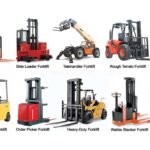
Single-Reach (Standard Reach Truck)
The most common configuration. The pantograph extends the forks one pallet position into the rack. Suitable for standard single-deep pallet racking — the most common racking configuration in general warehousing.
Best for: General distribution, e-commerce fulfillment, manufacturing storage, any standard pallet racking environment.
Double-Reach (Deep-Reach Truck)
The pantograph can extend two pallet positions deep, enabling access to double-deep racking systems. This increases storage density further — roughly 20–25% more pallet positions compared to single-deep reach truck layouts — by eliminating every other access aisle.
The tradeoff: double-deep storage requires last-in-first-out inventory management within each double-deep lane. The pallet at the back can only be accessed after the front pallet is removed. For operations with high SKU diversity or FIFO inventory requirements, double-deep creates inventory management complexity that may outweigh the storage density benefit.
Best for: High-volume operations with relatively homogeneous SKU profiles, goods that don't require strict FIFO rotation, operations prioritizing maximum density over inventory access flexibility.
Multi-Directional Reach Truck (Sideloader Variant)
Can traverse aisles laterally, enabling handling of long loads — steel bar, aluminum extrusions, timber, pipe — in very narrow aisles without needing the load length to clear aisle width. A specialist tool for specific industries.
Best for: Steel service centers, aluminum distributors, timber operations, any facility handling long-format loads that can't be managed with standard forward-facing forks.
Very Narrow Aisle (VNA) Turret Truck
A distinct but related category. VNA turret trucks can rotate the forks 90 degrees in both directions without the truck turning, enabling operation in aisles as narrow as 5–6 feet. This represents the ultimate in storage density.
VNA systems require floor-embedded wire guidance or rail systems, laser navigation, or inductive guidance to operate safely in aisles too narrow for safe manual steering. They are a significant capital investment in both equipment and facility infrastructure — appropriate for very large, high-throughput facilities where the storage density gain justifies the system cost.
The Buying Guide: What to Confirm Before You Purchase
Step 1: Measure Your Floor Flatness First
Not second. Not as a formality. First. Before you do anything else, know your floor's F-number at your intended operating height. This single measurement can change the entire scope and cost of your project.
If your floor meets the standard: proceed normally. If your floor doesn't meet the standard: get remediation quotes and add them to your total project cost before making any equipment commitments.
Step 2: Calculate Your Required Lift Height With Margin
Your required lift height is not your top rack beam height. It's your top rack beam height plus the height of your tallest pallet plus 6–12 inches of clearance for placing and retrieving loads over the beam.
Example: Top beam at 28 feet + 4-foot pallet height + 10 inches clearance = 33.5 feet of required lift height. A reach truck rated to 30 feet doesn't cover this application. A truck rated to 35 feet does.
Get this calculation right before specifying equipment. Discovering the truck can't reach your top level after installation is an expensive correction.
Step 3: Confirm Rated Capacity at Your Maximum Operating Height
Ask for the load capacity chart, not just the nameplate capacity. Verify that the truck's rated capacity at your actual maximum lift height exceeds your heaviest pallet weight by a comfortable margin — not just technically adequate, but practically safe for daily operation.
Step 4: Match Aisle Width to Truck Turning Radius
Reach trucks operate in narrow aisles, but 'narrow' means different things for different models. A truck's working aisle requirement is determined by its turning radius plus the pallet dimensions plus safety clearance on each side.
Get the specific working aisle requirement (sometimes called 'aisle width required' or 'AST — aisle width to stack and travel') from the manufacturer for the exact model and pallet size you'll be using. Compare this number to your measured aisle widths, not the nominal aisle width in your layout drawings.
Step 5: Choose Battery Technology Based on Your Shift Pattern
Reach trucks are almost exclusively electric. The battery choice matters:
Single shift: Lead-acid or lithium-ion both work. Overnight charging covers single-shift needs without operational complexity. Lead-acid is the lower upfront cost; lithium-ion offers better performance consistency through the shift and eliminates maintenance requirements.
Two shifts: Lithium-ion is strongly preferred. Its opportunity charging capability — plugging in during breaks without damage or full cool-down requirements — makes two-shift operation manageable with a single battery per truck. Lead-acid requires either multiple battery sets per truck or a battery swap infrastructure investment that adds significantly to the total project cost.
Three shifts or near-continuous operation: Lithium-ion with a well-planned charging schedule. The fast charge time (1–3 hours to 80%) and opportunity charging flexibility make lithium-ion the practical choice for high-intensity operations.
Step 6: Plan the Racking System as Part of the Same Project
A reach truck and its racking system are a matched system. The rack beam heights, rack depth, and aisle widths must all be specified in coordination with the truck's operating dimensions.
If you're installing new racking alongside the reach truck purchase, design both together — ideally with input from the equipment supplier, the racking supplier, and a warehouse layout specialist.
If you're introducing reach trucks into an existing racking system, verify compatibility in detail: beam height clearances, rack depth relative to the truck's reach extension, and aisle width relative to the truck's working aisle requirement. Assumptions here lead to expensive post-installation modifications.
Reach Truck vs Counterbalance Forklift: When to Switch
For operations currently running counterbalance forklifts and evaluating whether to transition to reach trucks, here is a straightforward framework.
Strong case for switching to reach trucks when:
- Your warehouse is at or near capacity and expansion is cost-prohibitive
- Your aisle widths are 10 feet or under, or you're willing to redesign your layout to achieve narrow aisles
- Your ceiling clear height is 25 feet or above and you're not using it fully
- Your floor is new or recently resurfaced to high-flatness standards
- Your loads are consistently under 4,000 lbs
- You have a stable, trained operator team or the budget to develop one
Keep counterbalance forklifts (or run a mixed fleet) when:
- Your operation involves significant dock work, trailer loading, or outdoor movement
- Your loads regularly exceed 4,000–4,500 lbs
- Your floor condition is poor and remediation cost is high
- Your operator turnover is very high and ongoing training is a budget constraint
- Your ceiling clear height is under 20 feet (the reach truck advantage in lift height isn't fully utilized)
The mixed fleet approach: Many well-run warehouses use reach trucks for high-bay racking operations and counterbalance forklifts for dock work, receiving, and yard movement. This division of labor uses each machine type where it performs best. The capital investment is higher than a single-type fleet, but the operational efficiency across the full scope of tasks is better.
A Practical Pre-Purchase Checklist
Before committing to a reach truck purchase, confirm each of these:
- Floor flatness measured and documented (F-number confirmed for intended lift height)
- Required lift height calculated correctly with pallet height and clearance margin included
- Rated capacity at maximum lift height verified against heaviest actual load
- Working aisle requirement of specific model confirmed against measured aisle widths
- Racking system compatibility verified or new racking designed in coordination with truck specs
- Battery technology selected based on actual shift pattern
- Operator training plan and timeline established
- Total project cost calculated: truck + battery + charger + floor remediation (if needed) + racking modifications (if needed) + training
Where Maoxiang Fits in Your Material Handling Setup
Hebei Maoxiang Technology Co., Ltd. manufactures CE-certified electric counterbalance forklifts from 0.6 to 5 tons — the equipment that complements reach truck operations in a complete warehouse material handling system.
In most facilities that adopt reach trucks for high-bay narrow-aisle storage, counterbalance forklifts continue to handle dock receiving, trailer loading, outdoor yard movement, and any tasks involving loads above the reach truck's capacity ceiling. Maoxiang's electric counterbalance range covers this role: zero emissions for indoor compliance, lithium-ion battery configurations built to customer duty cycle, CE-certified for European and international markets, and competitive pricing that makes equipping a complete mixed fleet financially practical.
For buyers evaluating their full material handling setup — reach trucks for the racks, counterbalance units for the docks and yard — Maoxiang's electric counterbalance forklifts are built to work alongside high-bay storage systems as the ground-level complement to vertical storage equipment.
Global shipping supported. Contact Maoxiang for configuration-specific pricing based on your capacity requirements and operating environment.
The Bottom Line
A reach truck is not a forklift upgrade. It's a warehouse space optimization tool that happens to look like a forklift.
If your warehouse is running out of room, your ceiling has unused height, and your floor is flat enough to support high-bay operation, a reach truck can meaningfully increase your storage capacity without adding a square foot of building. That's a genuine and substantial financial return in a market where industrial space is expensive and getting more so.
If your floor is old and uneven, your loads are heavy, your operators turn over frequently, or your operation involves significant outdoor work, a reach truck creates problems that outweigh its benefits. The right tool for those conditions is a counterbalance forklift — or a mixed fleet that uses each type where it performs correctly.
Measure your floor. Calculate your actual lift height requirement. Verify capacity at height. Match the truck's working aisle requirement to your measured aisles. Do these four things before signing, and you'll avoid the most expensive mistakes in reach truck purchasing.