In heavy-duty material handling, a standard forklift is often limited by its own geometry. When faced with 'unpalletized' loads—such as bundles of steel, industrial engines, or equipment buried deep in a 40ft container—the forks become a liability rather than an asset. This is where the Forklift Boom (also known as a Crane Jib) serves as a strategic engineering upgrade, bridging the gap between a forklift and a mobile crane.
1. What Exactly is a Forklift Boom? (The Engineering Perspective)
A Forklift Boom is a high-tensile steel attachment designed to slide over a forklift’s tines to provide overhead suspension lifting. Unlike a standard lift where the center of gravity is directly over the forks, a boom shifts the lift point forward and upward.
Core Components of an Industrial-Grade Boom:
-
Fork Pockets: Precision-welded sleeves that must match the fork profile to prevent lateral wobbling.
-
Telescoping Inner Beam: An adjustable section held by locking pins, allowing the operator to reach further into inaccessible areas.
-
The Pivot Hook: A 360-degree swivel hook that prevents the lifting chains from twisting, which is critical for load stability.
-
Safety Restraint System: A heavy-duty chain and grab hook that anchors the attachment to the forklift’s carriage, preventing the boom from sliding off during a sudden stop or tilt.
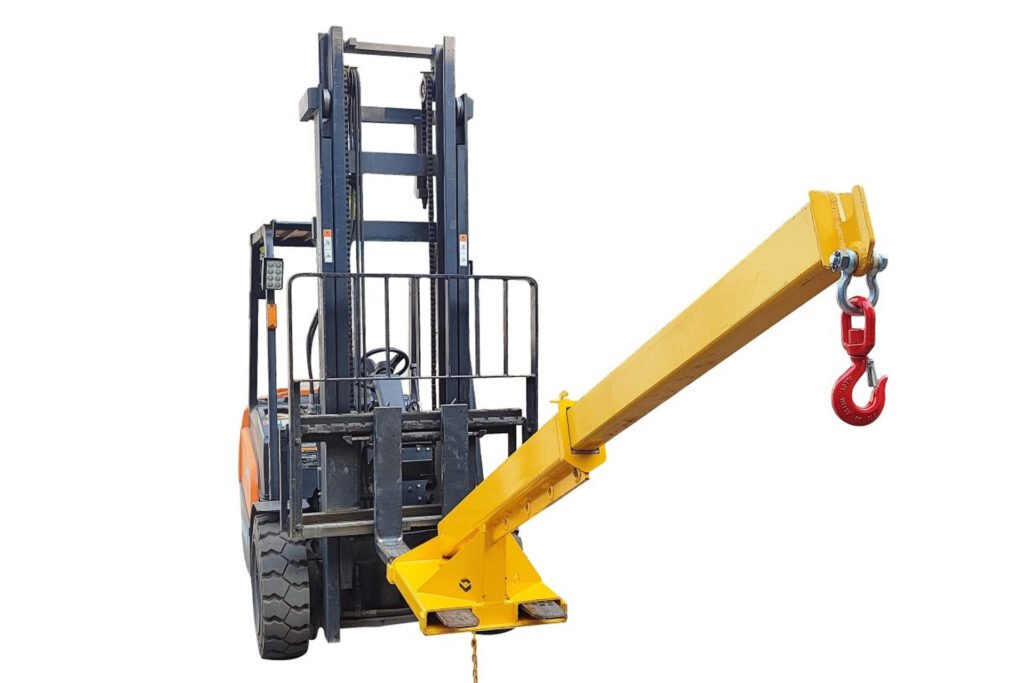
Forklift Boom
2. How Does It Work? The Physics of Leverage
Understanding the mechanics of a forklift boom is vital for site safety. It operates on the Principle of the Lever, and this is where most untrained operators make mistakes.
-
The Shifting Load Center: A forklift is rated based on a 24-inch (600mm) load center. When you install a 2.5-meter boom, you are dramatically moving that load center forward.
-
The Capacity Drop-off: As the hook moves further away from the mast, the forklift’s lifting capacity decreases exponentially. For example, a 3-ton forklift might only be able to safely lift 800kg at the full extension of a 3000mm boom.
-
The Role of the Tilt Cylinder: To pick up a load, the operator doesn't just lift the mast; they use the mast tilt function to position the hook. Once lifted, the mast is tilted back slightly to bring the center of gravity closer to the drive wheels, increasing stability during transport.
3. Critical Types and Their Specialized Functions
To make the most of this attachment, you need to select the configuration that matches your operational 'pain points':
-
Fixed vs. Telescoping: Fixed booms are the 'workhorses' for repetitive tasks at a set distance. Telescoping booms are 'problem solvers'—essential for reaching over fences, walls, or to the very back of a flatbed trailer.
-
Low Profile vs. High Lift: A flat (low profile) boom is designed to work in areas with restricted overhead clearance, like inside a container. A high-lift (angled) boom provides extra vertical clearance, allowing you to lift taller machinery that would otherwise hit the forklift's mast.
4. Why Quality Matters: The 'Hebei Manufacturing' Edge
As a manufacturer, we see many 'budget' booms on the market that compromise on safety to save a few dollars. When evaluating a supplier, look for these professional-grade markers:
-
Reinforced Fork Pockets: The point where the pocket meets the boom takes the most stress. We use double-seam welding to ensure structural integrity under maximum load.
-
Material Certification: High-tensile steel (like Q355B) is mandatory. Lower-grade steel can suffer from 'metal fatigue' over thousands of lift cycles.
-
The 'Belly' Safety Chain: A high-quality boom must have a heavy-duty chain that tethers it directly to the forklift's carriage. If you see a boom secured only by a friction bolt, it is not safe for industrial use.
5. Final Verdict: A Strategic Investment for Your Fleet
The Forklift Boom is more than an 'accessory.' It is a cost-cutting tool that allows you to perform crane-level tasks with your existing forklift fleet. It reduces the need for expensive third-party rentals and speeds up the handling of oddly shaped cargo.