Someone searching 'forklift repair and maintenance' is usually trying to solve one of three problems: they want a maintenance schedule to prevent breakdowns, they're troubleshooting a specific issue and want to know if it's a DIY fix or needs a technician, or they're trying to estimate ongoing costs before or after buying a forklift. This guide covers all three — a practical maintenance schedule, the most common repairs and what causes them, and how to think about repair costs over the life of a fleet.
Forklift Repair and Maintenance
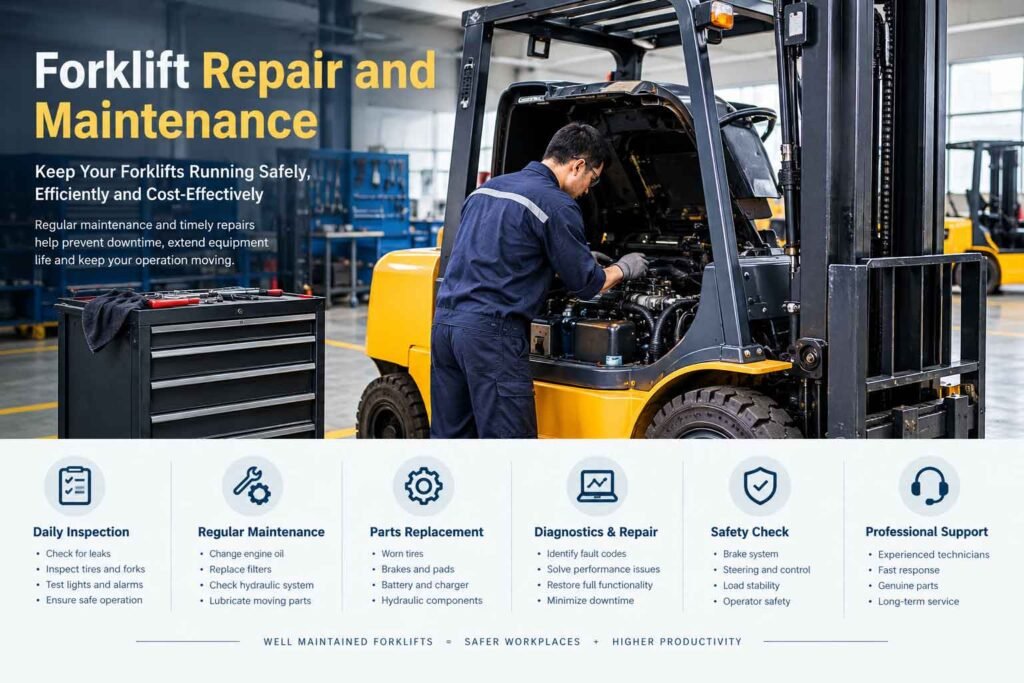
Why Maintenance Matters More Than Most Buyers Realize
A forklift is closer to a piece of industrial machinery than a car — it operates under sustained heavy load, often indoors with hydraulic systems working constantly, and downtime doesn't just cost a repair bill, it stalls warehouse operations entirely. Unlike a car that sits idle most of the day, a working forklift can run 6–10 hours in a single shift, which means wear accumulates fast if maintenance is skipped or delayed.
The core idea that should drive every maintenance decision: most expensive forklift repairs started as cheap, ignorable warning signs. A slow hydraulic leak, a slightly loose chain, or a battery that's not holding charge as well as it used to — none of these stop a shift, so they get ignored until they become a $2,000 repair instead of a $50 fix.
The Maintenance Schedule That Actually Prevents Breakdowns
Daily Pre-Shift Checks (5–10 minutes, every operator, every shift)
- Visual inspection for fluid leaks (hydraulic oil, coolant, fuel)
- Tire condition and pressure (for pneumatic tires)
- Fork condition — check for cracks, bends, or excessive wear
- Horn, lights, and backup alarm function
- Seatbelt and safety features
- Hydraulic fluid level
- Battery charge level (electric) or fuel level (IC forklifts)
This is the single highest-leverage maintenance habit in any fleet. Most catastrophic failures show early warning signs that a five-minute daily check would catch — but this step gets skipped constantly because operators are rushed at shift start.
Weekly Checks
- Tire wear pattern (uneven wear signals alignment or pressure issues)
- Chain lubrication and tension
- Mast operation — smooth lift, no jerking or hesitation
- Brake responsiveness
- Coolant level (IC forklifts)
Monthly / 250-Hour Checks
- Engine oil and filter (IC forklifts)
- Hydraulic filter inspection
- Battery terminal cleaning and water levels (electric, lead-acid)
- Belt tension and condition
- Steering system inspection
500–1,000 Hour / Quarterly Service
- Full hydraulic fluid change
- Transmission fluid check
- Differential fluid check
- Spark plug inspection/replacement (LPG/gas forklifts)
- Complete brake system inspection
- Mast chain and roller inspection
Annual Service
- Full safety inspection (often required for compliance/certification)
- Load capacity and stability testing
- Complete fluid system flush and replacement
- Comprehensive electrical system check
Manufacturers publish specific interval recommendations by model — always check your operator's manual, since hour-based intervals matter more than calendar-based ones for equipment with variable usage.
The Most Common Forklift Repairs (and What Usually Causes Them)
Hydraulic System Failures
Symptoms: Slow or jerky lifting, forks drifting down when idle, visible fluid leaks.
Common cause: Worn seals, contaminated hydraulic fluid, or low fluid levels. Hydraulic issues are among the most common forklift repairs because the system is under constant pressure during every lift cycle.
Fix approach: Minor leaks and fluid top-offs can often be handled in-house; seal replacement and cylinder repair typically need a certified technician.
Battery and Charging Issues (Electric Forklifts)
Symptoms: Reduced run time, slow charging, forklift losing power under load.
Common cause: Sulfation from incomplete charging cycles, low water levels in lead-acid batteries, or a battery reaching end-of-life (typically 5–7 years with proper care).
Fix approach: Proper charging habits (full charge cycles, not partial top-offs) prevent most premature battery failures — this is one of the cheapest problems to prevent and one of the most expensive to fix once a battery pack needs replacement.
Tire Wear and Damage
Symptoms: Uneven wear, cracking, reduced traction, vibration while driving.
Common cause: Overloading, hard surfaces combined with high mileage, or incorrect tire type for the operating surface.
Fix approach: Solid and cushion tires typically need replacement rather than repair; catching uneven wear early through weekly checks can extend tire life significantly.
Mast and Chain Problems
Symptoms: Jerky lifting motion, uneven fork height, unusual noise during lift/lower.
Common cause: Chain stretch, inadequate lubrication, or roller wear.
Fix approach: Chain lubrication is a simple, frequent maintenance task; chain replacement or roller repair should go to a trained technician given the safety implications of mast failure.
Brake System Issues
Symptoms: Longer stopping distance, spongy brake pedal, unusual noise when braking.
Common cause: Worn brake pads/shoes, low brake fluid, or contamination in the brake system.
Fix approach: This is a safety-critical system — even minor brake issues should be inspected by a technician rather than delayed.
Engine Performance Issues (IC Forklifts)
Symptoms: Rough idle, power loss, difficulty starting, excessive exhaust smoke.
Common cause: Dirty air/fuel filters, spark plug wear (LPG/gas), or fuel system contamination.
Fix approach: Filter and spark plug replacement are routine maintenance items; persistent performance issues after basic maintenance usually indicate a deeper mechanical or fuel system problem.
In-House Maintenance vs. Professional Service: Where to Draw the Line
| Task | In-House OK? | Why |
|---|---|---|
| Daily fluid/visual checks | Yes | Requires no special tools or certification |
| Tire pressure, basic cleaning | Yes | Low risk, routine |
| Filter and fluid replacement | Often yes | Requires basic mechanical skill, low safety risk |
| Battery watering/terminal cleaning | Yes, with training | Requires care around acid and electrical contacts |
| Hydraulic seal/cylinder repair | Usually no | Requires specialized tools and expertise |
| Brake system repair | No | Safety-critical, often requires certification |
| Mast and lift chain repair | No | Safety-critical, structural implications |
| Engine/transmission overhaul | No | Requires specialized diagnostic equipment |
A good rule of thumb: if a failure could cause the forklift to drop a load, lose braking, or become structurally unstable, it goes to a certified technician — no exceptions, regardless of how confident an in-house team feels about the fix.
Estimating Forklift Maintenance and Repair Costs
Annual maintenance costs vary significantly by forklift type, age, and usage intensity, but general planning benchmarks include:
- Routine maintenance (filters, fluids, inspections): Often several hundred to a couple thousand dollars per year per unit, depending on usage hours.
- Major repairs (hydraulic system, transmission, engine): Can range from a few hundred to several thousand dollars per incident depending on severity.
- Preventive maintenance contracts: Many dealers offer scheduled maintenance plans, which can reduce unexpected repair costs by catching issues early — often worth it for fleets running multiple units continuously.
The real cost of poor maintenance usually isn't the repair bill itself — it's the downtime. A forklift out of service during a shift can stall receiving, shipping, or production workflows, and that lost productivity frequently costs more than the repair itself.
Warning Signs That Should Never Be Ignored
Regardless of maintenance schedule, these symptoms warrant immediate attention rather than waiting for the next scheduled service:
- Any hydraulic fluid leak, however small
- Forks drifting downward when raised and held
- Unusual noises during lifting or braking
- Warning lights or error codes on electric/computerized models
- Visible cracks in forks, mast, or overhead guard
- Battery not holding charge through a normal shift
Conclusion
Forklift repair and maintenance isn't really about fixing things when they break — it's about catching the small, cheap warning signs before they become expensive, safety-critical failures. A consistent daily-to-annual maintenance schedule, clear rules about what stays in-house versus what goes to a certified technician, and attention to early warning signs will do more to control repair costs and downtime than any single repair decision made after something has already gone wrong.