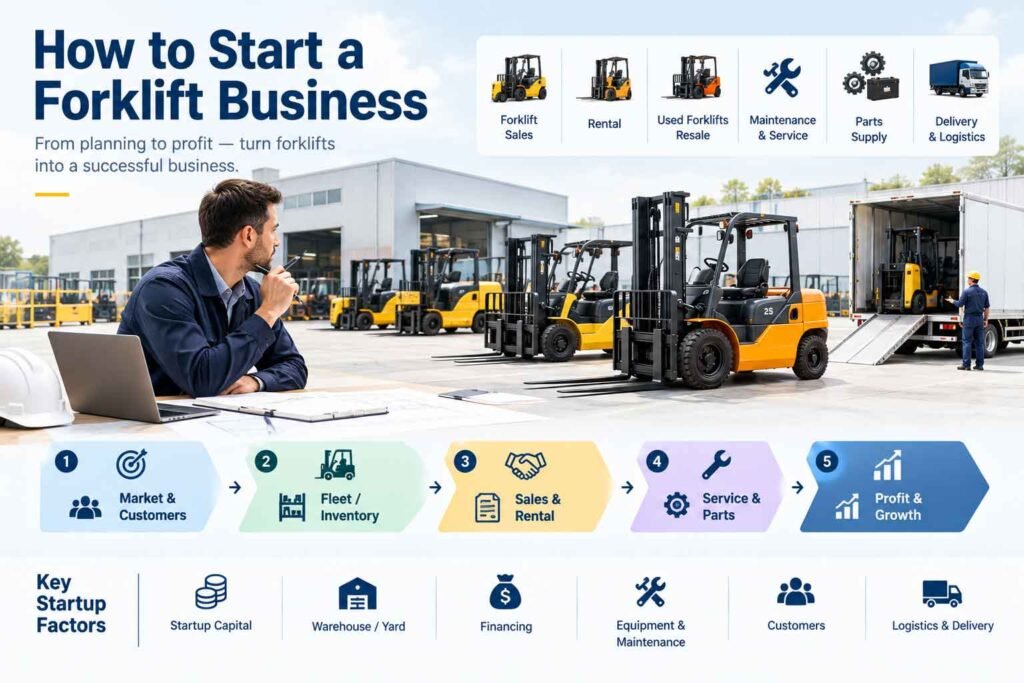
'Forklift business' usually means one of four distinct models — forklift rental/leasing, forklift sales (new or used dealership), forklift repair and maintenance service, or operator training/certification — and each has a completely different startup cost, skill requirement, and path to profitability. Renting or reselling forklifts requires significant capital tied up in equipment; repair and training businesses require less capital but more technical expertise and certification. Here's a breakdown of each model, what it actually takes to start, and how to figure out which one fits your situation.
How to Start a Forklift Business
Why 'Forklift Business' Isn't One Business
Before diving into steps, it's worth being honest about something most guides skip: someone searching this term could be picturing four very different businesses. A forklift rental company and a forklift repair shop have almost nothing in common in terms of startup cost, daily operations, or required expertise. Figuring out which model fits your capital, skills, and local market is the actual first decision — everything else follows from that.
Model 1: Forklift Rental / Leasing Business
What it is: Purchasing or financing a fleet of forklifts and renting them out to warehouses, construction sites, and manufacturers on short- or long-term contracts.
Startup capital needed: High. Even a small starting fleet of 5–10 used forklifts can require $75,000–$250,000+ depending on equipment condition and type, before accounting for storage, transport, and insurance.
What's required:
- A fleet of forklifts (new or refurbished used units)
- Storage/yard space
- Delivery trucks or trailers to transport equipment to customer sites
- Liability insurance and equipment insurance
- Maintenance capability (in-house or contracted)
- A system for tracking utilization, maintenance schedules, and contracts
Revenue model: Daily, weekly, or monthly rental rates, often with maintenance included in longer-term contracts. Profitability depends heavily on fleet utilization rate — an idle forklift is a depreciating asset generating zero revenue.
Best fit for: Buyers with access to capital or financing, existing relationships in construction/warehousing, or those acquiring an existing rental business rather than starting from zero.
Model 2: Forklift Sales / Dealership
What it is: Selling new or used forklifts, either as an independent dealer, a used equipment reseller, or an authorized dealer for a specific manufacturer.
Startup capital needed: Very high for a new-equipment authorized dealership (often requiring manufacturer approval, minimum inventory commitments, and showroom/service facilities). Lower — though still significant — for a used equipment resale model.
What's required:
- Relationships with manufacturers (for new equipment) or a sourcing network (for used equipment auctions, trade-ins, liquidations)
- Sales and negotiation experience
- A facility for inventory storage and display
- Financing options to offer buyers, since most business customers finance rather than pay cash
- Basic inspection/reconditioning capability, especially for used equipment resale
Revenue model: Margin on equipment sales, plus financing referral fees and parts/service revenue as an add-on.
Best fit for: People with existing industry relationships, sales experience, and access to either manufacturer partnerships or reliable used-equipment sourcing channels.
Model 3: Forklift Repair and Maintenance Service
What it is: Providing on-site or shop-based repair, maintenance contracts, and inspections for forklift fleets owned by other businesses.
Startup capital needed: Moderate. A mobile repair service can start with $20,000–$60,000 for a service vehicle, tools, and initial parts inventory — significantly less than the rental or dealership models.
What's required:
- Certified mechanics with forklift-specific experience (hydraulics, electrical systems, engines, mast/chain systems)
- A service vehicle equipped with tools and common parts
- Liability insurance
- Relationships with parts suppliers for fast turnaround
- Optionally, a shop location for larger repairs that can't be done on-site
Revenue model: Hourly labor rates, parts markup, and recurring maintenance contracts. Maintenance contracts (scheduled preventive service) tend to provide more predictable revenue than one-off repair calls.
Best fit for: People with hands-on mechanical or technician experience, particularly those who've worked in forklift dealership service departments or industrial equipment repair.
Model 4: Forklift Operator Training and Certification
What it is: Providing OSHA-compliant forklift operator training and certification for businesses that need to train or recertify their workforce.
Startup capital needed: Low relative to the other models. Often $10,000–$30,000 covers training materials, a training forklift, insurance, and certification program development — the lowest barrier to entry of the four models.
What's required:
- A certified trainer (often requiring the trainer's own qualifications and experience operating and training on forklifts)
- Access to at least one forklift for hands-on training
- A training location (can be mobile, training on-site at client facilities)
- Curriculum meeting OSHA 29 CFR 1910.178(l) requirements for powered industrial truck operator training
- Liability insurance
Revenue model: Per-person training fees, corporate contracts for recurring recertification (OSHA requires recertification periodically or after specific incidents), and potentially online/hybrid training components.
Best fit for: Experienced forklift operators or safety trainers looking for a lower-capital entry point, especially those who can build relationships with warehouses and logistics companies needing ongoing compliance training.
Common Steps Across All Four Models
Regardless of which model you choose, a few foundational steps apply universally:
1. Research Local Demand
Before committing capital, identify what's actually needed in your area — an oversaturated rental market with three established competitors is a very different opportunity than an underserved repair/service niche.
2. Handle Business Registration and Licensing
This includes standard business registration, liability insurance, and — depending on your model — potentially specific certifications (mechanic certifications for repair, trainer certifications for training businesses).
3. Understand Financing Options
Equipment-heavy models (rental, dealership) often rely on equipment financing or leasing arrangements rather than paying cash outright — lenders specializing in commercial equipment financing are usually more familiar with this asset class than general small business lenders.
4. Build Relationships Before Launch
Warehouses, construction companies, and manufacturers are the primary customer base across nearly all forklift business models. Relationships built through industry associations, local trade groups, or prior employment in the space are often more valuable at launch than marketing spend.
5. Plan for Insurance and Liability
Forklifts are heavy equipment involved in a meaningful share of workplace injuries — liability insurance isn't optional for any of these models, and rates should be factored into your startup budget from day one, not treated as an afterthought.
Which Model Should You Actually Start With?
| If you have... | Consider... |
|---|---|
| Significant capital and industry relationships | Rental/leasing business |
| Sales experience and manufacturer/sourcing connections | Sales/dealership |
| Hands-on mechanical/technician background | Repair and maintenance service |
| Operator experience and limited startup capital | Training and certification business |
A common and lower-risk path some entrepreneurs take is starting with the training or repair model — both require less capital and can be built on existing hands-on expertise — then expanding into rental or sales once the business has generated capital and industry relationships.
Realistic Challenges to Plan For
- Capital-intensive models carry real depreciation risk — a forklift sitting unused or unsold is losing value the entire time
- Competition from established dealers and rental companies with existing customer relationships can make market entry slow
- Certification and compliance requirements vary by region and must be researched specifically for your area before launch, not assumed
- Seasonal and economic sensitivity — construction and warehousing demand fluctuates with broader economic conditions, which directly affects rental and sales business models
Conclusion
'Starting a forklift business' isn't a single path — it's a choice between four distinct business models with very different capital requirements, skill demands, and risk profiles. Rental and dealership models offer higher revenue potential but require significant upfront capital; repair and training models offer lower barriers to entry but depend more heavily on technical expertise and certification. Choosing based on your actual capital, background, and local market demand — rather than picking the model that simply sounds most profitable — is what determines whether the business is viable in year one.