Most warehouses run on standard equipment. Standard pallets, standard aisles, standard pallet jacks. The system works — until it doesn't.
If you've ever tried to manoeuvre a standard pallet jack through a tight retail aisle, a narrow cold storage corridor, or a compact stockroom, you already know the problem. The forks are too wide. The unit won't turn. You're either damaging racking, blocking the aisle, or manually repositioning loads that should take seconds to move.
A narrow pallet jack solves this problem directly. It's not a compromise — it's a purpose-built tool for environments where standard equipment simply doesn't fit.
This guide explains exactly when you need one, how it differs from standard equipment, and what specifications to look for before you buy.
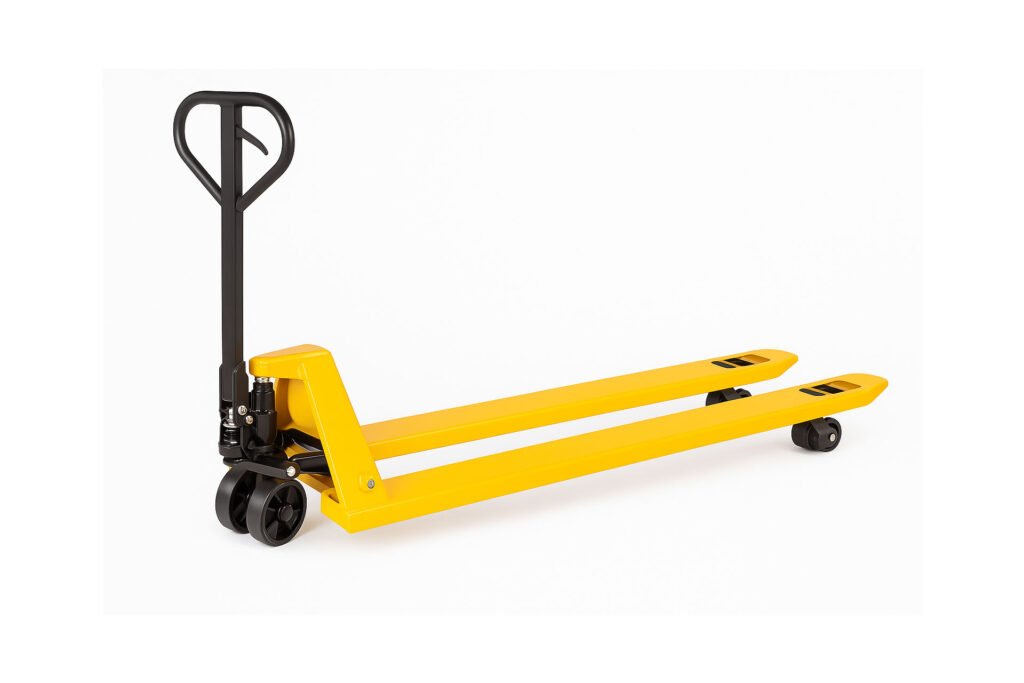
Narrow Pallet Jack
What Is a Narrow Pallet Jack?
A narrow pallet jack is a manual or electric pallet truck built with a significantly reduced fork width and a slimmer overall profile compared to standard models.
Where a standard pallet jack has an outside fork width of around 540 mm, a narrow model typically measures between 280 mm and 450 mm. The overall body width is reduced proportionally, allowing the unit to operate in aisles, corridors, and storage areas that standard equipment cannot access.
Everything else works the same way — the forks slide into the pallet, the load is raised just enough to clear the floor, and the operator moves it to the destination. The difference is purely dimensional: narrow pallet jacks fit where standard ones don't.
Also known as: narrow pump truck, slim pallet truck, narrow hand pallet truck, narrow pallet trolley.
Standard vs Narrow: The Key Dimensional Differences
Understanding the numbers makes the choice straightforward.
Fork Width Comparison
| Type | Outside Fork Width | Inside Fork Width |
|---|---|---|
| Standard pallet jack | 540 mm | 350 mm |
| Narrow pallet jack | 280 – 450 mm | 180 – 300 mm |
Overall Unit Width Comparison
| Type | Overall Body Width |
|---|---|
| Standard pallet jack | 550 – 570 mm |
| Narrow pallet jack | 290 – 470 mm |
What This Means in Practice
A standard pallet jack needs a usable aisle width of at least 700–800 mm to operate safely — accounting for the unit width plus clearance on both sides. A narrow pallet jack can operate in aisles as tight as 400–600 mm depending on the model.
In a retail environment where gondola shelving is fixed and aisles are set at 600–700 mm, the difference between standard and narrow is the difference between a unit that works and one that doesn't.
Full Specification Overview
Before selecting a narrow pallet jack, understand what each specification means for your operation.
1. Load Capacity
Narrow pallet jacks are generally rated for lighter loads than heavy duty standard models — reflecting the smaller pallet sizes and lighter goods typically handled in the environments they serve.
| Type | Typical Capacity Range |
|---|---|
| Manual narrow pallet jack | 1,000 kg – 2,000 kg |
| Electric narrow pallet jack | 1,000 kg – 1,500 kg |
What to check: Always weigh your actual loads — goods plus pallet — and confirm the rated capacity of the unit exceeds that figure by a safe margin. Never operate a pallet jack at its maximum rated capacity as a routine practice.
2. Fork Length
Fork length determines whether the unit fits your specific pallet.
| Pallet Type | Recommended Fork Length |
|---|---|
| Standard EUR pallet (1200×800 mm) | 1,150 mm |
| Half pallet (600×800 mm) | 800 mm |
| Quarter pallet | 600 mm |
| Non-standard / custom | Match to pallet depth |
Important: A narrow fork width alone is not sufficient if your pallet requires a specific fork length. Measure both dimensions of your pallet before specifying the unit.
3. Fork Width Options
Narrow pallet jacks are available in several width configurations to match different pallet types:
| Fork Width | Suited To |
|---|---|
| 280 – 320 mm | Very narrow or custom pallets, tight retail fixtures |
| 350 – 400 mm | Half pallets, slim display pallets |
| 420 – 450 mm | Standard narrow aisles with slightly reduced pallets |
Measure your pallet's fork entry width — the distance between the pallet's inner blocks or boards — and ensure the fork width of your chosen unit fits comfortably with clearance on both sides.
4. Lift Height
Like standard pallet jacks, narrow models lift loads just enough to clear the floor for transport — typically 85 mm to 200 mm.
This is sufficient for:
- Moving pallets across flat warehouse or retail floors
- Loading onto trucks via dock levellers
- Transferring between floor-level storage positions
If you need to lift pallets to any height above ground level — onto shelving, into racking, or above floor level — a narrow stacker is the appropriate equipment, not a narrow pallet jack.
5. Wheel Configuration
Wheel type affects performance on different floor surfaces and is particularly important in the environments where narrow pallet jacks are most commonly used.
| Wheel Type | Best For | Avoid If |
|---|---|---|
| Polyurethane (PU) | Smooth concrete, epoxy, tile | Wet floors, outdoor use |
| Rubber | Slightly uneven floors, light outdoor use | Precision flooring |
| Nylon | Smooth floors, light duty indoor | Any uneven surface |
| Stainless steel wheels | Cold storage, hygienic environments | Standard dry warehouse |
For cold storage: Specify stainless steel or food-grade wheel materials, and confirm the unit's overall construction is rated for low-temperature environments. Standard lubricants and seals may not perform correctly below 0°C.
6. Handle and Ergonomics
In tight spaces, operator ergonomics matter more than in open warehouse environments. Look for:
- Ergonomic handle design — reduces wrist strain during repeated pumping
- Low pump effort — lighter hydraulic pump action reduces fatigue in high-frequency use
- Smooth steering — particularly important when manoeuvring in tight turns
- Compact handle width — some narrow pallet jacks also feature a reduced handle width for use in very confined spaces
When Do You Actually Need a Narrow Pallet Jack?
The answer is more specific than 'tight spaces.' Here are the situations where a narrow pallet jack is the right — and often the only — practical solution.
Situation 1: Retail and Supermarket Aisles
Retail environments are built for shoppers, not equipment. Gondola shelving systems create fixed aisles typically 600–900 mm wide. Standard pallet jacks cannot operate safely in these spaces — they're too wide to turn and too bulky to control without risking damage to shelving, products, or floors.
Narrow pallet jacks are the standard solution for retail replenishment operations: moving stock from the back-of-house stockroom onto the shop floor, repositioning display pallets, and handling roll cages in confined areas.
Relevant industries: Supermarkets, convenience stores, DIY retailers, pharmacies, off-licences, electronics retailers.
Situation 2: Small and Compact Warehouses
Not every warehouse is a 10,000 m² distribution centre with wide racking aisles. Small 3PL facilities, urban fulfilment hubs, mezzanine storage levels, and basement stockrooms often have structural constraints that limit aisle width to 600–800 mm.
In these environments, a narrow pallet jack allows pallet movement without the constant need to partially dismantle loads or manually carry goods — operations that are time-consuming and increase injury risk.
Relevant facilities: Urban warehouses, basement storage, mezzanine levels, small 3PL operations, storage units.
Situation 3: Cold Storage and Refrigerated Environments
Cold storage facilities — particularly smaller blast freezers, refrigerated rooms, and controlled-atmosphere storage — are built to minimise the volume of chilled or frozen space. Every square metre costs money to cool. Aisle widths are kept to the absolute minimum to maximise storage density.
Standard pallet jacks often cannot operate in these aisles at all. Narrow pallet jacks — specified with appropriate cold-rated materials — are the correct tool for this environment.
Additional consideration for cold storage: Specify stainless steel construction where hygiene standards require it, cold-rated lubricants and seals for temperatures below 0°C, and battery heating systems for electric models used in freezer environments.
Relevant facilities: Blast freezers, refrigerated warehouses, controlled-atmosphere storage, food production cold rooms.
Situation 4: Non-Standard or Half Pallets
The global pallet landscape is not uniform. Alongside standard EUR and GMA pallets, many industries use half pallets, quarter pallets, display pallets, and custom-dimensioned platforms — particularly in food, beverage, pharmaceutical, and retail supply chains.
Standard pallet jacks are dimensioned for standard pallets. If your operation uses smaller or non-standard pallets, a narrow pallet jack with matching fork dimensions is the appropriate choice.
Relevant industries: Food and beverage (promotional display pallets), pharmaceutical distribution (smaller unit loads), retail supply chain (half and quarter pallets).
Situation 5: Wine, Beverage, and Bottle Storage
Wine cellars, beverage warehouses, and bottle storage facilities present a specific combination of challenges: high-value fragile goods, narrow storage aisles, and often uneven or irregular floor surfaces.
Narrow pallet jacks allow stock movement in these environments without the risk of damaging adjacent racking or product from oversized equipment. For high-value stock in particular, the cost of a single incident from using the wrong equipment far exceeds the cost of specifying the correct one.
Relevant facilities: Wine merchants, beverage distributors, spirit warehouses, brewery storage.
Situation 6: Manufacturing Cells and Production Areas
Modern manufacturing facilities — particularly those using lean or cell-based production layouts — are designed to minimise movement and floor space. Component trolleys, sub-assembly areas, and inter-cell transfer routes are often tight.
Narrow pallet jacks allow material handlers to move components and finished sub-assemblies between production cells without disrupting the layout or requiring wide access routes.
Relevant industries: Electronics manufacturing, automotive component production, pharmaceutical manufacturing, food processing.
Manual vs Electric: Which Is Right for a Narrow Pallet Jack?
Narrow pallet jacks are available in both manual and electric configurations. The right choice depends on the same factors that drive the decision for standard models.
Manual Narrow Pallet Jack
Choose if:
- Movement is infrequent — occasional replenishment, not continuous operation
- Trips are short — under 20 metres per move
- Budget is the primary constraint
- No charging infrastructure is available
- The environment makes electric impractical (very small space, outdoor use)
Advantages:
- Lower purchase cost
- No battery maintenance
- No charging required
- Reliable in cold storage (no battery performance issues)
- Simple to operate with minimal training
Electric Narrow Pallet Jack
Choose if:
- Operators are moving pallets repeatedly throughout a shift
- Travel distances exceed 20–30 metres regularly
- Operator fatigue or injury risk is a concern
- You run a medium to high-frequency operation
Advantages:
- Powered travel eliminates pushing effort
- Faster throughput per operator
- Reduced fatigue and injury risk
- Better suited to continuous, high-frequency use
Consideration for cold storage: Electric narrow pallet jacks used in freezer environments require lithium-ion batteries or battery heating systems. Standard lead-acid batteries lose significant capacity at low temperatures and may not complete a full shift in freezer conditions.
What to Check Before You Buy
Step 1: Measure Your Aisle Width
Measure the narrowest point in your operating environment — not the average, the minimum. This determines the maximum overall unit width you can accommodate.
Allow a minimum of 100–150 mm clearance on each side of the unit for safe operation.
Maximum unit width = narrowest aisle width − 200 mm minimum clearanceExample: 700 mm aisle → maximum unit width of 500 mm.
Step 2: Measure Your Pallet Dimensions
Confirm the fork entry width of your pallets — the clear distance between the pallet's inner support blocks or boards. The fork width of the unit must be narrower than this measurement, with enough clearance to enter and exit cleanly.
Also confirm pallet length to specify the correct fork length.
Step 3: Confirm Your Load Weight
Weigh your heaviest regular load including the pallet. Select a unit with a rated capacity at least 10–15% above this figure.
Step 4: Assess Your Floor Surface
Confirm floor type and condition — particularly important for cold storage and retail environments where surfaces may be tiled, coated, or subject to moisture. Specify wheel type accordingly.
Step 5: Consider Environmental Requirements
| Environment | Special Requirements |
|---|---|
| Cold storage (0°C to −5°C) | Cold-rated lubricants, appropriate wheel materials |
| Freezer (below −10°C) | Cold-rated construction, lithium battery or battery heater |
| Hygienic / food production | Stainless steel construction, food-grade materials |
| Retail (polished floors) | PU wheels, non-marking specification |
Narrow Pallet Jack vs Narrow Stacker: Understanding the Difference
A common point of confusion. Here's the direct distinction:
| Feature | Narrow Pallet Jack | Narrow Stacker |
|---|---|---|
| Lift height | 85 – 200 mm (floor clearance only) | Up to 5,000 mm+ |
| Function | Horizontal transport | Stacking and racking |
| Cost | Lower | Higher |
| Complexity | Simple | Greater |
| Use case | Moving pallets at floor level | Placing pallets into racking |
If you need to move pallets across the floor in tight spaces — narrow pallet jack. If you need to lift pallets into racking in tight spaces — narrow stacker.
Many operations use both: a narrow pallet jack for inbound receiving and floor-level transport, and a narrow stacker for putting stock away into racking.
Summary
A narrow pallet jack is not a scaled-down compromise. It is a purpose-built tool for a specific set of operating conditions — and in those conditions, it outperforms standard equipment in every practical respect.
If your operation involves any of the following, a narrow pallet jack is worth serious consideration:
- Fixed retail aisles under 800 mm wide
- Small or structurally constrained warehouses
- Cold storage or freezer environments with limited space
- Non-standard, half, or display pallets
- High-value storage environments where equipment damage risk must be minimised
- Manufacturing cells with tight inter-cell transfer routes
The specification process is straightforward: measure your aisle, measure your pallet, confirm your load weight, assess your floor and environment, and match those numbers to a unit rated accordingly.
Source Narrow Pallet Jacks Direct from the Manufacturer
At Hebei Maoxiang Technology Co., Ltd., we manufacture narrow pallet jacks in both manual and electric configurations, with fork width options from 280 mm, across a range of load capacities and fork lengths.
All units are CE certified. Custom specifications are available for non-standard pallet dimensions, cold storage requirements, and hygienic environments. Factory-direct pricing with export to 86 countries.
Contact us with your aisle width, pallet dimensions, and load weight — and we'll confirm the right model within 24 hours.