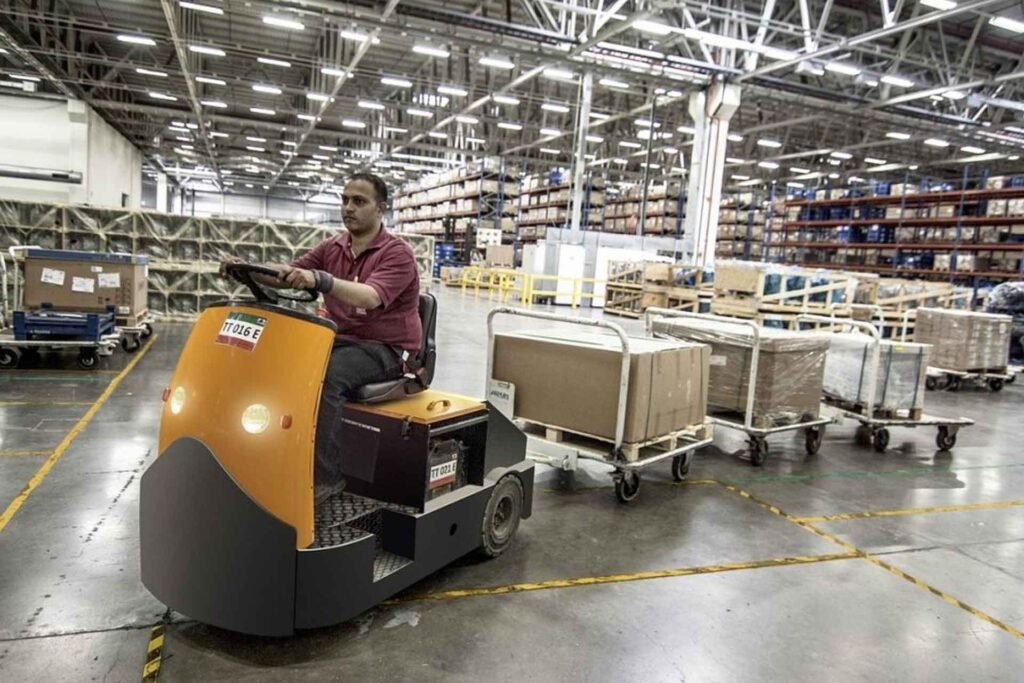
In a high-volume warehouse or a busy manufacturing plant, you’ll often see a compact, powerful machine pulling a 'train' of multiple carts loaded with parts or packages. While many people search for this machine as a 'tugger forklift,' its professional name is a Tow Tractor or Electric Tugger.
Unlike a standard forklift that specializes in vertical lifting, a tugger is the undisputed king of horizontal transport. In this guide, Hebei Maoxiang Technology Co., Ltd. explains what a tugger forklift is, how it works, and why it is the backbone of Lean Manufacturing.
What is a Tugger Forklift
1. Defining the Tugger: Horizontal vs. Vertical
The most important thing to understand about a tugger is its function:
- A Standard Forklift: Uses forks to lift pallets vertically onto racks.
- A Tugger: Uses a hitch or a tow bar to pull one or more carts horizontally across the floor.
It is essentially a 'locomotive' for your warehouse. It doesn't have forks; instead, it has a high-torque motor designed to pull heavy rolling loads, sometimes exceeding 10,000 lbs, with ease.
2. Why Use a Tugger Instead of a Forklift?
Many facility managers are shifting toward 'Fork-free' environments using tugger trains. Here’s why:
- Higher Efficiency (The 'Milk Run'): A forklift can usually carry only one or two pallets at a time. A tugger can pull a 'train' of 5, 10, or even more carts in a single trip. This significantly reduces the number of trips across the factory floor.
- Enhanced Safety: Tuggers provide better visibility because there are no tall masts or bulky loads blocking the operator's view. They are also less likely to tip over since the weight is pulled behind rather than lifted high.
- Better Ergonomics: For assembly lines, tuggers deliver materials at a height that is easy for workers to reach, eliminating the need for constant bending or the use of heavy lifting equipment at every workstation.
3. Key Visual Features: What to Look For
When you are sourcing a tugger from a supplier like Hebei Maoxiang, you will notice several distinct designs:
- Walkie Tuggers: The operator walks behind the unit. Ideal for short distances and tight spaces.
- Stand-on Tuggers: Features a platform for the operator. Perfect for medium-to-long distances where speed and operator comfort are important.
- Sit-down Tuggers: Designed for long-haul transport in massive logistics hubs or airports.
4. Tugger vs. Forklift: A Quick Comparison
5. Is a Tugger Right for Your Operation?
A tugger is the ideal solution if:
- You move materials over long distances within a large facility.
- You are implementing Lean Manufacturing or 'Just-in-Time' (JIT) delivery.
- You want to reduce the traffic of heavy forklifts in pedestrian-heavy areas.
Why Choose Hebei Maoxiang Technology?
At Hebei Maoxiang Technology Co., Ltd., we provide robust material handling solutions for the global export market. Our tuggers and tow tractors are engineered for durability and precision. We understand that in a fast-paced industrial environment, downtime is not an option. That’s why our machines feature:
- High-Torque AC Motors: For smooth, powerful acceleration under heavy loads.
- Advanced Hitch Systems: Compatible with a wide variety of industrial carts and trailers.
- Long-Lasting Battery Life: Designed to power through multi-shift operations.
Conclusion: Driving Efficiency Forward
While it may be called a 'tugger forklift' by many, this machine is in a class of its own. By focusing on moving more goods in fewer trips, tuggers represent the future of efficient, safe, and lean material handling.
Ready to Optimize Your Material Flow?
Contact Hebei Maoxiang Technology today to explore our full range of electric tuggers, forklifts, and custom lifting solutions tailored for your business.