When sourcing forklifts and material handling equipment from China, one critical decision that procurement managers face is whether to work directly with a China forklift manufacturer or a trading company. This choice significantly impacts pricing, quality control, customization capabilities, lead times, and overall supply chain transparency. Yet, many buyers struggle to distinguish between these two types of suppliers, often leading to costly mistakes.
In this comprehensive guide, we will explore the key differences between Chinese forklift manufacturers and trading companies, provide practical methods to identify which type you are dealing with, and share expert insights from industry-leading sources. By understanding these distinctions, you can make informed sourcing decisions that optimize costs and mitigate risks.
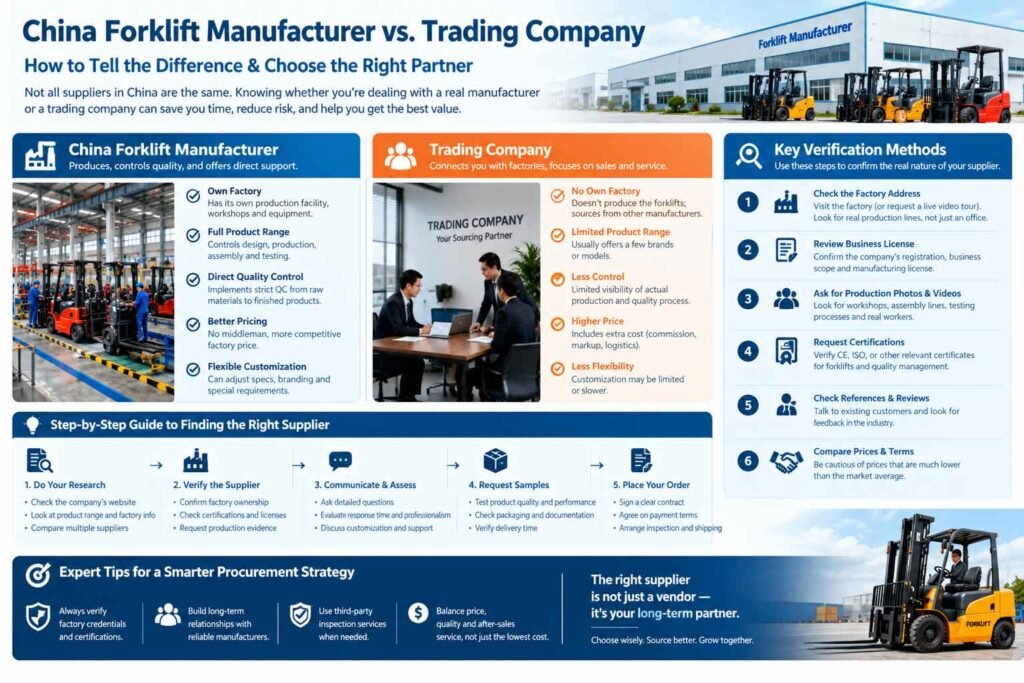
China Forklift Manufacturer vs Trading Company
Why Understanding the Difference Matters
The China forklift manufacturer vs trading company question is more than a semantic debate. It affects your entire procurement process:
- Pricing: Manufacturers offer factory-direct pricing without middleman margins, while trading companies add their markup.
- Quality Control: Manufacturers maintain direct oversight of production and quality assurance; trading companies rely on third-party factories, limiting control.
- Customization: Manufacturers can modify specifications, tooling, and branding; trading companies have limited or no customization power.
- Lead Times: Factory-direct suppliers can provide more reliable lead times; trading companies often depend on multiple factories, increasing variability.
- Certification and Compliance: Manufacturers hold essential certifications (ISO 9001, CE marking) tied to their production facilities, critical for regulatory compliance.
Failing to identify the true nature of your supplier can lead to inflated costs, substandard products, shipment delays, and compliance issues.
Defining the Two Supplier Types
China Forklift Manufacturer
A manufacturer owns and operates the production facility where forklifts are designed, engineered, and assembled. Key characteristics include:
- In-house engineering and tooling: Ability to customize products and develop OEM/ODM solutions.
- Direct quality management: Factory-level control over production processes and inspections.
- Certification ownership: Holds valid ISO 9001, CE, and other relevant certificates under the manufacturing entity.
- Higher MOQs: Due to production line economics and tooling setup.
- Transparent operations: Factory tours, live video inspections, and direct communication with engineering teams.
Examples of top Chinese forklift manufacturers include Anhui Heli, Hangcha Group, EP Equipment, and Run TX Machinery Group.
Trading Company
A trading company acts as an intermediary that sources forklifts from multiple factories and resells them. Characteristics include:
- No owned production line: Does not manufacture products but manages purchasing from factories.
- Broader product range: Often offers various unrelated categories.
- Flexible MOQs: Can aggregate small orders from multiple buyers.
- Limited customization: Relies on factories for product changes, often causing delays.
- Added margin: Prices include a markup for coordination and sales services.
- Opaque supply chain: May not disclose the exact factory producing your order.
Trading companies can be valuable for small or mixed orders but present higher risks for large-scale or customized procurements.
How to Tell If Your Supplier Is a Manufacturer or Trading Company
Industry experts and sourcing professionals recommend a multi-step verification approach. Below are the 12 proven methods to differentiate between a factory and a trader, distilled from authoritative sources such as ChineseCheck, Plutonia Global, and RUNTX Machinery Group.
1. Check the Business License Scope (经营范围)
- Manufacturers register production-related activities like 生产 (produce), 制造 (manufacture), or 加工 (process).
- Trading companies only have sales-related registrations such as 销售 (sales), 批发 (wholesale), or 贸易 (trade).
You can verify this on China's official enterprise credit system (GSXT).
2. Industry Classification Code (GB/T 4754)
- Manufacturing companies have codes between 13–43.
- Trading companies fall under 51–52 (wholesale and retail).
3. Manufacturing Permits (生产许可证)
For regulated equipment like forklifts, manufacturers must hold specific production licenses, which traders cannot have.
4. ISO 9001 Certification Verification
Request the ISO 9001 certificate and verify that it is issued to the factory’s legal entity and address, not a trading company.
5. VAT Invoice Type
- Manufacturers issue 13% VAT special invoices (general taxpayers).
- Traders typically issue 3% simplified VAT invoices (small-scale taxpayers).
6. Site Visit or Live Video Tour
Unscripted live video tours showing actual production lines and workers provide high-confidence verification.
7. Asset Scale: Employees and Paid-in Capital
Factories generally have 50+ employees and higher paid-in capital (RMB 1 million+), while trading companies are smaller.
8. Product Range Analysis
Manufacturers specialize in narrow product categories; traders offer broad, unrelated catalogs.
9. Technical Response Quality and Speed
Factories respond quickly (24-72 hours) with detailed engineering feedback; traders delay or provide vague answers.
10. Sample Cost Policy
Factories often waive sample fees for serious buyers; traders usually charge for samples.
11. Registered Address Check
Factories are located in industrial zones or factory buildings; traders often have office addresses in commercial towers.
12. Minimum Order Quantity (MOQ) Patterns
Factories have higher, rigid MOQs; traders offer flexible, lower MOQs by pooling orders.
Insights from Leading Chinese Forklift Manufacturers
According to RUNTX Machinery Group's 2025 report, China produced 5.4 million forklift units in 2024, with manufacturers like Anhui Heli, Hangcha, and EP Equipment leading the market. These manufacturers offer:
- OEM/ODM capabilities: Customizable mast heights, battery configurations, and branding.
- Certifications: ISO 9001 and CE marking compliant with EU machinery directives.
- Electrification focus: Integration of lithium-ion battery systems with advanced battery management.
- Robust supply chains: Located in industrial clusters such as Shandong, Anhui, and Zhejiang provinces.
Run TX Machinery Group, for example, operates a 35,000 m² ISO 9001-certified factory with full in-house engineering, offering multi-category forklifts and warehouse equipment with direct factory pricing and full compliance documentation.
When Trading Companies Can Be Useful
Trading companies are not inherently bad. They add value in scenarios such as:
- Small or mixed orders: Aggregating low-volume purchases across categories.
- First-time importers: Providing sourcing coordination and quality control layers.
- Broad product sourcing: Offering convenience for boutique stores or diversified inventories.
- Local quality control: Managing inspections and mitigating risks in complex supply chains.
However, transparency is key—buyers must know exactly who controls production and quality.
Practical Tips for Buyers
- Always verify business licenses and certifications independently.
- Request live video tours or factory visits before committing.
- Ask for technical documentation and engineering contacts.
- Clarify MOQ requirements and customization capabilities upfront.
- Be cautious of suppliers with overly broad product catalogs or unusually flexible MOQs.
- Confirm the VAT invoice type to assess supplier scale and legitimacy.
Conclusion
Navigating the China forklift manufacturer vs trading company landscape is essential for successful procurement. Manufacturers offer direct control, better pricing, and customization but require higher MOQs and due diligence. Trading companies provide flexibility and convenience for smaller or diverse orders but come with added margins and less transparency.
By applying the 12 verification methods and leveraging insights from top Chinese manufacturers, procurement managers can confidently identify genuine factories, avoid costly pitfalls, and build reliable supply chains.