Why Export Documents for Forklifts Matter
Export Documents for Forklifts
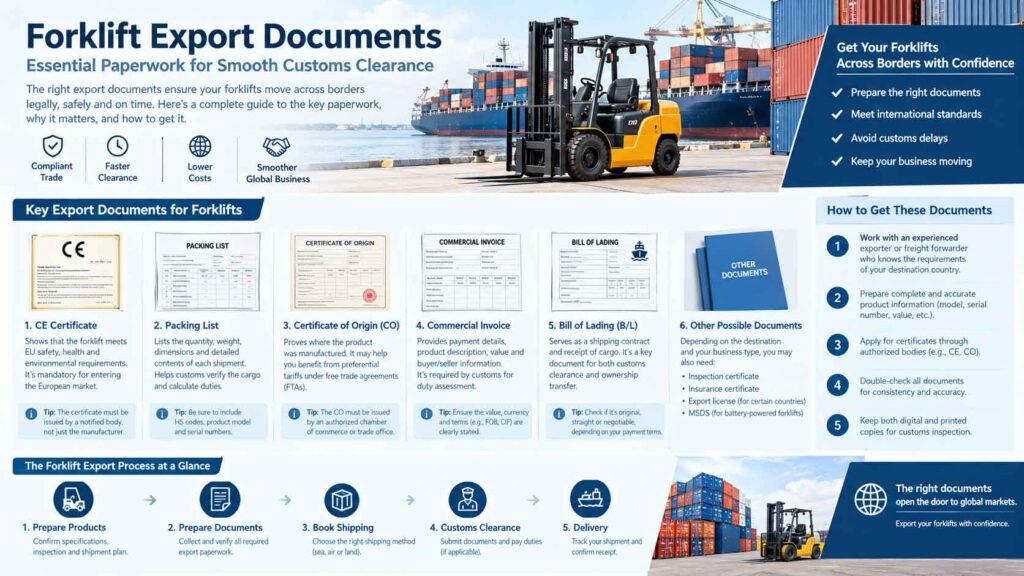
Essential Export Documents for Forklifts
1. CE Certificate (Declaration of Conformity)
What is it?
The CE certificate is a mandatory conformity marking for forklifts exported to the European Union and other countries recognizing EU standards. It certifies that the forklift complies with the EU Machinery Directive (2006/42/EC) or the newer Machinery Regulation (EU 2023/1230 effective from 2027), ensuring health, safety, and environmental protection standards.
- Legally required for forklift imports into the EU.
- Demonstrates compliance with harmonized standards like EN ISO 3691-1 (industrial truck safety).
- Supports faster customs clearance and market acceptance in Europe.
How to obtain it?
Manufacturers must conduct thorough risk assessments, structural and safety tests, and prepare a technical file that includes design documentation, risk analysis, and test reports. In many cases, a notified body may verify compliance before issuing the CE certificate.
- The declaration and operator manuals must be provided in the official language(s) of the importing country.
- CE marking is not a quality mark but a legal declaration of conformity.
2. Packing List
What is it?
The packing list details the contents of the shipment, including the number of packages, gross and net weights, volume, and serial or VIN numbers of each forklift unit.
- Enables customs to verify shipment contents against invoices and bills of lading.
- Helps logistics providers handle and track cargo correctly.
- Prevents customs holds due to discrepancies in shipment details.
- Ensure the packing list matches exactly with the commercial invoice and bill of lading.
- Include detailed descriptions and dimensions to assist freight forwarding and customs inspection.
3. Certificate of Origin (CO)
What is it?
The certificate of origin certifies the country where the forklift was manufactured. It is typically issued by the exporter’s chamber of commerce or customs authority.
- Determines applicable import tariffs and duties.
- Enables eligibility for preferential tariff rates under free trade agreements.
- Acts as proof of origin in trade disputes or customs audits.
How to obtain it?
Exporters must apply for the certificate through their local chamber of commerce or customs office, submitting relevant export documentation and invoices.
Additional Important Export Documents for Forklifts
- Commercial Invoice: Specifies the transaction price, currency, and trade terms (FOB, CIF, etc.). Customs use it to calculate duties and VAT.
- Bill of Lading (B/L): The shipping contract and title document issued by the carrier.
- Compliance Certificates: Depending on the destination, forklifts may require additional certificates such as EPA emission standards for diesel engines or MSDS and UN38.3 certifications for lithium batteries in electric forklifts.
- Technical Documentation: Includes drawings, circuit diagrams, and manuals necessary for customs and regulatory inspections, especially in markets like Germany.
Insights from Industry Leaders and Best Practices
Compliance and Certification
Step-by-Step Checklist for Exporting Forklifts
| Document | Issued By | Purpose |
|---|---|---|
| CE Certificate | Manufacturer / Notified Body | Confirms compliance with EU safety standards |
| Packing List | Exporter / Supplier | Details shipment contents and weights |
| Certificate of Origin | Chamber of Commerce | Proves manufacturing country |
| Commercial Invoice | Exporter / Seller | Declares transaction value for customs |
| Bill of Lading | Carrier / Freight Forwarder | Shipping contract and ownership document |
| Compliance Certificates | Manufacturer / Testing Body | Emission, battery safety, or other local requirements |
| Technical Documentation | Manufacturer | Provides detailed product info for customs and regulatory authorities |
Tips for a Smooth Export Process
- Pre-Audit Compliance: Before ordering, send technical parameters and engine nameplate info to your customs broker to verify emission standards and HS codes compliance.
- Third-Party Inspection: Consider inspections by SGS, Bureau Veritas, or Intertek to validate quality and compliance before shipment.
- Clear Contract Terms: Define payment milestones, inspection rights, and Incoterms in your contract to avoid disputes.
- Language and Manuals: Provide operator manuals and safety instructions in the importing country’s official language(s).
- Battery Safety: For electric forklifts, ensure MSDS and UN38.3 lithium battery transport certifications are included to comply with international transport regulations.