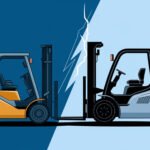
Lithium-ion forklift batteries cost roughly 2-3x more upfront than lead-acid, but typically last 2-4x longer, charge in 1-2 hours instead of 8, and eliminate watering, battery swaps, and dedicated charging rooms. For multi-shift operations, lithium usually wins on total cost of ownership within 2-4 years. For single-shift, low-utilization operations, lead-acid is often still the cheaper and more practical choice. The right answer depends almost entirely on how many hours your forklifts run per day, not on which technology is 'better' in general.
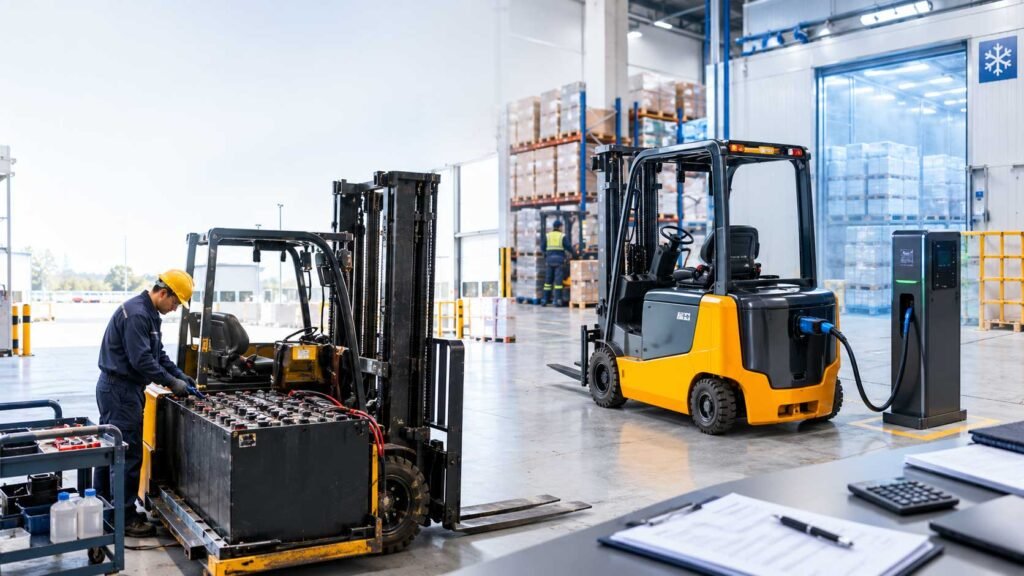
lithium vs lead-acid forklift
Why This Comparison Is Really About Utilization
Most lithium vs lead-acid articles treat this as a technology contest. It's really a utilization question. Lithium's advantages (fast charging, long cycle life, no swapping) only translate into savings if the forklift is running enough hours for those advantages to matter. A forklift used four hours a day on one shift barely stresses a lead-acid battery, so lithium's premium price buys features the operation never needed. A forklift running 16-20 hours a day across multiple shifts is the opposite: lead-acid forces battery swaps, spare batteries, and a charging room, and lithium removes all of that.
Side-by-Side Comparison
| Factor | Lead-Acid | Lithium-Ion (LFP) |
|---|---|---|
| Upfront battery cost | Lower | Roughly 2-3x higher |
| Cycle life | ~1,200-1,500 cycles | ~3,000-5,000+ cycles |
| Typical lifespan | 3-5 years with good care | 8-10 years |
| Charge time | 8 hours (plus ~8 hours cooldown) | 1-2 hours |
| Opportunity charging | Damages battery life | Designed for it |
| Batteries needed per truck (multi-shift) | 2-3 | 1 |
| Daily maintenance | Watering, cleaning, equalizing charges | Essentially none |
| Energy efficiency | ~70-80% | ~95% |
| Power delivery | Fades as charge drops | Consistent until nearly depleted |
| Cold storage performance | Loses capacity | Better, especially with heated options |
| Charging infrastructure | Ventilated battery room required | Charge at the truck |
Specific numbers vary by manufacturer, forklift class, and usage pattern, so treat these as planning ranges and confirm against actual quotes and warranties.
Cost: Look Past the Sticker Price
Lead-acid wins the purchase price comparison every time. But the real cost picture includes everything that surrounds the battery:
Lead-acid hidden costs:
- Spare batteries for multi-shift operation (typically one per shift)
- Battery changing equipment (hoists, rollers, or a dedicated changing station)
- A ventilated charging room, since lead-acid batteries release hydrogen gas while charging
- Labor for watering, cleaning terminals, and equalizing charges
- Labor time for every battery swap, plus the risk of acid spills and injuries during handling
- Higher electricity cost due to lower charging efficiency
Lithium hidden costs:
- Higher upfront cost per battery
- Possible need for compatible chargers or truck modifications
- Ballast weight in some retrofits (covered below)
An Illustrative Two-Shift Example
This is a simplified illustration, not a quote. Real prices vary widely by forklift class, battery capacity, and region.
| Cost Item (10-year view, one forklift, two shifts) | Lead-Acid | Lithium |
|---|---|---|
| Batteries | 2 batteries, replaced once (~4 batteries total) | 1 battery |
| Charger(s) | 1 | 1 |
| Battery room/changing equipment | Required | Not required |
| Watering and maintenance labor | Ongoing | Minimal |
| Swap labor | Ongoing, multiple times daily | None |
In this scenario, the lithium battery's higher purchase price is offset by buying fewer batteries over the decade, plus eliminating swap labor and battery room costs. Run the same math for a single-shift forklift and the result often flips, because lead-acid never needs the spare battery or replacement frequency that makes it expensive in multi-shift use.
Lifespan: Cycles Matter More Than Years
Battery life is best measured in charge cycles, not calendar years, because cycles reflect actual use.
Lead-acid typically delivers around 1,200-1,500 cycles, but only if it's maintained properly: watered regularly, fully charged, and not routinely discharged too deeply. Skipped watering, partial charging, or overheating can shorten its life significantly, meaning real-world lifespan often falls short of the rated figure.
Lithium (specifically lithium iron phosphate, or LFP, the chemistry most commonly used in forklifts) typically delivers 3,000-5,000+ cycles and tolerates partial charging and deep discharge without the same degradation. Many manufacturers back this with warranties of 5-10 years, usually tied to a capacity retention threshold (often 70-80% of original capacity) rather than guaranteeing the battery is 'like new' at the end.
Read lithium warranties carefully. The headline number (such as '10 years') matters less than the conditions: how many operating hours or cycles are covered, what capacity retention counts as acceptable, and whether the warranty is prorated.
Charging: Where the Operational Difference Is Biggest
Lead-acid charging is rigid. A full charge takes about 8 hours, followed by roughly 8 hours of cooling before the battery should be used again. Opportunity charging (topping up during breaks) shortens lead-acid battery life, so multi-shift operations swap in a charged battery instead. That means a battery room, spare batteries, changing equipment, and a person (or time from an operator) to perform each swap.
Lithium charging is flexible. Batteries can be charged in 1-2 hours, require no cooldown period, and are designed for opportunity charging. A truck can plug in during a lunch break or shift change and keep running, with no swapping and no dedicated charging room. For high-throughput operations, this removes a major source of downtime and labor.
Performance and Operating Conditions
Consistent power: Lead-acid voltage drops as the battery discharges, so a forklift can feel noticeably slower late in a shift. Lithium holds consistent voltage until close to depletion, so lift speed and travel speed stay steady throughout.
Cold storage: Lead-acid batteries lose usable capacity in freezer and cold storage environments, reducing run time. Lithium handles cold better, and many models offer heating systems for sub-zero operation, though performance still depends on the specific battery and conditions.
Clean environments: Because lithium batteries are sealed and don't off-gas hydrogen or leak acid, they suit food, pharmaceutical, and other clean-environment operations more easily.
The Compatibility Issue Buyers Often Miss: Battery Weight
In many electric forklifts, the lead-acid battery is also the counterweight. It's heavy on purpose, because it balances the load being lifted. Lithium batteries are much lighter, so a lithium battery fitted into a truck designed for lead-acid may need added ballast to maintain stability and meet the truck's rated capacity.
This is why you should never simply swap a lithium battery into a forklift without confirming compatibility with the manufacturer. Forklifts designed around lithium from the start handle this properly. Retrofits need to verify minimum battery weight, voltage compatibility, battery compartment dimensions, and the effect on the truck's rated load capacity and stability.
Safety Considerations
Lead-acid: Risks include acid spills, hydrogen gas buildup during charging (requiring ventilation), and injuries from manually handling heavy batteries during swaps.
Lithium: Eliminates acid and hydrogen risks, but introduces its own considerations. LFP chemistry is generally considered more thermally stable than other lithium chemistries, and quality batteries include a battery management system (BMS) that monitors temperature, voltage, and current. Still, confirm the battery meets relevant safety certifications for your region (such as UL 2580 in North America), and check whether your insurer or local fire code has specific requirements for lithium battery charging and storage.
When Lead-Acid Still Makes More Sense
- Single-shift operations with moderate daily hours
- Tight capital budgets where the upfront difference matters most
- Short planned ownership of the forklift (the lithium payback may not arrive in time)
- Older forklifts not designed for lithium retrofits
- Facilities with an existing, well-run battery room and trained staff
When Lithium Usually Wins
- Multi-shift or near-continuous operation
- Cold storage and freezer environments
- Operations where battery swap labor and downtime are significant costs
- Facilities that want to repurpose battery room space
- Clean-environment operations (food, pharma) where acid and off-gassing are concerns
- Fleets planning to keep trucks 5-10 years
Questions to Ask Before Buying
- How many hours per day does each forklift actually run?
- Is the truck designed for lithium, or is this a retrofit that needs ballast and compatibility checks?
- What does the warranty cover: years, hours, or cycles, and what capacity retention counts as acceptable?
- Is the charger included, and is it compatible with your electrical setup?
- What safety certifications does the battery hold, and does your insurer have requirements?
- What's the total cost over 5 and 10 years, including spare batteries, labor, and charging infrastructure for lead-acid?
Conclusion
Lithium vs lead-acid isn't a question of which technology is better. It's a question of how hard your forklifts work. Lead-acid remains a sensible, lower-cost choice for light, single-shift use. Lithium earns its premium in demanding, high-utilization operations, where faster charging, longer life, and the removal of battery swapping and maintenance translate into real savings. Calculate total cost over the battery's full life, not just the purchase price, and confirm truck compatibility before committing.