Many warehouses are introducing AGVs (Automated Guided Vehicles) while still operating traditional manual forklifts. Although this hybrid warehouse model appears flexible and cost-effective, it often creates unexpected operational problems.
The biggest challenge is that AGVs and manual forklifts operate very differently.
AGVs prioritize:
- Predictable routes
- Stable traffic flow
- Controlled environments
- Fixed operating logic
Manual forklifts rely on:
- Human judgment
- Flexible movement
- Fast decision-making
- Dynamic route changes
When both systems operate in the same warehouse without proper planning, businesses commonly experience:
- Traffic congestion
- AGV waiting delays
- Safety conflicts
- Reduced efficiency
- Charging bottlenecks
- Route interference
- Workflow instability
In many warehouses, hybrid automation projects fail not because AGVs are ineffective, but because the warehouse was never redesigned for mixed human-machine traffic.
Before introducing AGVs into a manual forklift environment, companies should evaluate traffic flow, aisle design, charging systems, task allocation, and safety protocols.
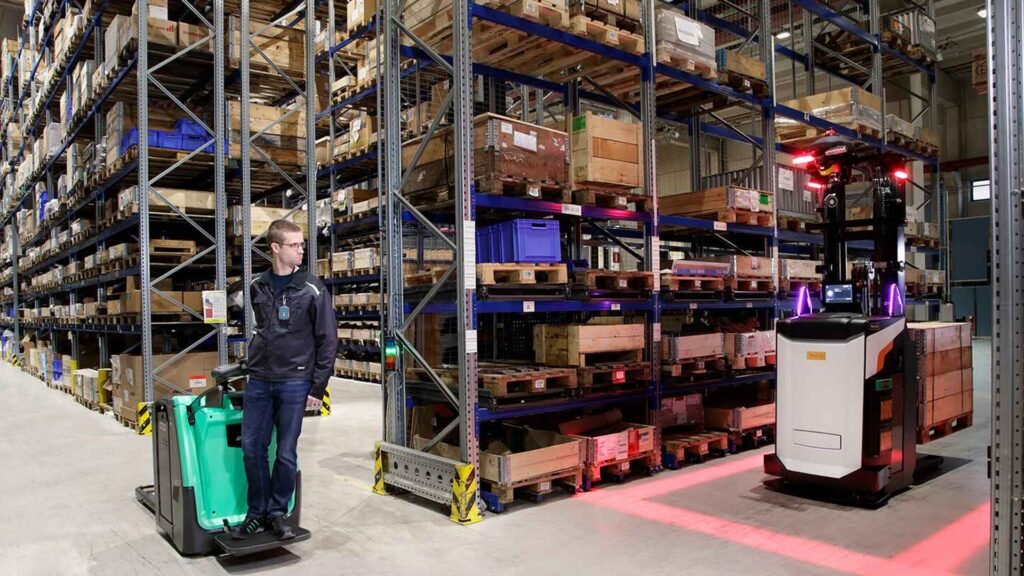
AGV + Manual Forklift Hybrid Warehouse Problems
Why Hybrid AGV Warehouses Are Becoming Common
Most warehouses cannot fully replace manual forklifts immediately.
Instead, many businesses adopt a gradual automation strategy:
- AGVs handle repetitive transport
- Manual forklifts manage complex tasks
- Human operators support exceptions and flexible operations
This hybrid model reduces initial automation investment while improving efficiency in selected areas.
Common examples include:
- AGVs moving pallets between production lines
- Manual forklifts handling truck loading
- AGVs supplying raw materials
- Operators performing high-level stacking
While this approach seems practical, mixed operations introduce major coordination challenges.
AGVs and Manual Forklifts Move at Completely Different Speeds
One of the biggest operational conflicts is travel speed.
Manual forklift operators naturally:
- Accelerate quickly
- Take shortcuts
- Adjust routes dynamically
- React instantly to warehouse changes
AGVs move much more conservatively because they prioritize:
- Safety
- Predictable navigation
- Collision avoidance
As a result:
- AGVs often slow down warehouse traffic
- Manual operators become impatient
- Unsafe overtaking behavior increases
In busy warehouses, human operators may even intentionally bypass AGV routes, creating dangerous traffic conflicts.
Mixed Traffic Creates Safety Problems
AGVs depend heavily on:
- Sensors
- Laser scanners
- Navigation systems
- Predefined safety zones
Manual forklift operators depend on:
- Visual awareness
- Experience
- Human reaction
The problem is that humans and AGVs do not “think” the same way.
For example:
- A human forklift operator may expect another driver to yield
- An AGV simply follows programmed rules
This mismatch can create:
- Sudden stops
- Unexpected blocking
- Near-collision situations
- Confusion at intersections
Safety risks become even worse in:
- Narrow aisles
- Blind corners
- Shared pedestrian areas
- High-traffic loading zones
AGVs Struggle in Dynamic Warehouse Environments
AGVs work best in:
- Stable layouts
- Repetitive workflows
- Predictable routes
But many warehouses constantly change:
- Pallet positions
- Temporary storage zones
- Traffic flow
- Loading schedules
Manual forklifts adapt easily to these changes.
AGVs often cannot.
As a result:
- AGVs stop frequently
- Error alarms increase
- Route recalculation delays occur
- Operators must manually intervene
This reduces the efficiency advantage automation was supposed to provide.
Manual Forklift Operators Often Ignore AGV Logic
Another common problem is operator behavior.
Experienced forklift drivers prioritize speed and productivity.
In hybrid warehouses, operators may:
- Block AGV paths temporarily
- Leave pallets in AGV travel lanes
- Cross AGV routes unpredictably
- Ignore designated automation zones
From the operator’s perspective, these actions may seem harmless.
But for AGVs, even small obstacles can cause:
- Complete route shutdown
- Safety stop activation
- Traffic congestion
One blocked AGV can sometimes affect an entire automated workflow.
AGV Traffic Bottlenecks Reduce Warehouse Efficiency
Many warehouses underestimate how much space AGVs require.
AGVs usually need:
- Wider safety clearance
- Controlled intersections
- Defined travel paths
- Slower movement speeds
When manual forklifts share the same routes:
- Congestion increases rapidly
- Waiting times become unpredictable
- Productivity decreases
Ironically, some hybrid warehouses become slower after partial automation because traffic flow becomes more restricted.
Charging Infrastructure Creates New Problems
Hybrid warehouses often operate:
- Lithium AGVs
- Electric forklifts
- Multiple charging systems
Without proper planning, charging areas become chaotic.
Common issues include:
- Charger shortages
- Peak electricity demand overload
- Shared charging conflicts
- Poor cable management
AGVs also require predictable charging schedules, while manual forklifts are often charged more flexibly.
Balancing these systems becomes difficult in older warehouses.
Warehouse Wi-Fi and Navigation Stability Become Critical
AGVs rely heavily on:
- Stable wireless communication
- Navigation signals
- Fleet management software
Older warehouses may have:
- Weak Wi-Fi coverage
- Signal interference
- Dead zones
- Metal rack reflection problems
Manual forklifts are unaffected by these issues.
AGVs are not.
Poor connectivity can cause:
- Navigation failure
- Sudden stops
- Route errors
- Traffic synchronization problems
Many warehouses underestimate how important digital infrastructure becomes after automation.
Hybrid Warehouses Often Require Complete Layout Redesign
One of the biggest mistakes companies make is trying to insert AGVs into warehouses designed entirely for human forklift traffic.
In reality, successful hybrid automation often requires:
- Dedicated AGV lanes
- Separate pedestrian zones
- New intersection controls
- Charging area redesign
- Modified pallet staging locations
Without layout optimization:
- Traffic conflicts multiply
- Efficiency drops
- Safety risks increase
AGVs are not simply “plug-and-play forklifts.”
They require warehouse infrastructure designed around automation logic.
Task Allocation Is Often Poorly Planned
AGVs are excellent at:
- Repetitive transport
- Long-distance pallet movement
- Fixed-route operations
Manual forklifts are better for:
- Complex loading tasks
- Truck unloading
- Irregular pallet handling
- High-speed response work
Many hybrid warehouses fail because task allocation is unclear.
This creates:
- Duplicate work
- AGV idle time
- Manual operator delays
- Workflow imbalance
Successful hybrid warehouses carefully separate:
- Automated tasks
- Human-controlled tasks
How to Improve AGV + Manual Forklift Operations
Separate Traffic Zones
Whenever possible:
- Create dedicated AGV routes
- Reduce mixed traffic areas
- Minimize intersection conflicts
Use AGVs for Predictable Tasks
Best AGV applications include:
- Repetitive pallet transport
- Fixed production supply
- Long travel routes
Keep Manual Forklifts for Flexible Operations
Manual forklifts remain better for:
- Complex loading
- Outdoor work
- Dynamic warehouse environments
Improve Warehouse Connectivity
Ensure:
- Stable Wi-Fi coverage
- Reliable navigation signals
- Strong fleet management systems
Redesign Warehouse Layouts
Optimize:
- Traffic flow
- Charging zones
- Pallet staging areas
- Safety separation
The Real Problem Is Not the AGV
Many companies believe AGV projects fail because the technology is immature.
In reality, most problems come from:
- Poor warehouse planning
- Mixed traffic conflicts
- Weak infrastructure
- Unrealistic automation expectations
AGVs perform best in warehouses specifically designed around automation principles.
Trying to force AGVs into traditional forklift environments without redesign often creates operational inefficiency instead of improvement.
Conclusion
AGV and manual forklift hybrid warehouses are becoming increasingly common as companies transition toward automation.
However, combining automated vehicles with human-operated forklifts creates major operational challenges, including:
- Traffic congestion
- Safety conflicts
- Navigation instability
- Charging problems
- Workflow inefficiency
Successful hybrid warehouse automation requires more than simply adding AGVs into an existing operation.
Warehouses must redesign traffic flow, infrastructure, task allocation, and safety systems to ensure humans and automation can work together efficiently.