While many people associate Automated Guided Vehicles (AGVs) with massive e-commerce warehouses, their impact on the manufacturing sector is perhaps even more profound. In a factory setting, an AGV isn't just a transport tool; it is a critical component of Smart Manufacturing and Industry 4.0.
In this article, Hebei Maoxiang Technology Co., Ltd. explores the specific role of AGVs in manufacturing, how they differ from warehouse units, and why they are essential for Lean Production.
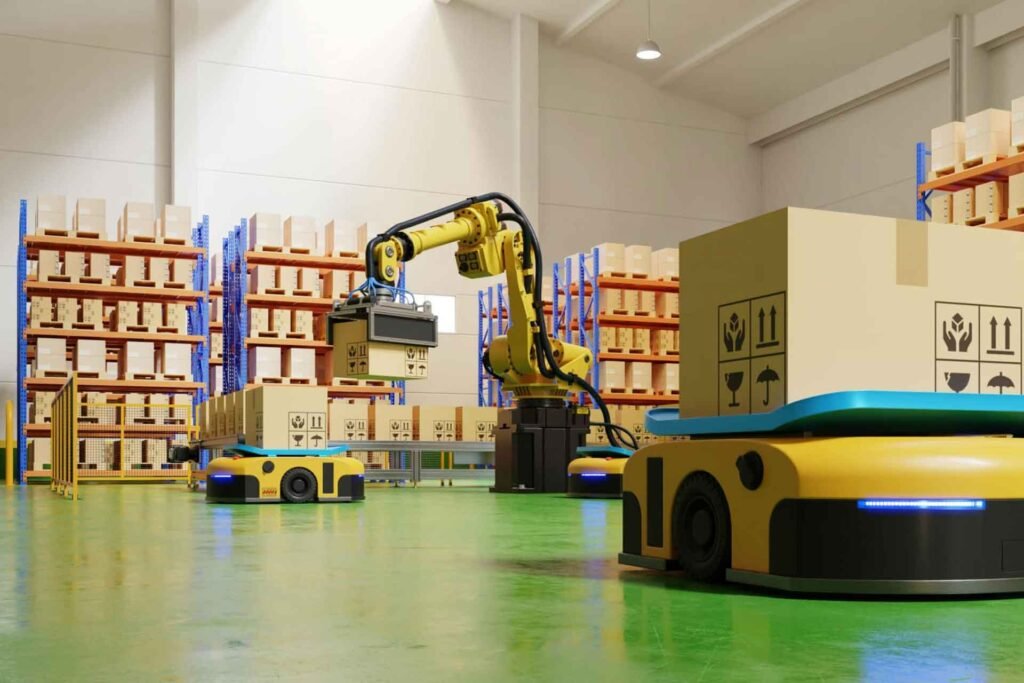
what is agv in manufacturing
1. Beyond Warehousing: The Role of AGVs in Production
In manufacturing, an AGV’s job is to manage the flow of materials between different stages of production. Unlike warehouse AGVs that focus on 'Store and Retrieve,' Manufacturing AGVs focus on 'Process Integration.'
They typically handle three critical movements:
- Raw Material Delivery: Transporting components from storage directly to the assembly line.
- Work-in-Progress (WIP) Movement: Moving a partially finished product (like a car chassis or a large engine block) from one workstation to the next.
- End-of-Line Transport: Taking finished, packaged products from the production area to the shipping dock or high-bay storage.
2. AGV vs. Conveyor Belts: Why Manufacturing is Shifting
For decades, the fixed conveyor belt was the king of the factory floor. However, AGVs are rapidly replacing them due to one word: Flexibility.
- Fixed vs. Agile: A conveyor belt is permanent. If you want to change your production layout, you have to tear it down. An AGV’s path can be reprogrammed in minutes.
- Floor Space: AGVs leave floor space open for foot traffic and other machinery when they aren't in use, whereas conveyors create permanent barriers.
- Scalability: If production demand increases, you can simply add another AGV to the fleet. You can't easily 'add' capacity to a fixed belt.
3. How AGVs Support 'Just-in-Time' (JIT) Manufacturing
The core of Lean Manufacturing is reducing waste and inventory. AGVs are the perfect tool for Just-in-Time (JIT) delivery.
By integrating the AGV’s software with your Manufacturing Execution System (MES), the vehicle knows exactly when a workstation is running low on parts. It arrives with the necessary components just as they are needed—preventing bottlenecks and eliminating the need for large piles of inventory sitting on the factory floor.
4. Specific AGV Types for the Manufacturing Floor
Manufacturing environments often require more specialized vehicles than warehouses:
- Towing AGVs (Tuggers): These pull a 'train' of carts loaded with various parts, making multiple stops along an assembly line.
- Heavy-Load AGVs: Designed to carry massive loads (sometimes up to 50+ tons) like aircraft wings or industrial transformers.
- Assembly AGVs: These actually act as a 'moving workbench.' The product is built directly on top of the AGV as it moves slowly through different assembly stations.
5. Why Choose Hebei Maoxiang Technology for Industrial Lifting?
At Hebei Maoxiang Technology Co., Ltd., we understand that manufacturing environments are demanding. Whether you are using manual forklifts, electric stackers, or preparing for full automation, your equipment must be robust and reliable.
Our products are engineered to provide the foundation for industrial efficiency:
- High-Precision Handling: Essential for the tight tolerances of a factory floor.
- Durability: Built to withstand 24/7 multi-shift production cycles.
- Export Expertise: Supporting global manufacturers with reliable machinery that meets international safety standards.
Conclusion: The Future of the Factory Floor
What is AGV in manufacturing? It is the pulse of the modern factory. By automating the movement of goods between processes, manufacturers can reduce human error, enhance worker safety, and achieve a level of operational 'flow' that was previously impossible.
Optimize Your Production Flow Today
Whether you are starting with high-quality manual stackers or looking to integrate advanced automated solutions, Hebei Maoxiang Technology is your technical partner.
Contact our export team today to explore our full range of lifting and material handling solutions tailored for the manufacturing industry.