The Numbers First
| Statistic | Value |
|---|---|
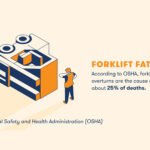
| Forklift fatalities per year (US) | 85–100 |
| Serious injuries per year | ~35,000 |
| Annual OSHA citations related to forklifts | 5,000+ |
| Average fine per serious violation | $16,000+ |
| Most common cited standard | 29 CFR 1910.178 (Powered Industrial Trucks) |
The interesting part: most citations aren't for spectacular failures. They're for paperwork, training records, and maintenance logs — the boring stuff. The boring stuff is where inspectors look first, because it's where companies fail most.
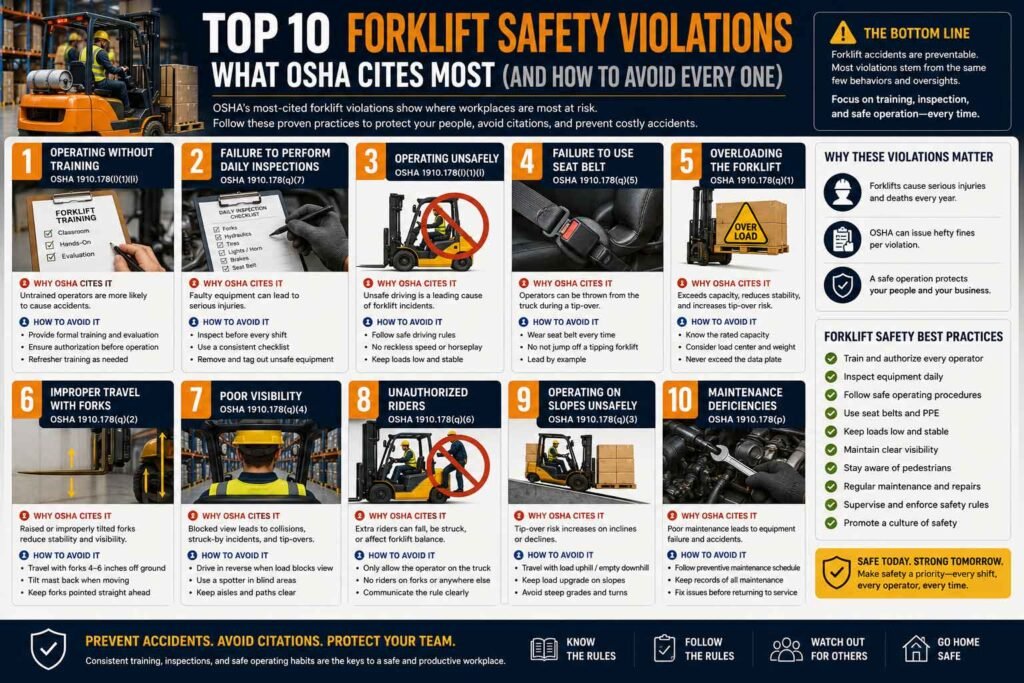
Top 10 Forklift Safety Violations
Violation #1 — Inadequate Operator Training
The citation: Operators not trained and certified per 29 CFR 1910.178(l). No certification records. Training done once, years ago, never refreshed.
Why it's #1: It's the easiest violation to prove — the inspector just asks to see training records. If you can't produce a certification file for every operator, you're cited.
The fine: $16,000+ per uncertified operator.
How to fix:
- Every operator has a written certification record: training date, trainer name, evaluation score
- Refresher training every 3 years
- Immediate retraining after any accident, near-miss, or observed unsafe operation
- Training must be classroom + hands-on evaluation — a video alone doesn't count
Violation #2 — No Written PPE / Safety Program
The citation: No written hazard assessment or PPE program (29 CFR 1910.132).
Why it's cited: Inspectors expect documentation of a hazard assessment — what hazards exist, what PPE is required, who gets it, and training on when to use it.
How to fix:
- Written hazard assessment for the forklift operation area
- PPE policy in writing: safety shoes, high-visibility vests, gloves (and hard hats where falling-object risk exists)
- Training records showing operators were instructed on PPE use
- PPE available and enforced on the floor — not just written on paper
Violation #3 — Daily Inspection Not Documented
The citation: No pre-start inspection records (29 CFR 1910.178(q)(7)).
Why it's cited: The standard requires the forklift to be examined before each shift. Inspectors ask to see the inspection logs — blank or missing logs are an instant citation.
How to fix:
- Pre-start inspection checklist for every truck, every shift
- Operator signs and dates the log daily
- Logs kept for at least 1 year
- Defects found → truck tagged 'Out of Service' and repaired before return to service
Violation #4 — Operating Defective Equipment
The citation: Forklifts with inoperative safety devices — horn, lights, brakes, backup alarm, OPS, seat belts (29 CFR 1910.178(q)(7) and (p)).
Why it's cited: An inspector walking the floor will test: horn, backup alarm, lights, brakes, seat belt. A broken horn on one truck is a citation for the whole facility.
How to fix:
- Daily pre-start inspection catches these — enforce it
- Any defect = out-of-service tag immediately
- Repair before return to service — no 'we'll fix it Friday'
- Monthly documented checks of all safety devices
Violation #5 — No Seat Belt Enforcement
The citation: Operators not wearing seat belts (29 CFR 1910.178(m)(3)).
Why it's cited: Seat belts are the #1 preventable fatality prevention device — tip-overs kill operators who don't wear them. Inspectors watch, and they also check whether your policy requires and enforces belts.
How to fix:
- Written policy: seat belt mandatory, no exceptions
- Enforcement: supervisors spot-check, disciplinary action for violations
- OPS systems (belt-interlock) on new trucks — the truck won't operate without the belt
Violation #6 — Pedestrian Hazards Not Controlled
The citation: No separation of pedestrians and forklift traffic (general duty clause + 1910.178).
Why it's cited: After training, this is the most common operational citation. Warehouses that let forklifts and pedestrians share aisles without marked walkways, mirrors, horns at corners, or speed limits get cited.
How to fix:
- Marked pedestrian walkways, clearly painted and maintained
- Mirrors at blind corners and intersections
- Speed limit signs posted and enforced
- Horn-at-blind-corner policy
- Where possible, physical separation (gates, barriers, one-way aisles)
Violation #7 — Forklift Exceeding Rated Capacity
The citation: Operation with loads exceeding the data plate capacity (29 CFR 1910.178(o)).
Why it's cited: Inspectors check the data plate and compare to the loads in the facility. They also look for modified trucks (added counterweights, bigger attachments) without re-rating.
How to fix:
- Data plates present, legible, and matching the truck's actual configuration
- Attachments re-rated — the data plate must reflect reduced capacity with attachments
- Load weights verified before lifting
- Operators trained on load center math
Violation #8 — No Refueling / Charging Compliance
The citation: Unsafe battery charging or fuel handling — charging in unventilated areas, smoking near charging, no acid spill kit, no eyewash (29 CFR 1910.178(g)).
Why it's cited: Lead-acid charging rooms are a documented fire and chemical hazard. Inspectors check: ventilation, eyewash, spill containment, 'no smoking' signs, and proper PPE.
How to fix:
- Charging area: ventilated, marked, no-smoking signage
- Eyewash station within the charging area
- Acid spill kit available
- Operators trained on battery handling
- Lithium conversion removes most of this — no gas, no acid, no battery room
Violation #9 — Blocked Exits and Fire Lanes
The citation: Aisles, exits, and fire lanes blocked by pallets, equipment, or parked forklifts (29 CFR 1910.37).
Why it's cited: This is a walk-around citation — inspectors see it in 30 seconds. Parked forklifts in aisles, pallets stacked in fire lanes, exits blocked by staging.
How to fix:
- Designated parking areas for forklifts — forks down, brake on, key out
- Clear painted fire lanes and exit paths
- Staging areas defined — not 'wherever there's space'
- Monthly walk-through with a checklist for clear paths
Violation #10 — No Inspection / Maintenance Records
The citation: No maintenance records, no inspection documentation, no repair history (1910.178(q)).
Why it's cited: This is the umbrella violation — if you have no records, the inspector assumes the worst and cites everything.
How to fix:
- Maintenance log per truck: date, hours, work performed, parts replaced
- Inspection records retained 1+ year
- Scheduled maintenance calendar (500-hour, 1,000-hour, annual)
- Repair records tied to the truck's serial number
The Checklist — Get Compliant in One Day
| # | Action | Who | Done |
|---|---|---|---|
| 1 | Certification files for every operator — current, signed, dated | HR / Safety | ☐ |
| 2 | Written hazard assessment + PPE policy | Safety | ☐ |
| 3 | Daily inspection logs — every truck, every shift, kept 1 year | Operators | ☐ |
| 4 | Safety devices test — horn, alarm, lights, brakes, belt, OPS on every truck | Mechanic | ☐ |
| 5 | Seat belt policy written + enforced | Supervisor | ☐ |
| 6 | Pedestrian walkways marked, mirrors at corners, speed limits posted | Facilities | ☐ |
| 7 | Data plates verified — legible, matching configuration, attachments re-rated | Mechanic | ☐ |
| 8 | Charging area: ventilation, eyewash, spill kit, no-smoking signs | Facilities | ☐ |
| 9 | Aisles/exits/fire lanes clear, designated parking spots | Facilities | ☐ |
| 10 | Maintenance log per truck — started today, kept forever | Mechanic | ☐ |
The Bottom Line
Every one of the top 10 forklift violations is preventable with documentation and enforcement. OSHA isn't looking for perfect operations — it's looking for proof that you're trying: training records, inspection logs, maintenance files, written policies.
The pattern of every cited facility is the same: the rules existed informally, nobody wrote them down, and one inspector visit turned informality into $50,000–$100,000 in fines.
Write it down. Enforce it. Log it. That's the entire compliance program.
About the Author
Edward handles export sales at Hebei Maoxiang Technology, helping international buyers with forklift pricing, configuration, shipping, and export documentation. He has helped customers in 80+ countries get the right machines — including models that come with OPS, FOPS-rated guards, and backup alarms as standard, so compliance starts at the factory.
Hebei Maoxiang Technology Co., Ltd.
- Web: forkliftlift.com
- Email: sales@maoxiang-tech.com
- Electric forklifts | Diesel forklifts | Reach trucks | Pallet jacks | Rough terrain | Telehandlers
- FOB Tianjin | CE certified | 20–35 day lead | 24/7 quote support