Quick Answer
OSHA's forklift standard — 29 CFR 1910.178 — governs how every U.S. employer must train, certify, inspect, and document powered industrial truck operations. There is no government-issued forklift license. Instead, OSHA places the entire burden of certification, evaluation, and recordkeeping on the employer. Miss a documentation requirement, and a fully competent operator can be legally uncertified — which is exactly why forklift training violations remain one of OSHA's most frequently cited categories year after year.
This guide breaks down what the standard actually requires, where employers most often get it wrong, and what non-compliance costs in 2026.
OSHA Forklift Requirements
Why This Isn't a 'Best Practice' — It's the Law
A lot of forklift safety content online blurs the line between 'recommended' and 'required.' That distinction matters, because OSHA inspectors don't cite you for skipping a nice-to-have — they cite you for violating a specific subsection of 1910.178, and each violation carries a specific dollar penalty.
Here's the core fact most operations don't fully internalize: there is no national forklift license. OSHA doesn't certify individual operators — it requires employers to run their own certification process, keep it documented, and be able to produce that documentation on demand. An operator who's been running a forklift safely for ten years with no paperwork to prove it is, from OSHA's perspective, uncertified.
Operator Training and Certification (29 CFR 1910.178(l))
This subsection generates more citations than any other part of the forklift standard, and it has three components that must all be present before certification legally exists:
- Formal instruction — classroom or online training covering truck operation, workplace-specific hazards, and load handling principles
- Practical training — hands-on demonstrations and exercises under the trainer's supervision
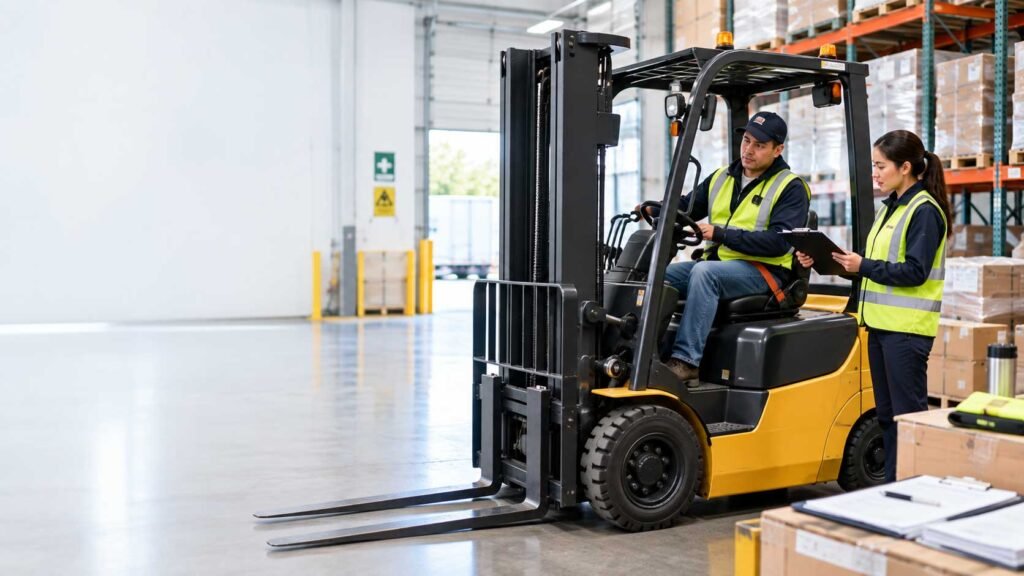
- Workplace performance evaluation — the operator demonstrating competence on the actual equipment, in the actual work environment, they'll be operating in
Skip any one of the three, and the certification isn't valid — even if the operator completed the other two.
The Detail Almost Everyone Gets Wrong: Evaluation vs. Refresher Training
This is worth its own section because so much content online conflates these two requirements:
Performance evaluation has a fixed clock. OSHA requires each operator's performance to be evaluated at least once every three years. This is a calendar requirement — it happens regardless of how the operator has been performing.
Refresher training does not have a fixed clock. It's triggered by specific events, not a calendar date. Refresher training is required when:
- The operator has been observed operating the vehicle in an unsafe manner
- The operator has been involved in an accident or near-miss incident
- An evaluation reveals the operator isn't operating safely
- The operator is assigned to a different type of truck
- Workplace conditions change in a way that could affect safe operation
The practical mistake this causes: employers treat 'three years' as the refresher cycle and stop there, assuming that if nothing has gone wrong, nothing needs to happen until the three-year mark. That's incomplete. The three-year clock applies to evaluation. Refresher training can be required at any point in between if one of the five triggers above occurs — and failing to provide it when triggered is a separate, citable violation from failing to re-evaluate on schedule.
What Certification Records Must Include
Under 1910.178(l)(6), the employer must maintain a record for each operator containing:
- Operator's name
- Date of training
- Date of evaluation
- Identity of the person who conducted the training and evaluation
OSHA doesn't specify a trainer credential or certification body — the standard only requires that the trainer have the knowledge, training, and experience to train operators and evaluate their competence. Most employers handle this through a train-the-trainer program for internal staff rather than outsourcing to a third-party certifying body, since none is legally required.
Daily Pre-Shift Inspection (29 CFR 1910.178(q))
This is not a 'best practice' — it's a standing requirement. Every powered industrial truck must be inspected before use in each shift it operates. If the inspection reveals a defect affecting safe operation, the truck must be removed from service immediately and repaired only by authorized personnel using manufacturer-approved parts.
The compliance gap here is usually cultural, not procedural: many operations have an inspection checklist, but no consistent system for confirming it was actually completed before the shift started, or for tracking what happens when a defect is found. A checklist that exists but isn't verifiably used doesn't hold up during an inspection any better than no checklist at all.
Attachment Capacity Plates: A Requirement That Gets Overlooked
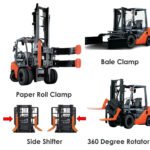
When a forklift is fitted with an attachment — a clamp, boom, or fork extension — the truck's rated capacity changes, and the law requires this to be reflected on an updated capacity plate, jointly specified by the forklift and attachment manufacturers. This requirement is easy to miss because it doesn't come up in general forklift training; it only becomes relevant once an attachment is installed. If you're evaluating an attachment purchase, see our complete guide to forklift boom attachments for how this de-rating actually works and what the plate needs to show.
Recordkeeping: What OSHA Requires vs. What's Actually Smart
Here's a detail worth being precise about: OSHA does not specify a fixed retention period for forklift training records. This surprises a lot of compliance officers who assume there's a hard number.
In practice, this doesn't mean retention doesn't matter — it means the guidance comes from elsewhere:
- Industry best practice generally recommends retaining records for a minimum of 3–5 years
- Many legal advisors recommend retaining an operator's certification records for the full duration of their employment, since a records gap discovered during an incident investigation is far more costly than the minor administrative burden of holding onto the paperwork
The practical approach: don't rely on OSHA's silence on this point as a reason to purge records early. Build a retention policy based on the more conservative legal guidance, not the regulatory minimum that doesn't actually exist.
What Non-Compliance Actually Costs in 2026
Penalty amounts are adjusted annually for inflation. As of January 15, 2026:
| Violation Type | Maximum Penalty |
|---|---|
| Serious violation | $16,550 per violation |
| Willful or repeated violation | $165,514 per violation |
A few details that change how this number hits in practice:
Each untrained operator is a separate violation. Five operators without documented training isn't one violation — it's five, which can push total exposure well past $80,000 before any other factor is considered.
Penalties are negotiable, within limits. Reductions of roughly 10–60% are available based on employer size, good faith, and inspection history — but this negotiation room doesn't apply to willful violations, which is where the largest exposure sits.
The two most-cited failure points remain constant year over year: operators without documented initial training, and refresher training not provided after one of the five trigger events. Both are documentation failures before they're safety failures — which is exactly why they're also the easiest to prevent with a functioning tracking system, and the easiest to get cited for without one.
Common Compliance Mistakes Worth Fixing Now
Treating three years as a fixed refresher cycle. As covered above, three years is the evaluation clock, not a blanket refresher schedule. An operator can need refresher training in month two of a three-year cycle if a trigger event occurs.
Waiting until an evaluation is due to schedule it. This routinely results in a gap where an operator is technically past their evaluation window and therefore uncertified — a completely avoidable, purely administrative violation.
Assuming experience substitutes for documented certification. OSHA does not recognize years of informal experience as equivalent to a documented training, instruction, and evaluation record. An operator with a decade of safe operation and no paperwork is not certified in the eyes of an inspector.
Not updating training when equipment changes. An operator certified on a Class I counterbalance truck is not automatically certified to operate a Class VII rough terrain unit. Each distinct truck type the operator will use requires its own training and evaluation record.
A Practical Self-Check
Before your next internal review, confirm:
- Every current operator has a complete certification record: name, training date, evaluation date, and trainer identity
- No operator's evaluation is older than three years
- You have a documented process for triggering refresher training after any of the five trigger events — not just a calendar reminder for the three-year mark
- Pre-shift inspections are being completed and logged, not just theoretically required
- Any attachment-equipped forklift in your fleet carries an updated, attachment-specific capacity plate
- Your record retention policy extends beyond OSHA's silence on the topic, following the more conservative industry guidance
Where This Fits Into Your Broader Fleet Strategy
Compliance documentation isn't just an internal safety matter — for operations that export, work with international clients, or go through supplier audits, equipment certification (CE marking, ISO-compliant manufacturing) and operator compliance records are often reviewed together as part of the same due diligence process.
At Hebei Maoxiang Technology Co., Ltd., our CE-certified electric forklifts come with the manufacturing and compliance documentation that international buyers typically need to fold into their own operational compliance file — one less gap to track down when your equipment paperwork and your training paperwork both need to hold up under the same audit.