The E-commerce Part (The Obvious One)
E-commerce grew from 10% of US retail in 2019 to 16% in 2025. Every percentage point shift from brick-and-mortar to online adds roughly 100 million square feet of warehouse demand. Why?
- Brick-and-mortar retail: One store serves walk-in customers. Inventory turns 12–20× per year. Products are on shelves, not in boxes.
- E-commerce: One warehouse serves a city or region. Inventory turns 4–8× per year (because you need size/color/style depth). Every item needs its own pickable location. Returns come back and need to be processed separately.
A $100 million retail business needs about 30,000 ft² of retail space and 5,000 ft² of backroom storage. A $100 million e-commerce business needs 80,000–120,000 ft² of warehouse space. The same revenue requires 3–4× more warehouse square footage.
That alone explains a lot. But it doesn't explain the speed of warehouse construction since 2021. E-commerce grew gradually. Warehouse construction spiked.
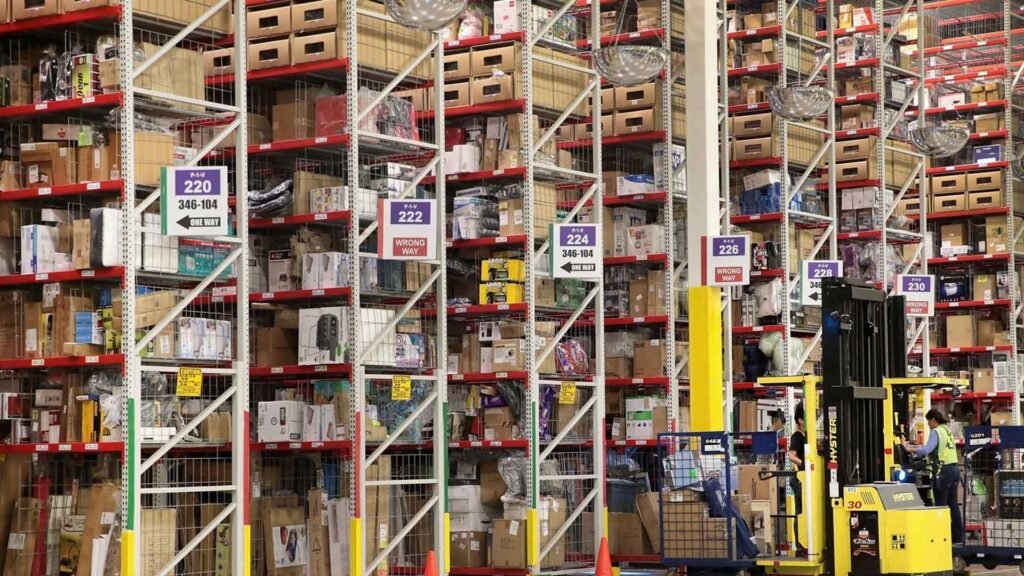
Why Are So Many Warehouses Being Built
The Inventory-to-Sales Flip (The Part Nobody Talks About)
Before 2020, US businesses ran on just-in-time (JIT) inventory. The formula was simple: carry as little inventory as possible, because holding costs (space, insurance, obsolescence) ate into margins. Inventory-to-sales ratio for US wholesalers sat at 1.20–1.30 for years.
COVID broke that.
When supply chains froze in 2020, companies that ran lean ran out of product in 6 weeks. The ones that survived had inventory sitting in warehouses. After COVID, the corporate risk calculus changed:
| Before 2020 | After 2020 | |
|---|---|---|
| Inventory philosophy | Just-in-time | Just-in-case |
| Inventory-to-sales ratio | 1.25 | 1.45–1.50 |
| Weeks of stock on hand | 4–5 weeks | 6–8 weeks |
| Warehouses per $1B revenue | 3–4 | 5–7 |
What that means in real terms: A $500 million wholesale distributor carried $156 million in inventory pre-2020. Now they carry $180 million. That extra $24 million in inventory needs shelf space, handling equipment, and a building around it.
That shift from 1.25 to 1.50 doesn't sound dramatic. But applied across the entire US wholesale and retail sector, it represents roughly 400 million square feet of additional warehouse demand — equivalent to building 80 million-square-foot warehouses. This is structural demand. It's not going back to 1.25. Boards of directors saw what happens when you run lean and decided they'd rather carry inventory than risk losing customers.
Nearshoring
China's share of US manufacturing imports dropped from 22% in 2018 to 16% in 2025. Companies moved production to Mexico, Vietnam, India, and Eastern Europe.
Nearshoring creates a new warehouse problem: when goods came from China, you ordered in 90-day batches and shipped directly to a national distribution center. Now, with manufacturing in Mexico or Eastern Europe, lead times are 2–4 weeks instead of 8–12. That means more frequent, smaller shipments — which requires regional warehouses to receive and redistribute rather than one big national DC.
The number of regional warehouses per company has roughly doubled since 2019. A company that used to have one 500,000 ft² DC in Memphis now has three 200,000 ft² warehouses in Dallas, Atlanta, and Columbus. Same total square footage, but three buildings instead of one. That means more construction per dollar of inventory.
The 3PL Explosion
Third-party logistics (3PL) providers now operate 25–30% of US warehouse space, up from 15% in 2015. Why does this matter? 3PLs don't build one warehouse per client. They build one warehouse and pack it with multiple clients — which means they need inventory buffers for demand spikes, seasonal swings, and client churn.
A 3PL warehouse typically runs at 75–85% utilization (versus 85–95% for a dedicated DC). That margin sounds small, but it means 3PLs need about 15–25% more space per unit of throughput than a dedicated operator. If 3PLs run 30% of the warehouse market and they're 20% less space-efficient, that's another 50–80 million square feet of demand.
The Geographic Story
Not all warehouses are being built in the same places. Here's where the construction is going:
1. Inland Empire, California — Still the #1 warehouse market in the US. Serves Los Angeles port traffic moving inland. Rents hit $15–$18/ft². Vacancy rates under 3%. The problem: no land left. Developers are tearing down mid-century strip malls for warehouse space.
2. Dallas-Fort Worth — The fastest-growing warehouse market in the US. Central location, cheap land ($5–$8/ft²), interstate hub, no state income tax attracting corporate relocations. Over 50 million ft² under construction in 2025.
3. Atlanta / Savannah — Savannah is the fastest-growing US port. Warehouses are being built 150 miles inland in Atlanta because there's no available land within 30 miles of the port.
4. Columbus, Ohio — Became the 'Golden Triangle' of logistics (interstates 70, 71, and 75). One-day trucking to 60% of the US population. Warehouse construction doubled between 2021 and 2025.
5. Mexico border cities — Laredo, El Paso, San Diego. Nearshoring created a boom in cross-dock warehouses. Laredo alone added 15 million ft² of warehouse space since 2022.
What This Means for Equipment Demand
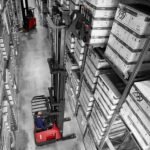
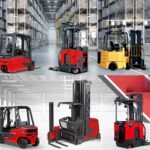
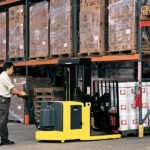
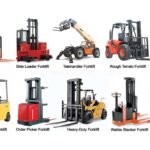
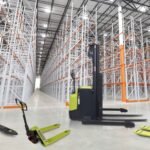
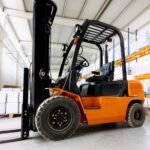
More warehouses means more forklifts. Every 100,000 ft² of new warehouse space needs roughly:
| Equipment | Quantity |
|---|---|
| Electric stand-up forklifts (1–2 ton) | 8–15 |
| Electric pallet jacks | 15–30 |
| Reach trucks | 4–8 |
| Hand pallet jacks | 20–40 |
| Dock levelers / dock equipment | 8–15 sets |
That's over 2 billion square feet of building globally. Even if only half of that comes online, it means hundreds of thousands of new forklifts, pallet jacks, and warehouse trucks sold into new buildings — not replacement demand, pure new demand.
The Inconvenient Truth: Empty Warehouses Are Also Rising
Here's what warehouse developers don't want you to read: vacancy rates in some markets are rising. The Inland Empire hit near-zero vacancy in 2022 — it's back to 4–5% now. Atlanta ticked up from 3% to 6%. The reason is simple: everyone started building at the same time, and demand takes longer to fill space than to build it.
But structural demand (e-commerce growth + inventory-to-sales shift + nearshoring) still supports 200–300 million ft² of net absorption per year in the US. The construction spike may slow, but warehouse demand is not going down. It's stabilizing at a new, higher baseline.
The Bottom Line
Warehouses are being built because:
- E-commerce needs 3–4× more warehouse space per dollar of revenue than retail
- Inventory-to-sales ratio permanently shifted from just-in-time to just-in-case — that's 400 million ft² of structural demand
- Nearshoring replaced long supply chains with shorter, more distributed ones — more regional warehouses per company
- 3PL growth means more space per unit of throughput
- Port congestion drove a permanent regionalization of inventory — companies won't go back to single-DC models
This isn't a bubble. It's a structural shift. The warehouse construction boom is the physical manifestation of the global supply chain rewriting itself. It will slow when supply catches up to demand, but the baseline is permanently higher than it was in 2019.
We build electric forklifts, stand-up warehouse trucks, pallet jacks, and AGVs for the warehouses going up right now. If you're outfitting a new facility, contact us for factory-direct pricing and spec sheets.
Hebei Maoxiang Technology Co., Ltd.
- forkliftlift.com
- Electric forklifts | Pallet jacks | Reach trucks | AGVs
- FOB Tianjin | 20–35 day lead | CE certified