The Problem with 'Smart Warehouse' Marketing
Every technology vendor tells you their system is the center of the smart warehouse. The WMS vendor says it's the WMS. The AGV vendor says it's the AGV. The sensor company says it's IoT. The AI platform says it's the AI.
None of them is lying. They're all right, from their own angle. But a warehouse that buys one of these in isolation isn't smart — it's just a warehouse with an expensive gadget.
A smart warehouse has three technology layers working together. If you skip one, the other two deliver half the value.
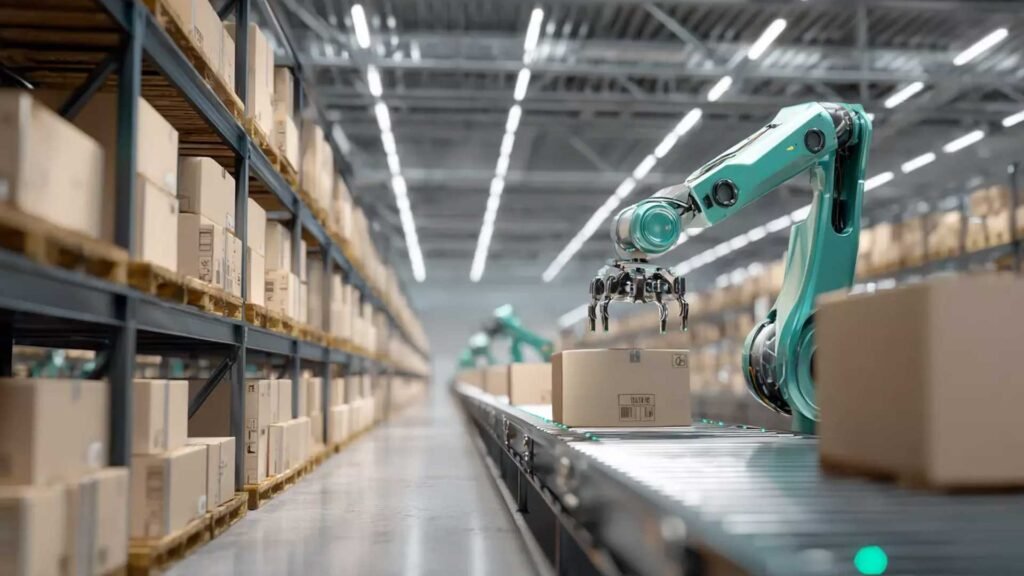
smart warehouse technologies
Layer 1: Sensing Technologies — Seeing Everything in Real Time
Before you optimize movement, you need to know where everything is. This is the cheapest layer with the fastest payback, and most warehouses skip it.
Barcode Scanning on Forklifts
The single highest-ROI technology in any warehouse. Mount a rugged scanner on each forklift, connect it to the WMS. Every time the operator picks up or drops a pallet, they scan the location barcode and the pallet label.
Cost: $200–$800 per scanner + mounting kit Payback: 3–6 months What it fixes: Lost inventory, mis-picks, cycle count errors. Most warehouses that adopt this cut inventory discrepancies from 5–8% to under 1% in the first quarter.
Hardware options: Honeywell CK65, Zebra TC53, or rugged vehicle-mount terminals with wired scanners. Don't buy consumer-grade scanners — they break in 4 months on a forklift.
RFID at Dock Doors and Gate Points
Passive UHF RFID readers at receiving and shipping doors. Pallets with RFID tags pass through the door and the system automatically confirms receipt or shipment without anyone scanning.
Cost: $2,000–$5,000 per door (reader + antenna + controller) + $0.10–$0.20 per tag What it fixes: Manual check-in/check-out, data entry errors, receiving delays. Automates the dock worker's clipboard. Limitation: Doesn't work well on metal pallets or pallets wrapped in metalized stretch film. Test on your actual pallet type before buying.
UWB / RTLS Asset Tracking
Ultra-wideband tags on forklifts, pallet jacks, and high-value assets. Ceiling anchors triangulate position to ±30 cm.
Cost: $15,000–$50,000 for a 10,000 m² warehouse (anchors + tags + software) What it fixes: Finding equipment. 'Where's the reach truck?' becomes a screen lookup, not a 10-minute walk. Also enables geofencing (forklift slows down near pedestrian zones). Vendors: Sewio, Ubisense, Decawave-based systems.
Weight Sensors on Forklift Forks
Load cells in the fork carriage or pinned between the mast and carriage. Measures actual load weight at pickup — no need to drive to a floor scale.
Cost: $800–$2,000 per forklift retrofit What it fixes: Overloading, load verification at pickup, automatic weight capture for shipping docs. Also catches mis-picks (weight doesn't match expected product).
Layer 2: Software Technologies — Deciding What Should Happen
Sensors give you data. Software decides what to do with it.
WMS (Warehouse Management System)
The foundation. Without a WMS, nothing else matters. The WMS tracks inventory location, manages put-away logic, and issues pick tasks. It's the brain.
| Type | Example | Best For |
|---|---|---|
| Cloud WMS | Extend, SnapFulfill | Small to mid-size, fast deploy, monthly subscription |
| On-prem WMS | Korber, Manhattan, Blue Yonder | Large operations, heavy customization, high throughput |
| Free / Open Source | Odoo, Dolibarr | Micro-warehouses, sub-5,000 SKUs |
What to look for: Task interleaving (combining put-away and pick in one route), real-time inventory visibility (not batch-updated), integration API (connects to your ERP and shipping systems).
What to avoid: Any WMS that requires you to restructure your warehouse to fit its logic. The WMS should adapt to your process, not the reverse.
WES (Warehouse Execution System)
A newer layer that sits between the WMS and the equipment. The WMS says 'pick pallet A'. The WES decides which forklift should do it, what route to take, and whether to combine it with another task on the way.
When you need it: When you have 5+ forklifts or AGVs operating simultaneously and task assignment needs real-time optimization. Skip it for small operations — task interleaving in the WMS is enough.
Slotting Optimization Software
Analyzes pick frequency per SKU and recommends where each product should live. Fast movers near the dock. Slow movers on top rack. Bulky items in floor stack.
Cost: $5,000–$20,000 one-time or built into advanced WMS modules Payback: 2–4 months — a good slotting re-org reduces travel distance 15–25% without buying any equipment.
Layer 3: Movement Technologies — Executing the Move
This is what most people think of when they hear 'smart warehouse.' It's also the most expensive layer and the easiest to get wrong.
AGVs (Automated Guided Vehicles)
Follow fixed magnetic tape or wire paths. Good for predictable, repetitive routes. Cheap but rigid — change the route, change the tape.
Cost: $30,000–$70,000 per unit Best for: Dock-to-staging transfer, cross-dock operations, shuttle between two fixed points Limitation: Can't adapt to dynamic obstacles. If a pallet falls in the path, the AGV stops and waits for help.
AMRs (Autonomous Mobile Robots)
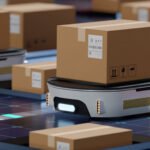
Navigate by LiDAR and cameras — no fixed path. If an obstacle blocks the route, the AMR finds a new one. More expensive but more flexible.
Cost: $50,000–$120,000 per unit Best for: Multi-route environments where traffic patterns change. Warehouses that redeploy equipment between zones. Vendors: MiR, Geek+, Locus, OTTO Motors
Automated Forklifts
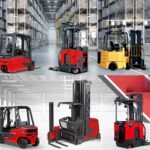
Full counterbalance or reach truck that drives and lifts autonomously. Purpose-built (like Linde's automated truck) or retrofit (add autonomy kit to a standard forklift).
Cost: $60,000–$150,000 per unit Best for: Pallet moves that require lifting — AGVs and AMRs typically handle flat transport only. Automated reach trucks in high-bay warehouses.
Conveyor and Sortation
Overhead or in-floor conveyor systems for high-volume carton / tote movement. Often paired with automated storage and retrieval systems (AS/RS).
Cost: $500,000–$3,000,000+ for a full system Best for: Warehouses moving 10,000+ cartons per day. E-commerce fulfillment centers. Not cost-effective for low-volume or mixed-SKU operations.
Goods-to-Person (G2P) Systems
Automated storage (vertical lift modules, shuttles, mini-load AS/RS) that bring the product to the picker instead of the picker walking to the product.
Cost: $150,000–$500,000 per workstation cluster Best for: Small parts / high SKU count operations. Pharmacy, electronics, auto parts distribution. Overkill for full-pallet warehouse operations.
The Technology Stack — In Order
| Step | Technology | Investment | Impact |
|---|---|---|---|
| 1 | Barcode scanning on forklifts | $5,000–$15,000 | Eliminates 80% of inventory errors |
| 2 | WMS with task interleaving | $15,000–$50,000 | +15–25% operator efficiency |
| 3 | Slotting optimization | $5,000–$20,000 | -15–25% travel distance |
| 4 | RFID at dock doors | $10,000–$25,000 | Automates receiving/shipping check-in |
| 5 | Weight sensors on forks | $5,000–$15,000 | Eliminates weighing bottleneck |
| 6 | AGV / AMR for dock-staging | $80,000–$200,000 (2–3 units) | Replaces 1–2 FTE per shift |
| 7 | RTLS asset tracking | $15,000–$50,000 | Eliminates search time for equipment |
| 8 | Full automation (AGV fleet + WES) | $300,000–$1,000,000 | Scalable throughput, less labor dependency |
Don't skip steps 1–5 before buying step 8. Every smart warehouse failure I've seen started with someone buying a $500,000 AGV fleet for a warehouse that didn't have clean inventory data.
Technologies That Are Overhyped
Digital twins — A 3D real-time model of your warehouse looks impressive in the boardroom. Most operators look at it once, say 'cool,' and go back to their WMS screens. Useful for layout planning, nearly useless for daily operations.
AI demand forecasting built into WMS — The forecast is only as good as the data you feed it. If your demand history has gaps, seasonality shifts, or one-time events mixed in, the 'AI' is just linear regression with a prettier interface. Most mid-size warehouses get better results from a spreadsheet trendline + a knowledgeable warehouse manager.
Augmented reality pick glasses — Still too heavy, too hot, and too expensive. Operators prefer voice-directed picking ($1,000–$2,000 per headset) over AR glasses ($5,000–$15,000 per unit). Come back in 2 years.
Blockchain for supply chain — If someone pitches you blockchain for warehouse inventory, ask them what problem it solves that a properly configured WMS + barcode scanning doesn't. The answer is usually 'trust in multi-party transactions' — which matters for contract logistics with 10+ parties, and matters approximately zero for your warehouse.
The Payback Math (Real Numbers)
| Technology | Medium Warehouse (10,000 m²) Investment | Annual Savings | Payback |
|---|---|---|---|
| Barcode + WMS | $50,000 | $80,000–$120,000 | 5–8 months |
| + Slotting | $10,000 | $30,000–$50,000 | 2–4 months |
| + RFID at doors | $20,000 | $25,000–$40,000 | 6–10 months |
| + 2 AGVs | $120,000 | $60,000–$90,000 (labor) | 16–24 months |
| + Full automation | $500,000 | $200,000–$350,000 | 18–30 months |
Rule of thumb: If any technology has a payback longer than 24 months in your operation, either you don't need it, or your process isn't ready for it.
The 8-Question Technology Audit
Before you buy anything, answer these:
- Do you know your current inventory accuracy? (If less than 95%, start with barcode scanning, not automation)
- Does your WMS support task interleaving? (If no, upgrade the WMS before buying AGVs)
- What's your annual labor cost per shift? (If you're in a low-labor-cost market, automation payback extends by 2–3×)
- Are your fast-movers within 50 m of the dock? (If no, fix slotting first — it's free)
- Do you have reliable WiFi across the entire warehouse floor? (If no, buy mesh APs before any connected equipment)
- Is your receiving process under 30 minutes per truck? (If no, fix the process, don't automate a broken one)
- How many SKUs turn more than 12× per year? (High-velocity SKUs justify automation. Slow movers don't)
- How many FTEs walk more than 8 km per day? (Every km walked costs roughly $2,000/year in wasted time at US wages)
We build the movement layer — AGVs, electric forklifts, automated reach trucks, and warehouse stand-up forklifts. But we'll tell you to fix your barcode scanning and WMS before we quote automation. A smart warehouse isn't a collection of technology. It's technology in the right order.