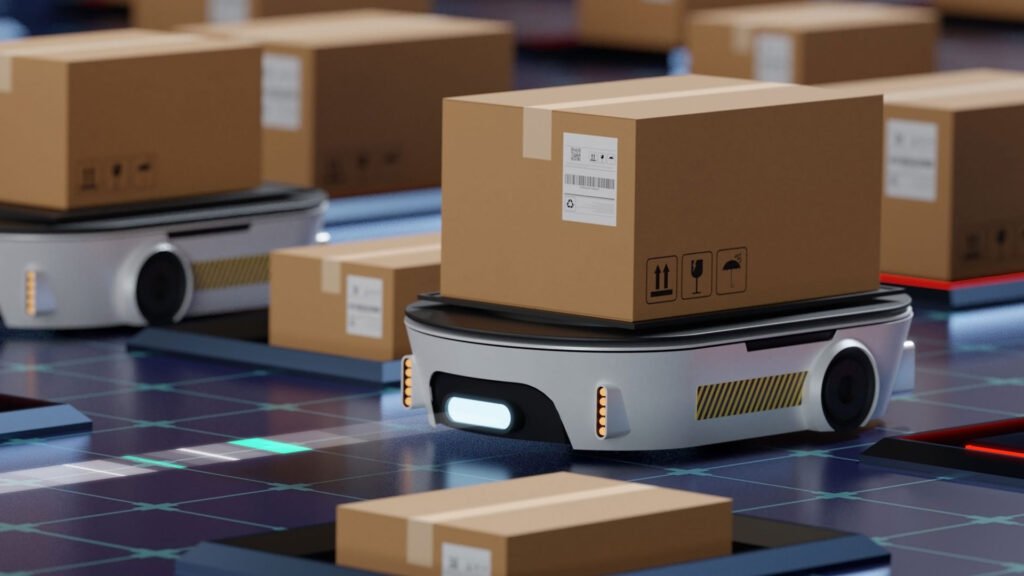
An autonomous mobile robot (AMR) is a vehicle that moves materials around a facility without a driver and without a fixed guide path. It uses LiDAR and sometimes cameras to see its surroundings, builds a map, and plans its own route. If a vendor calls a robot that only follows a painted line or magnetic tape an 'AMR,' it is an AGV with a different label.
This guide explains how AMRs differ from AGVs, how they navigate, what they can carry, what safety questions to ask, how to judge the payback, and what to check before you buy.
What Are Autonomous Mobile Robots
AMR vs AGV: The Practical Difference
The terms are often used interchangeably, and the line is blurring (some AGVs now navigate by laser instead of tape). The practical question is how much the machine decides for itself.
| AGV (Automated Guided Vehicle) | AMR (Autonomous Mobile Robot) | |
|---|---|---|
| Navigation | Typically follows a defined path: tape, wire, magnets, or laser reflectors | Plans its own route from a map built with LiDAR, cameras, or both |
| When something blocks the route | Usually stops and waits | Can re-route if there's room, otherwise it also stops |
| Changing the route | Often needs physical changes or reconfiguration of the guide system | Usually a software map update |
| Floor preparation | Depends on the guidance method | No tape or wire laid in the floor, though you still need WiFi coverage, charging points, and sometimes markers |
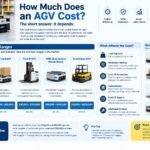
| Typical unit cost (planning range) | $30,000–$70,000 | $50,000–$120,000 |
| Best for | Fixed, repetitive routes | Changing traffic and layouts |
The cost ranges are planning figures. Real quotes depend on payload, navigation, software, and integration. See our AGV cost guide for the breakdown.
How an AMR Navigates
- LiDAR: a laser scanner fires pulses in all directions and measures how long they take to return, building a live picture of walls, racks, pallets, and people.
- SLAM (simultaneous localization and mapping): the software builds a map of the facility while tracking where the robot is on it, so little or no fixed infrastructure is needed.
- Safety scanners: laser scanners at the front (and often the sides) create protective fields. Objects entering an outer field make the robot slow down, and objects entering an inner field make it stop. The size of these fields depends on the robot's speed, load, and the site's risk assessment, so there is no universal figure.
- Cameras (optional): used for reading barcodes, identifying locations, or checking load orientation.
Positioning accuracy at pick-up and drop-off points varies by vendor and by how the docking is done. Ask for the specification and how it was measured.
Safety: The Question Buyers Skip
An AMR shares space with forklifts and pedestrians, so safety conformity matters as much as price. Ask every vendor which safety standards the robot is designed and certified to, such as ISO 3691-4, ANSI/RIA R15.08, or ANSI/ITSDF B56.5, depending on your market, and ask for the documentation. Also plan the traffic rules for mixed operation with manually driven trucks. See our article on AGV and manual forklift hybrid warehouses for the common conflicts.
What AMRs Can Carry
| Type | Typical Payload | Typical Use |
|---|---|---|
| Small AMR | 50–250 kg | Totes and carts between workstations |
| Mid-size AMR | 250–1,000 kg | Pallets, roll cages, bins |
| Heavy AMR | 1,000–2,000 kg | Full pallets and heavy components |
| AMR forklift | 1,000–2,000 kg with lift | Picking up and dropping pallets at floor or rack positions without an operator |
Payloads and capabilities differ a lot between products, so check the datasheet for your actual load, not the category name. Some robots sold as AMRs are designed for cases, totes, and shelves, not full pallets.
Where AMRs Work, and Where They Don't
Good fits
| Application | Why it works |
|---|---|
| Dock-to-staging transfer | Predictable, high-volume route |
| Staging-to-rack put-away | Repetitive with known drop zones |
| Workstation replenishment in factories | Handles moving people and changing traffic |
| Hospital and light-load logistics | Predictable corridors |
| E-commerce picking support | Robots carry the load while people pick, or bring shelves to stationary pickers, depending on the system |
Poor fits
| Application | Why it fails |
|---|---|
| Unstructured outdoor terrain | Mud, snow, and rain are hard on sensors, and outdoor-rated robots are a different product class |
| Very narrow aisles (roughly under 2.2 m) | An AMR can't pass a forklift in the same aisle |
| Facilities with weak WiFi | Task dispatch and status updates depend on connectivity |
| Low-volume, low-labor-cost operations | The payback period stretches to many years |
The Business Case: Do the Math With Your Own Numbers
AMRs usually move at around walking pace and can work long hours with opportunity charging. But a single AMR typically moves fewer pallets per hour than a good operator, so the savings come from running more hours and removing empty travel, not from raw speed.
Payback = (hardware + integration + setup) ÷ (annual labor saved − annual software, support, and maintenance cost)
An illustrative example, with all assumptions stated:
- Hardware, integration, and setup: $90,000
- Annual software subscription, support, and maintenance: $12,000
- Labor replaced: 1.5 full-time equivalents at $50,000 fully loaded = $75,000 per year
- Net annual saving: $63,000
- Payback: about 1.4 years (roughly 17 months)
Change any of those inputs and the answer moves a lot. AMRs usually pay back when they replace roughly 1.5 or more full-time equivalents on a high-volume route. They rarely do on a single shift with low labor costs, or on routes under about 100 pallet moves per day.
Four Questions to Ask Before You Buy
- Is your inventory data clean? If the WMS says a pallet is in A17 but it's in A19, the robot goes to A17, finds nothing, and waits for a human. Fix barcode scanning and location accuracy first.
- Is the route volume high enough? Count the real pallet moves per day on the route you want to automate.
- Does your WiFi cover the whole route? Map the coverage before installation, including dead zones.
- Do you have the floor space? AMRs working alongside forklifts typically need roughly 2.5–3 m of clear aisle.
What to Ask Any AMR Vendor, Including Us
The AMR market has had real casualties. Zebra Technologies wound down its Fetch-based mobile robot unit in late 2025, leaving customers to depend on whoever took over the support. Whoever you buy from, ask:
- How long has this exact model been in production, and how many are deployed in operation today?
- Can I speak to a customer running it on a route like mine?
- Who supports the robot and the fleet software, how fast do they respond, and where are the spare parts held?
- Who owns the fleet management software, and does it integrate with my WMS through an open interface?
- Is a paid pilot on one route possible before a fleet commitment?
- Which safety standards is it certified to, and where's the paperwork?
Common Failure Patterns
- Inventory data isn't ready. The robot moves pallets to where the system says they are, and the system is wrong. The robot didn't cause the problem, it exposed it.
- Volume is too low. A route with a few dozen moves a day looks fine on paper and leaves the robot idle most of the shift.
- Connectivity gaps. WiFi dead zones leave the robot stopped mid-route, and operators lose trust in it quickly.
All three are facility and process problems, not robot problems. If the data, volume, and infrastructure aren't ready, the robot just makes the problems visible faster.
The Bottom Line
An AMR is a self-navigating material mover. It doesn't replace your forklifts or your operators; it replaces wasted walking and empty miles. In a facility with clean data, high route volume, and solid WiFi, it can pay back in one to two years. In the wrong facility, it's an expensive lesson in process discipline. Fix the basics first, then automate.