CE Marking and Stage V Emissions
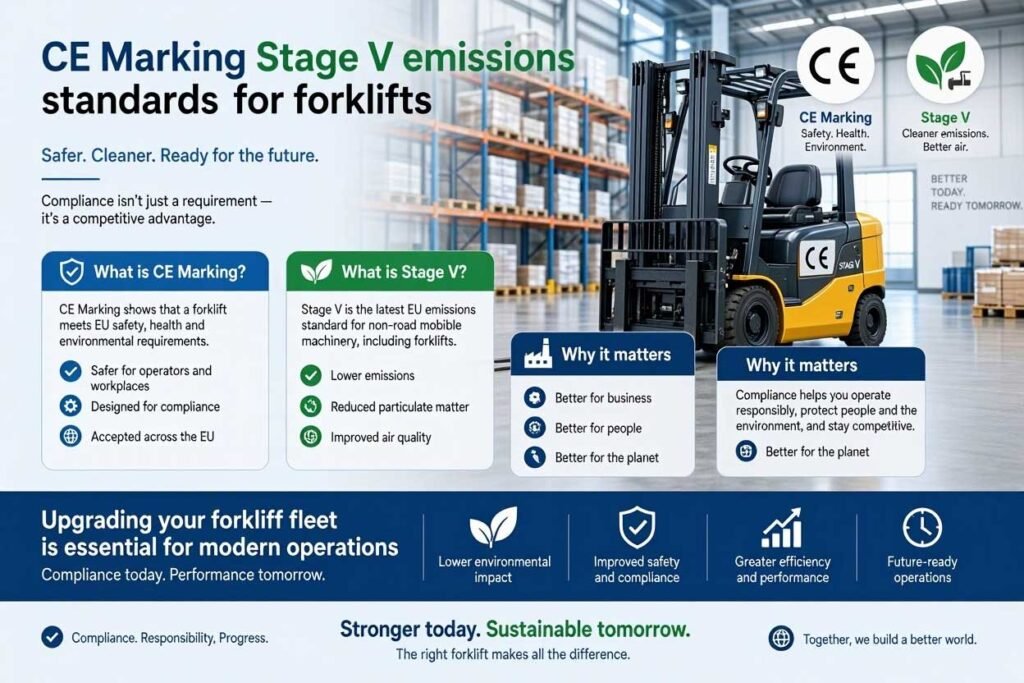
What is CE Marking for Forklifts?
- Key Aspects of CE Marking:
- Ensures forklift meets EU machinery safety standards.
- Confirms compliance with noise and vibration directives.
- Validates adherence to environmental regulations.
- Required for legal sale and operation within Europe.
Understanding Stage V Emissions Standards
- Why Stage V Matters:
- Reduces NOx emissions, which contribute to smog and respiratory issues.
- Introduces strict particulate number (PN) limits, targeting even the finest soot particles.
- Aligns with North America’s EPA Tier 4 Final standards, ensuring global regulatory compliance.
- Encourages use of advanced engine technologies like Diesel Particulate Filters (DPF) and Selective Catalytic Reduction (SCR).
How Stage V Forklift Engines Work
Diesel Particulate Filter (DPF):
Captures soot particles from exhaust gases. The DPF periodically undergoes “regeneration,” where trapped soot is burned off at high temperatures, converting it into harmless ash without interrupting forklift operations.
Selective Catalytic Reduction (SCR):
Targets NOx gases by injecting Diesel Exhaust Fluid (DEF), commonly known as AdBlue, into the hot exhaust stream. This causes a chemical reaction that breaks down NOx into nitrogen and water vapor, both harmless to the environment.
Why Upgrading to Stage V Forklifts is Essential
Compliance with Environmental Regulations:
Many European and North American ports and logistics hubs have established low-emission zones (LEZs) that prohibit older, non-compliant forklifts. Operating outdated equipment risks hefty fines and operational bans.
Eligibility for Contracts and Tenders:
Major infrastructure projects and multinational logistics companies (DHL, Maersk, etc.) now require suppliers to maintain “green fleets.” Without Stage V forklifts, companies may be disqualified from bidding.
Improved Fuel Efficiency and Reduced Operating Costs:
Stage V engines feature advanced electronic control units (ECUs) and common rail fuel injection, leading to more efficient fuel consumption and lower emissions. This translates into significant diesel savings and reduced total cost of ownership (TCO).
Enhanced Reliability and Uptime:
Modern Stage V forklifts are engineered for continuous heavy-duty use with optimized cooling systems and durable transmissions, ensuring minimal downtime and increased productivity.
CE Marking and Stage V: A Combined Assurance of Safety and Sustainability
Case Study: Xing Hao 25-Ton Euro V Forklift
- Powered by premium Stage V engines from renowned brands like Cummins or Volvo.
- Equipped with heavy-duty Kessler drive axles and ZF transmissions.
- Features intelligent cooling systems designed for efficient DPF regeneration cycles.
- Fully CE certified, ensuring compliance across Europe and North America.
Practical Tips for Fleet Managers
- Audit Your Current Fleet: Identify forklifts that do not meet Stage V or lack CE certification.
- Plan Upgrades Strategically: Consider total cost of ownership, fuel savings, and potential regulatory fines.
- Engage with Certified Manufacturers: Choose suppliers offering fully CE marked and Stage V compliant forklifts.
- Train Operators: Educate your team on the benefits and operational nuances of Stage V forklifts, including DEF handling.
- Monitor Regulatory Changes: Stay updated on evolving environmental laws and low-emission zone expansions.