Forklift Pre-Shipment Testing
What is Forklift Pre-Shipment Testing?
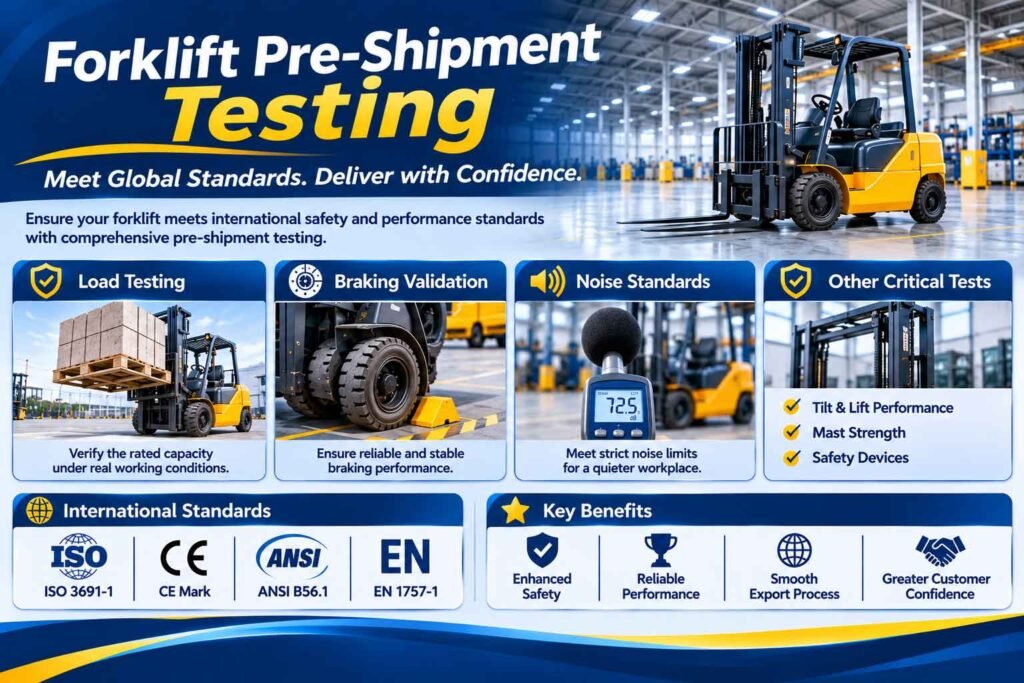
- Load Testing: Confirms the forklift can safely handle its rated capacity without structural or mechanical failure.
- Braking System Validation: Ensures reliable stopping power and parking brake performance under various load and terrain conditions.
- Noise Emission Testing: Verifies compliance with workplace noise regulations to protect operator health and meet environmental standards.
Load Testing: Ensuring Structural Integrity and Stability
Key Elements of Load Testing:
- Static Load Test:
The forklift carries the rated load at maximum lift height, typically between 3,000 mm and 6,000 mm. The load is held steady for at least 10 minutes to monitor mast deflection, hydraulic pressure stability, and chassis integrity. Acceptance criteria demand minimal mast deflection (within 1/500 of the lift height) and no hydraulic leaks or chassis settlement.
- Dynamic Load Test:
This involves operational scenarios such as acceleration, travel, lifting, lowering, and braking while carrying the rated load. It evaluates the forklift’s ability to maintain performance without excessive wheel slip, structural stress, or hydraulic instability.
- Load Center and Attachments:
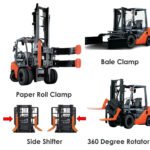
Fork spacing and load center distances (usually 600 mm) are standardized, but tests also account for extended load centers (up to 900 mm) when attachments like side-shifters or longer forks are used. Each configuration undergoes separate load validation to ensure safety margins.
- Lithium Battery Considerations:
Lithium-ion forklifts have unique weight and stability profiles due to lighter battery packs. Load tests recalibrate counterweights to maintain stability margins equivalent to lead-acid battery models, with special focus on lateral stability.
Braking System Testing: Critical for Operator Safety
Braking Performance Tests Include:
- Service Brake Test:
Measures stopping distance from maximum travel speeds (typically 18-20 km/h) with a full load. Standards such as ISO 3691-1 and JIS D 6023 specify maximum allowable stopping distances (around 4.5 meters at 20 km/h unloaded, adjusted for load).
- Regenerative Braking Validation:
Lithium forklifts often incorporate regenerative braking to enhance energy efficiency. Testing confirms that mechanical brakes alone can achieve required stopping distances in case of electrical failure, ensuring fail-safe operation.
- Parking Brake Test:
The forklift must hold position indefinitely on slopes up to 15%. Additionally, automatic parking brake engagement upon operator exit is verified.
- Fade Test:
Simulates repeated braking to observe any performance degradation due to heat buildup, ensuring brakes maintain effectiveness over extended use.
- Braking Force and Operator Effort:
Tests ensure braking force is sufficient without exceeding maximum operator input limits, balancing safety and ergonomics.
Noise Standards: Protecting Operators and Meeting Environmental Regulations
- Noise Measurement:
Testing is conducted with the forklift under load, measuring sound pressure levels at operator ear height and ambient workplace conditions.
- Compliance Standards:
Forklifts must meet directives such as the EU Machinery Directive and local workplace noise regulations, often requiring noise levels below specified decibel thresholds.
- Noise Reduction Strategies:
Manufacturers may incorporate sound-dampening materials, optimize hydraulic pump designs, and use quieter electric motors to reduce noise emissions.
Regulatory Frameworks Governing Pre-Shipment Testing
- ISO 3691-1:
The foundational global standard for self-propelled industrial trucks, covering safety, stability, and braking.
- EN 1175:
European standard addressing electrical safety and noise emissions, including provisions for lithium-ion batteries.
- ANSI/ITSDF B56.1:
North American standard with specific requirements for stability and load centers.
- JIS D 6023:
Japanese Industrial Standard focusing on braking performance and testing methods.
- GB/T 10827:
Chinese standard increasingly adopted in Asian markets.
- UN 38.3 and IEC 62660:
Lithium battery transportation and cell-level certifications critical for validating battery safety.
Pre-Test Preparation: Setting the Stage for Accurate Testing
- Run-In Period:
A minimum 50-hour operational period to stabilize mechanical components and battery chemistry.
- Baseline Configuration:
Fork spacing, mast tilt angles, tire pressures, and battery state of charge (80-100%) are standardized.
- Instrumentation:
High-precision sensors including strain gauges, pressure transducers, accelerometers, and thermocouples are installed to capture detailed performance data.
- Load Calibration:
Certified test masses with ±0.1% accuracy simulate rated loads, ensuring test validity.
Data Acquisition and Export Documentation
- High-Frequency Sampling:
Data loggers capture parameters at 100-1000 Hz, recording transient events during acceleration, braking, and lifting.
- Analysis and Reporting:
Statistical summaries identify performance consistency and potential issues. Reports include environmental conditions, calibration certificates, and detailed conformity declarations.
- Export Compliance:
Documentation forms part of technical construction files for CE marking, EPA/CARB compliance, or other market-specific certifications.
- Battery System Documentation:
Includes UN 38.3 test summaries, BMS safety assessments per ISO 13849 or IEC 61508, and electromagnetic compatibility (EMC) test results.
Market-Specific Adaptations
- High Ambient Temperatures:
Middle Eastern and Southeast Asian markets require thermal management validation at temperatures above 45°C.
- Noise Emission Limits:
European markets emphasize noise testing under load.
- Visibility Requirements:
North American OSHA standards demand unobstructed operator sightlines.
- Ingress Protection (IP) Ratings:
Dusty or moist environments necessitate enhanced enclosure sealing, especially for lithium battery compartments.