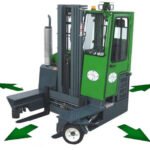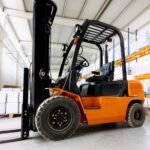
If you searched 'forklift that moves sideways,' you probably have one of two problems:
You handle long loads — steel pipes, timber, aluminum profiles, concrete beams. A standard forklift carries them sticking out the front, which means you need ridiculously wide aisles to turn. A sideloader carries them parallel to the direction of travel — so a 6 m pipe needs a 3 m aisle, not a 10 m one.
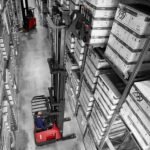
Your aisles are too tight for a standard forklift — You need a machine that can move in any direction without a huge turning radius. A multi-directional or side-loading design solves this.
Either way, here's what you're looking for.
Two Types of 'Moving Sideways'
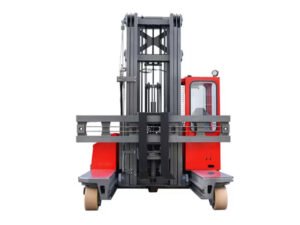
1. Sideloader Forklift
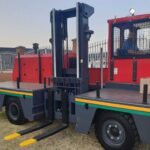
The load sits on a platform beside the operator, parallel to the direction of travel. The truck drives forward with the load alongside it — not sticking out in front.
Best for: Lumber yards, steel service centers, pipe and profile warehouses, precast concrete yards.
Key specs:
| Spec | Typical Range |
|---|---|
| Load capacity | 2,000–10,000 kg |
| Load length | Up to 12 m (longer with counterweight adjustment) |
| Aisle width needed | 2,000–3,000 mm |
| Drive | Diesel (outdoor) or Electric (indoor) |
Standard forklift handling a 6 m steel beam: Needs a 9–10 m aisle to turn.
Sideloader handling the same beam: Drives straight down a 2.5 m aisle. No turn needed.
2. Multi-Directional Forklift
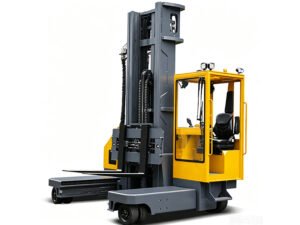
Multidirectional-Forklift
Uses Mecanum or omni-directional wheels. Can drive forward, backward, sideways, or diagonally. The load stays in front but the whole truck can crab-walk sideways into tight spaces.
Best for: Narrow warehouse aisles, loading docks with limited space, facilities that need one machine to do both standard forklift work and side-loading work.
How Much Space Does a Sideways Forklift Save?
| Load Length | Standard Forklift Aisle Width | Side Loader Aisle Width |
|---|---|---|
| 3 m | 5–6 m | 2.0–2.5 m |
| 6 m | 9–10 m | 2.5–3.0 m |
| 9 m | 13–15 m | 3.0–3.5 m |
| 12 m | 17–19 m | 3.5–4.0 m |
Real math: A lumber yard storing 6 m timber. Warehouse width: 30 m.
- Standard forklift: 2 aisles (9 m each) + 2 rack rows (6 m each) = 12 m of rack space
- Sideloader: 4 aisles (2.5 m each) + 4 rack rows (5 m each) = 20 m of rack space
Same building. 66% more storage with a side loader.
Available Product
Narrow Aisle Side Loader Forklift for Long Material Handling
| Spec | Value |
|---|---|
| Load capacity | Contact for model-specific data |
| Load type | Long materials: timber, steel, pipes, profiles |
| Aisle width | Narrow aisle capable |
| Power option | Electric (indoor) / Diesel (outdoor) |
| Operation | Side-loading platform, operator cabin |
Full spec sheet available on request.
Applications
| Industry | Typical Load | Why Side Loader Works |
|---|---|---|
| Lumber & timber | 3–8 m planks, beams, plywood bundles | Long loads stored in narrow rack lanes |
| Steel service centers | Rebar, angle iron, sheet, pipe | Heavy, long, needs side access |
| Pipe & tube distributors | 6–12 m PVC, steel, copper pipes | Standard forklift can't turn in the aisle |
| Building materials | Concrete beams, insulation panels, roofing sheets | Bulky lengths, indoor storage |
| Aluminum / window manufacturing | 6 m extrusions, frames | Delicate, need precision placement at height |
FAQ
Q: Can a standard forklift be made to move sideways?
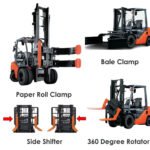
No. A standard counterbalance forklift drives forward and backward, and turns by pivoting. You can add a side-shifter attachment to move the forks left and right by 100–200 mm, but that's for pallet positioning — not moving the whole load sideways down an aisle. For true sideways travel, you need a sideloader or multi-directional truck.
Q: What's the difference between a sideloader and a multi-directional forklift?
A sideloader carries the load on a side platform. It drives straight with the load alongside. A multi-directional forklift uses special wheels to drive in any direction — forward, sideways, diagonally — while carrying the load in front. Both solve the 'move sideways' problem, but for different layouts.
Q: Can a sideloader also work as a standard forklift?
Most sideloaders are designed primarily for side-loading. Some models have front forks for dual use, but they're less maneuverable than a standard counterbalance forklift in front-loading mode. If you need one machine for both, consider a multi-directional forklift instead.
Q: What aisle width do I need for a sideloader?
2,000–3,000 mm depending on load length and model. Much narrower than the 6–15 m a standard forklift needs for long loads.