long load handling forklift
What Are Multidirectional Forklifts and Sideloaders?
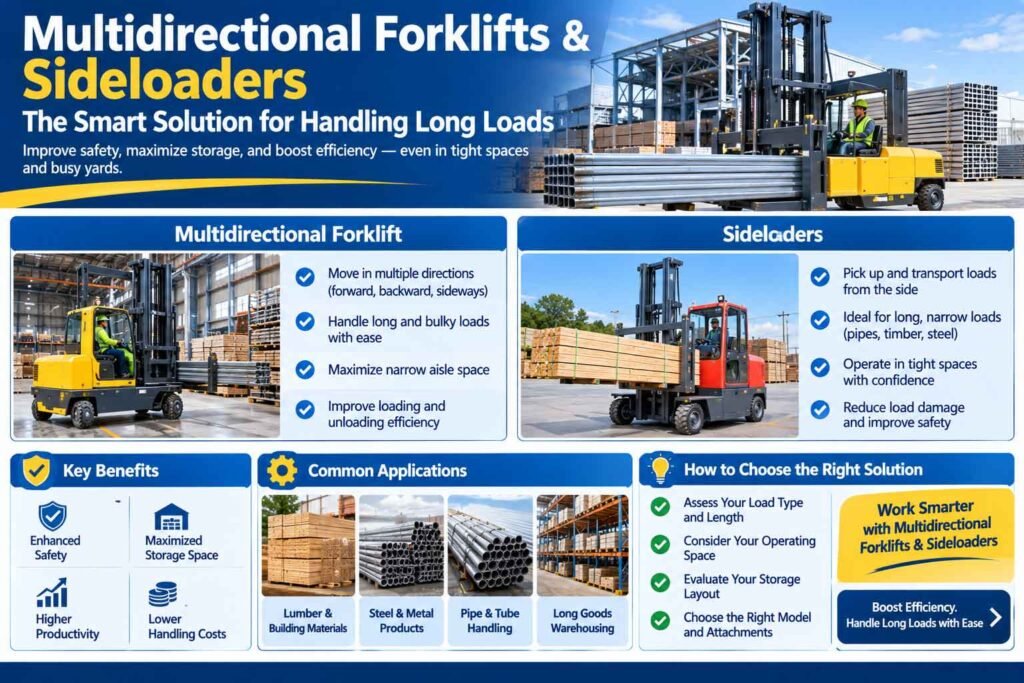
Multidirectional Forklifts
- Four-way steering enabling lateral movement.
- Cabin mounted to the side for enhanced visibility.
- Ability to operate indoors and outdoors without the need for double handling.
- Narrow aisle operation, often reducing aisle widths by up to 50%, thereby increasing storage capacity.
Sideloaders
- Stable, wide base for carrying long and heavy loads.
- Operator cabin positioned opposite the forks for unobstructed load visibility.
- Efficient stacking in cantilever racking systems.
- Suitable for open or semi-open spaces where maneuvering room is ample.
Advantages of Multidirectional Forklifts and Sideloaders for Long Load Handling
1. Enhanced Maneuverability and Space Utilization
2. Improved Safety
- Placing the operator’s cabin to the side, providing a clear line of sight along the load.
- Featuring a low center of gravity and integrated load platforms to stabilize loads.
- Incorporating innovative safety features such as load sensing steering and multi-position tiller arms (in pedestrian models) to reduce accidents.
3. Increased Efficiency and Productivity
Comparing Multidirectional Forklifts and Sideloaders: Which Is Better?
| Feature | Multidirectional Forklift | Sideloader |
|---|---|---|
| Maneuverability | Superior; moves in all directions including lateral and diagonal | Good; moves primarily forward and backward, limited lateral movement |
| Ideal Operating Environment | Narrow aisles, confined spaces, indoor/outdoor | Wide aisles, open yards, outdoor use |
| Operator Visibility | Cabin mounted to side for clear view of load | Cabin opposite forks; good visibility along load length |
| Storage Optimization | Enables narrow aisles, increasing storage density | Best with cantilever racking; requires wider aisles |
| Load Handling | Handles long, awkward loads with flexibility | Excellent for very long, heavy loads over distance |
| Cost | Higher initial investment; versatile long-term ROI | Generally lower initial cost; specialized use |
When to Choose a Multidirectional Forklift
- Your operation involves tight indoor spaces or warehouses with narrow aisles.
- You require versatility to handle various load types and sizes.
- Maximizing storage density is a priority.
- You want to reduce double handling by using one machine for multiple tasks.
When to Choose a Sideloaders
- You handle very long, heavy loads primarily in open or semi-open yards.
- Your warehouse uses cantilever racking systems designed for long goods.
- You need a stable platform for transporting loads over longer distances.
- Budget constraints favor a lower initial investment for specialized tasks.
Industry Applications and Case Studies
Steel and Timber Industries
Logistics and Warehousing
Container and Oversized Load Handling
Tips for Selecting the Right Forklift for Long Load Handling
Assess Your Space Constraints
Evaluate aisle widths, turning radii, and indoor vs. outdoor operation to determine if multidirectional forklifts’ maneuverability or sideloaders’ stability better suit your environment.
Understand Your Load Types and Sizes
Consider the length, weight, and shape of your typical loads. Multidirectional forklifts offer flexibility for mixed load types, while sideloaders excel with consistently long materials.
Factor in Safety and Visibility Requirements
Prioritize equipment with operator cabins designed for maximum visibility and safety features such as load sensing and ergonomic controls.
Consider Total Cost of Ownership
Beyond initial purchase price, factor in maintenance, fuel efficiency, productivity gains, and potential space savings.
Leverage Expert Consultation
Many manufacturers, like Combilift, offer free warehouse consultancy services to optimize layout and equipment selection, potentially doubling your storage capacity without expanding your facility.