In the fast-paced world of warehousing and material handling, the forklift battery is the powerhouse that keeps operations running smoothly. Proper forklift battery care, especially charging habits, plays a pivotal role in extending battery life, reducing downtime, and improving overall productivity. Neglecting these practices can lead to premature battery failure, costly replacements, and safety risks. This article dives deep into the best forklift battery charging habits, safety protocols, and maintenance tips backed by industry insights and Australian standards to help you get the most out of your investment.
Forklift Battery Care
Why Proper Forklift Battery Charging Matters
Forklift batteries, particularly lead-acid types, require careful handling and charging to maintain optimal performance. Incorrect charging can cause:
- Reduced battery capacity due to sulfation and stratification.
- Shortened battery life from overcharging or deep discharging.
- Safety hazards such as acid spills, hydrogen gas explosions, and electrical shocks.
- Increased operational costs due to downtime and frequent battery replacements.
By adopting the right charging habits, you safeguard your forklift’s “heart,” ensuring consistent power and trusted performance you can rely on.
Understanding Forklift Battery Types and Charging Needs
Lead-Acid Batteries
The most common forklift batteries, lead-acid batteries, consist of lead plates submerged in sulfuric acid electrolyte. They require:
- Controlled voltage and current during charging.
- Regular watering with distilled water after charging.
- Avoidance of deep discharge beyond 20-25% state of charge.
- Equalizing charges weekly or after deep discharge to rebalance electrolyte concentration.
Charging typically takes 6-8 hours, followed by a cooling period to prevent overheating and electrolyte loss.
Lithium-Ion Batteries
Increasingly popular for their fast charging and low maintenance, lithium-ion batteries offer:
- Rapid charging (often under 2 hours).
- Built-in battery management systems (BMS) for optimal charging and protection.
- Opportunity charging compatibility without reducing battery life.
- Minimal watering or maintenance needs.
Choosing the right battery and charger combination is critical to avoid damage and maximize lifespan.
Best Forklift Battery Charging Habits That Extend Life
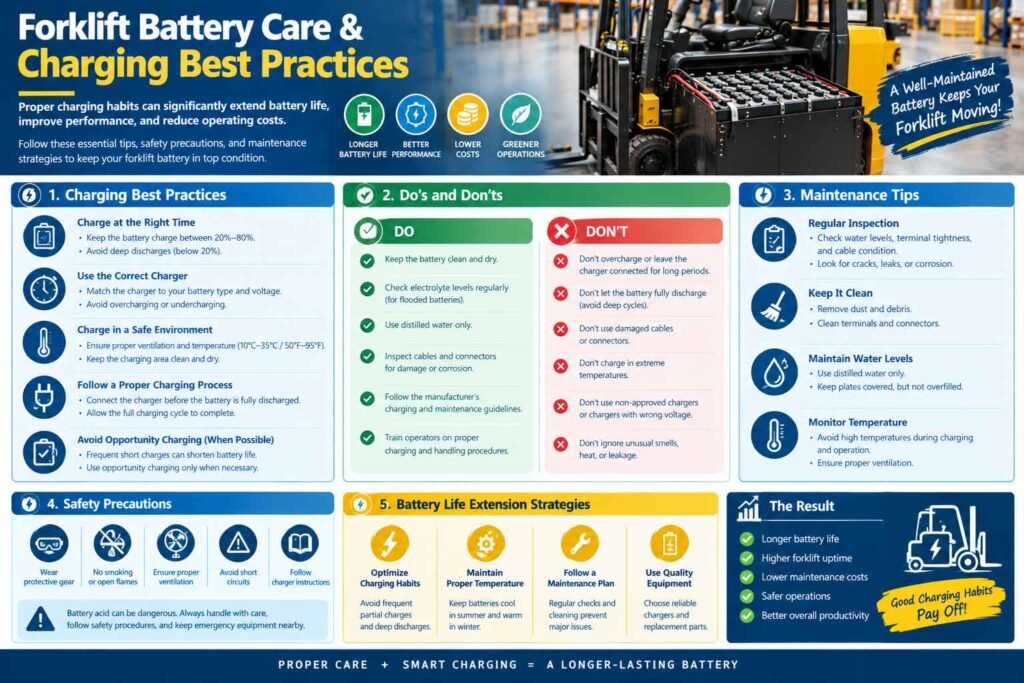
1. Charge at the Right Time
- Avoid deep discharges: Recharge when the battery reaches about 20-30% state of charge. Deep discharging causes irreversible damage and shortens battery life.
- Charge after every shift: For single-shift operations, an overnight full charge is ideal. Multi-shift or 24/7 operations may require opportunity or fast charging but ensure at least one full charge cycle regularly.
2. Use Correct Chargers and Settings
- Match the charger voltage and amperage to the battery specifications.
- Use chargers designed for your battery type (lead-acid vs lithium-ion).
- Ensure charger cables and connectors are in good condition and polarity is correct (positive to positive, negative to negative).
- Avoid overcharging by using chargers with automatic shut-off or float modes.
3. Ensure Proper Ventilation and Safety
- Charge batteries in well-ventilated areas to disperse explosive hydrogen gas.
- Keep the battery cover open during charging to allow gas escape.
- Prohibit smoking, open flames, and sparks near charging stations.
- Use personal protective equipment (PPE) such as acid-resistant gloves, aprons, and safety goggles.
4. Follow a Consistent Charging Procedure
- Park the forklift on level ground and engage the parking brake.
- Turn off the forklift and remove the key.
- Open battery compartment covers or vent caps.
- Inspect the battery for physical damage or electrolyte leaks.
- Connect charger cables securely and start charging.
- Monitor battery temperature; stop charging if the battery overheats.
- Once charging is complete, disconnect the charger (turning it off first), close covers, and allow the battery to cool before use.
5. Perform Regular Equalizing Charges
- Equalizing is a controlled overcharge that balances electrolyte concentration and prevents sulfation.
- Perform equalizing charges weekly or after deep discharges using a charging current not exceeding 5A per 100Ah of battery capacity.
- Avoid exceeding electrolyte temperatures of 55°C during equalizing.
Maintenance Tips to Support Charging Habits
- Check electrolyte levels: Top up with clean or purified water only after charging and cooling. Never add water before charging.
- Keep batteries clean and dry: Prevent tracking currents and corrosion by cleaning terminals and battery surfaces regularly.
- Inspect for damage: Look for cracks, leaks, or corrosion on battery cases and connectors.
- Maintain a watering log: Record water additions and maintenance activities to support warranty claims and track battery health.
- Store batteries properly: If out of service, store fully charged in a dry, frost-free environment with periodic float or equalizing charges.
Special Considerations for Cold Storage and Multi-Shift Operations
Charging forklift batteries in cold environments requires additional care:
- Warm batteries above freezing before charging to prevent incomplete charging and sulfation.
- Use battery heaters or insulated battery boxes to maintain optimal temperature.
- Choose chargers with temperature compensation features to adjust charging profiles based on battery temperature.
- For multi-shift operations, opportunity charging is beneficial but should be managed carefully to avoid incomplete charges and capacity loss.
Common Mistakes to Avoid When Charging Forklift Batteries
- Charging partially discharged batteries without full charge cycles.
- Using incorrect or damaged chargers and connectors.
- Ignoring ventilation and PPE requirements.
- Overcharging or undercharging, leading to electrolyte loss or sulfation.
- Failing to perform equalizing charges regularly.
- Skipping maintenance checks and logs.
Avoiding these pitfalls ensures your forklift battery remains reliable and safe.
Benefits of Proper Forklift Battery Charging
- Extended battery life: Reduces premature wear and replacement costs.
- Improved forklift performance: Consistent power output and runtime.
- Reduced downtime: Fewer mid-shift battery failures.
- Enhanced safety: Minimizes risks of acid spills, explosions, and electrical hazards.
- Lower total cost of ownership: Optimized charging reduces energy waste and maintenance expenses.
Conclusion
Forklift battery care through disciplined charging habits is the cornerstone of efficient and safe material handling operations. By understanding your battery type, using the correct chargers, following safety protocols, and performing regular maintenance, you can significantly extend your forklift battery life while boosting productivity and safety. Remember, your forklift battery is the heart of your electric forklift—treat it with the care it deserves.
Take action today: Review your current battery charging procedures, train your operators on best practices, and implement a maintenance log to monitor battery health. For tailored advice and expert support, consult your battery or charger manufacturer or trusted service providers.