Forklifts are the unsung heroes of warehouses, manufacturing plants, and distribution centers worldwide. These powerful machines efficiently lift, move, and position heavy loads, making them indispensable in material handling operations. But have you ever wondered what makes a forklift work so smoothly and reliably? Understanding the forklift key components—specifically the controllers, AC motors, and hydraulics—is essential for operators, maintenance teams, and fleet managers alike.
In this comprehensive article, we will break down these critical forklift components, explaining how they function individually and together to deliver precise control, power, and safety. Drawing on insights from industry-leading sources, this guide will deepen your understanding of electric forklifts and help you make informed decisions about operation, maintenance, and purchasing.
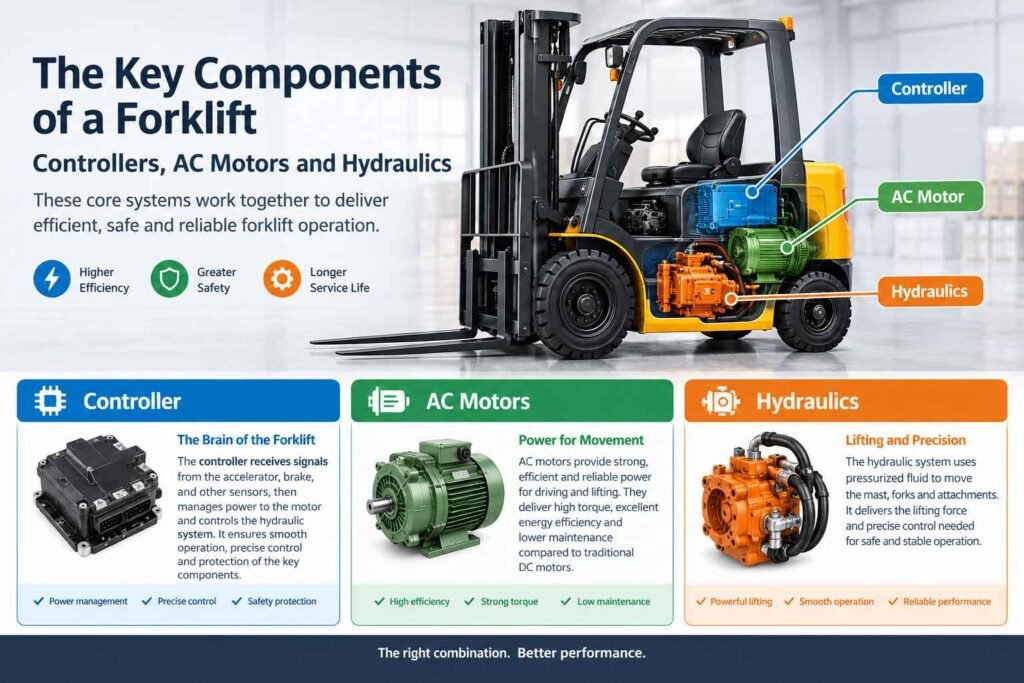
Forklift Key Components
The Core Architecture of Electric Forklifts
Modern electric forklifts operate by converting stored electrical energy from batteries into mechanical power for driving and lifting. The three pillars of this process are:
- Controllers: The electronic brains managing power flow.
- AC Motors: The workhorses converting electrical energy into motion.
- Hydraulics: The muscle that physically lifts and tilts loads.
Together, these systems create a seamless flow of energy and control that allows forklifts to perform demanding tasks with precision and efficiency.
1. Controllers: The Brain Behind the Operation
At the heart of every electric forklift lies the controller, an advanced electronic unit that manages how electrical energy flows from the battery to the motors. It acts as the critical interface between the operator’s commands and the forklift’s mechanical response.
How Controllers Work
- Power Regulation: Controllers convert the battery's direct current (DC) into the appropriate current and voltage needed by the motors, often transforming DC to alternating current (AC) for AC motors.
- Smooth Acceleration and Deceleration: Instead of delivering full power instantly, controllers use techniques like pulse-width modulation (PWM) to ramp power up or down smoothly, preventing jerky movements and protecting the drivetrain.
- Regenerative Braking: During deceleration or lowering loads, the controller switches the motor into generator mode, feeding energy back to the battery and extending runtime.
- Safety Monitoring: Controllers continuously monitor motor temperature, current draw, and battery voltage to prevent overloads or damage.
- Operator Input Processing: Inputs from the accelerator pedal, direction switch, and lift controls are translated into precise motor commands.
Why Controllers Matter
A well-designed controller is a major differentiator in forklift performance. It ensures responsive handling, energy efficiency, and longevity of components. Poorly tuned controllers can lead to sluggish response, excessive battery drain, and premature wear.
2. AC Motors: Efficient and Reliable Power
Electric forklifts typically use AC motors for both traction (driving the wheels) and hydraulic pump operation. These motors have largely replaced older DC motor designs due to their efficiency, durability, and performance advantages.
Types of Motors in Electric Forklifts
- Traction Motor: Powers the drive wheels, controlling travel speed and direction.
- Hydraulic Pump Motor: Powers the hydraulic pump that pressurizes fluid for lifting and tilting.
Advantages of AC Motors Over DC Motors
| Feature | AC Motors | DC Motors |
|---|---|---|
| Maintenance | Brushless, minimal upkeep | Brushes wear out, require replacement |
| Performance | Smooth acceleration, strong low-speed torque | Less smooth, brush wear affects performance |
| Regenerative Braking | Stronger and more efficient | Less effective |
| Overload Tolerance | Better momentary overload handling | Lower tolerance |
| Energy Efficiency | Higher overall efficiency | Lower efficiency |
How AC Motors Enhance Forklift Operation
AC motors provide smooth, precise torque control, which is crucial for maneuvering in tight aisles and handling delicate loads. Their brushless design reduces downtime and maintenance costs. Additionally, AC traction motors integrate well with regenerative braking systems, improving energy recovery during deceleration and mast lowering.
3. Hydraulics: The Muscle for Lifting and Tilting
While electric motors provide the power, hydraulics convert that power into the physical force needed to lift, lower, and tilt loads. The hydraulic system is fundamental to a forklift’s load handling capabilities.
Components of the Hydraulic System
- Hydraulic Pump: Driven by an electric motor, it pressurizes hydraulic fluid.
- Control Valves: Direct fluid flow based on operator inputs from levers or joysticks.
- Lift Cylinders: Extend or retract to raise and lower the mast.
- Tilt Cylinders: Adjust the mast angle forward or backward.
- Hydraulic Fluid Reservoir: Stores the hydraulic oil.
How Hydraulics Work in a Forklift
- When the operator activates the lift lever, the controller commands the hydraulic pump motor to pressurize fluid.
- Pressurized fluid flows through control valves to the lift cylinders, extending them and raising the forks.
- Similarly, tilt levers control fluid flow to tilt cylinders, adjusting the mast angle to stabilize or position loads.
- Closing valves hold the fluid under pressure, maintaining the load position securely.
Importance of Hydraulic System Tuning
Proper hydraulic flow rate and pressure control are vital for smooth, stable lifting. Excessive flow can cause jerky movements and destabilize loads, while insufficient pressure limits lift speed and capacity. Modern electric forklifts use electronically controlled variable-speed pumps to optimize performance dynamically.
Integrating Controllers, AC Motors, and Hydraulics for Optimal Performance
The seamless interaction between controllers, AC motors, and hydraulics enables electric forklifts to deliver:
- Precise Control: Operators can smoothly accelerate, steer, lift, and tilt with minimal effort.
- Energy Efficiency: Regenerative braking and optimized motor control reduce energy consumption.
- Safety: Load stability is maintained through controlled lift and tilt speeds, and the controller prevents overload conditions.
- Reduced Maintenance: Brushless motors and electronic controls minimize wear and downtime.
Battery Choice and Its Impact on Components
The battery powers the entire system, and its type influences how controllers and motors perform.
- Lead-Acid Batteries: Traditional choice, lower upfront cost but require watering, cooling periods, and have limited cycle life.
- Lithium-Ion Batteries: Higher energy density, support fast and opportunity charging, maintenance-free, and longer lifespan.
Lithium-ion batteries paired with advanced controllers and AC motors enable multi-shift operations without battery swapping, reducing downtime and operational costs.
Practical Tips for Operators and Fleet Managers
- Understand Your Duty Cycle: Match forklift components to your operational needs—heavy lifting, long shifts, or tight aisles.
- Prioritize AC Motor Systems: For better efficiency and lower maintenance.
- Leverage Regenerative Braking: Train operators to use smooth deceleration to maximize energy recovery.
- Maintain Hydraulics Properly: Regularly check fluid levels and inspect valves and cylinders.
- Monitor Controller Settings: Adjust torque limits and speed ramps to balance performance and safety.
Conclusion
Understanding the forklift key components—controllers, AC motors, and hydraulics—is essential for maximizing the performance, safety, and cost-efficiency of electric forklifts. The controller orchestrates power delivery with precision, AC motors provide smooth, reliable traction and lifting power, and the hydraulic system translates that power into the physical movement of loads.
By appreciating how these systems work together, operators can handle loads more safely and efficiently, maintenance teams can troubleshoot effectively, and fleet managers can make informed purchasing and operational decisions.
Frequently Asked Questions
Q1: What is the difference between AC and DC motors in forklifts?
AC motors are brushless, require less maintenance, provide smoother acceleration, and enable stronger regenerative braking compared to DC motors, which use brushes that wear out over time.
Q2: How does regenerative braking improve forklift efficiency?
When slowing down or lowering a load, the motor acts as a generator, converting kinetic energy back into electrical energy to recharge the battery, extending runtime.
Q3: Why are hydraulics essential in electric forklifts?
Hydraulics convert electrical power into the mechanical force needed to lift and tilt loads smoothly and safely.