Efficient warehouse operations depend heavily on the reliability and performance of electric forklifts. A critical factor in ensuring smooth forklift operation is understanding how to calculate forklift battery capacity and runtime accurately. Misjudging these parameters can lead to unexpected downtime, increased labor costs, and reduced productivity. This guide dives deep into the essentials of forklift battery runtime calculation, capacity sizing, and practical tips for optimizing battery life in real-world conditions.
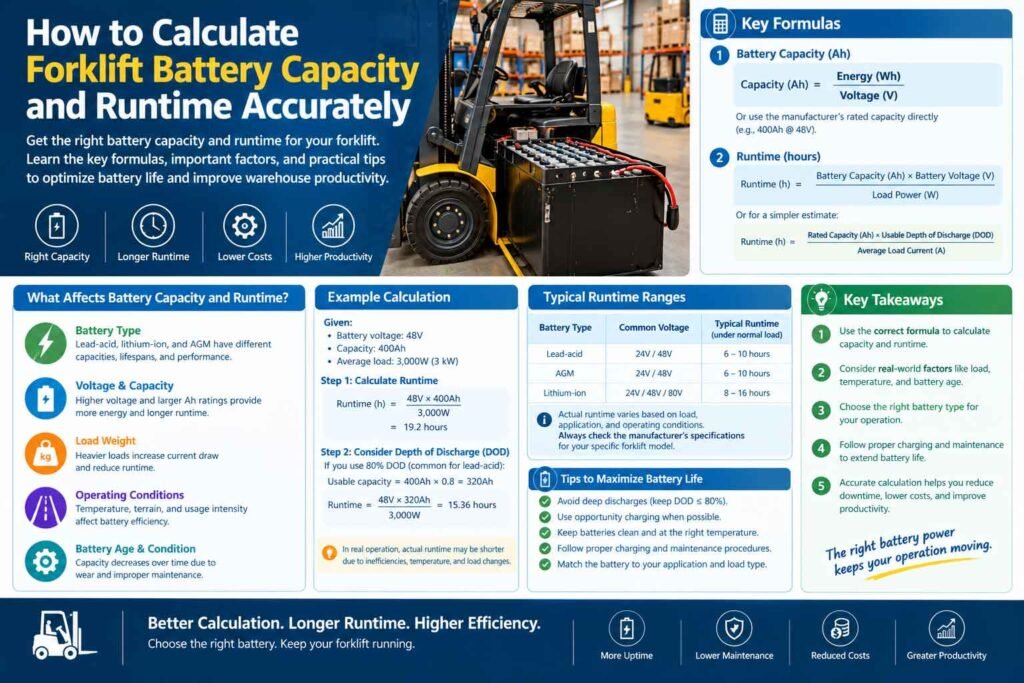
How to Calculate Forklift Battery Capacity and Runtime
Why Calculating Forklift Battery Capacity and Runtime Matters
Forklift batteries power critical material handling equipment in warehouses, manufacturing plants, and logistics centers. Calculating the right battery capacity and expected runtime ensures:
- Consistent forklift availability throughout shifts without mid-shift power loss.
- Optimized battery sizing, avoiding overspending on oversized batteries or frequent recharging due to undersized packs.
- Improved operational efficiency, reducing downtime and labor costs.
- Better energy management, especially in multi-shift or cold storage environments.
Understanding these calculations helps fleet managers make informed decisions about battery selection, charging strategies, and maintenance schedules.
Key Terms You Need to Know
Before jumping into calculations, it’s important to understand some fundamental battery terms:
- Voltage (V): The electrical “pressure” of the battery. Common forklift voltages include 24V, 36V, 48V, 72V, and 80V.
- Ampere-hours (Ah): Battery capacity rating indicating how many amps the battery can supply over one hour. For example, a 600Ah battery can theoretically deliver 600 amps for 1 hour or 100 amps for 6 hours.
- Kilowatt-hours (kWh): The total energy content, calculated as:kWh=1000Voltage×Ah
- Depth of Discharge (DoD): The percentage of battery capacity used before recharging. Lead-acid batteries typically use 70–80% DoD; lithium-ion batteries can safely use 80–90%.
- Duty Cycle: The intensity of forklift use, including lifting, traveling, idling, and peak loads.
How to Calculate Forklift Battery Runtime
1. Ampere-Hour (Ah) Based Runtime Formula
If you know the battery’s amp-hour rating and the forklift’s average current draw (in amps), use this formula:
Runtime (hours)=Average Amp Draw (A)Battery Capacity (Ah)×Usable DoD
Example:
- Battery: 48V, 600Ah
- Usable DoD: 80% (0.8)
- Average Draw: 90A
Runtime=90600×0.8=5.3 hours
This method is practical when you have ampere data and are comparing batteries of the same voltage.
2. Kilowatt-Hour (kWh) Based Runtime Formula
When working with power (kW) and energy (kWh), especially for fleet energy planning or comparing different voltages, use:
Runtime (hours)=Average Power Draw (W)Usable Wh
Where:
Battery Energy (Wh)=Voltage×Ah
Usable Wh=Battery Energy×DoD×System Efficiency
Example:
- Battery: 48V, 600Ah → 28,800Wh (28.8kWh)
- DoD: 80% (0.8)
- System Efficiency: 85% (0.85)
- Average Power Draw: 5,000W (5kW)
Usable Wh=28,800×0.8×0.85=19,584 Wh
Runtime=5,00019,584=3.9 hours
This formula accounts for system losses and is better for multi-voltage or multi-shift operations.
Factors Affecting Forklift Battery Runtime
Depth of Discharge (DoD)
DoD directly impacts usable capacity. Lead-acid batteries require conservative DoD limits to extend life, while lithium-ion batteries allow deeper discharge without damage.
Peukert’s Effect (Lead-Acid Specific)
At higher discharge rates, lead-acid batteries deliver less usable capacity than rated, reducing runtime during heavy lifting or ramp climbing.
Temperature Effects
- Cold Storage: Battery capacity can drop 20–40% for lead-acid and 10–20% for lithium-ion at low temperatures.
- High Heat: Accelerates battery degradation and reduces lifespan.
Battery Age
Older batteries may lose 15–30% of their original capacity, reducing runtime.
Duty Cycle
Heavy-duty cycles with frequent lifting and long travel reduce runtime compared to light or medium-duty cycles.
Lead-Acid vs Lithium-Ion Forklift Batteries: Runtime Comparison
| Feature | Lead-Acid Battery | Lithium-Ion Battery |
|---|---|---|
| Usable DoD | 70–80% | 80–90% |
| Voltage Stability | Voltage drops during discharge | Flatter voltage curve |
| Runtime at Same kWh | Lower usable runtime | 10–30% longer usable runtime |
| Charging Time | 7–10 hours + cool-down | 1–2 hours, supports opportunity charging |
| Maintenance | Requires watering, equalization | Minimal maintenance, BMS-managed |
| Cycle Life | 1,000–1,500 cycles | 3,000–5,000 cycles |
| Best Use Case | Light to medium single-shift | Multi-shift, high throughput |
Lithium-ion batteries provide more consistent power output and longer runtime, especially in multi-shift or demanding environments.
Step-by-Step Forklift Battery Runtime Calculation
- Define Shift Length and Operating HoursDetermine how many hours the forklift operates per shift and per day.
- Estimate Average Power or Amp DrawUse manufacturer data, telematics, or estimate based on duty cycle:
- Light duty: 20–40A
- Medium duty: 40–80A
- Heavy duty: 80–150A+
- Calculate Usable Battery CapacityUsable Ah=Rated Ah×DoD×System Efficiency
- Compute Expected RuntimeUse either Ah or kWh formula as shown above.
- Add Safety MarginsInclude 20–30% buffer for peak loads, aging, temperature, and operator behavior.
Common Mistakes in Forklift Battery Runtime Calculation
- Using nameplate capacity without adjusting for DoD and efficiency.
- Underestimating duty cycle and average current draw.
- Ignoring temperature effects, especially in cold storage.
- Not accounting for battery aging and degradation.
- Neglecting charging infrastructure and opportunity charging potential.
Avoiding these mistakes ensures accurate runtime estimates and better battery sizing.
Practical Tips to Maximize Forklift Battery Runtime
- Implement smart charging strategies: Full charges for lead-acid; opportunity charging for lithium-ion.
- Maintain batteries properly: Watering and equalization for lead-acid; monitor BMS for lithium-ion.
- Train operators: Encourage smooth acceleration, avoid unnecessary idling, and reduce lifting with raised mast during travel.
- Use telematics: Track real energy consumption and adjust runtime calculations accordingly.
- Plan for environmental conditions: Upsize batteries or choose lithium-ion for cold storage applications.
Conclusion: Mastering Forklift Battery Capacity and Runtime Calculation
Knowing how to calculate forklift battery capacity and runtime is essential for maintaining efficient warehouse operations and minimizing costly downtime. By understanding key battery metrics like voltage, amp-hours, kilowatt-hours, depth of discharge, and duty cycle, you can accurately estimate runtime and select the right battery for your forklift fleet.
Whether you choose lead-acid or lithium-ion batteries, applying realistic usage data and adding safety margins will help you avoid mid-shift failures and optimize total cost of ownership. Embrace data-driven sizing, integrate telematics, and invest in proper maintenance to maximize forklift uptime and productivity.
Ready to optimize your forklift fleet’s battery performance?
Explore our related resources on forklift battery selection and maintenance, or contact our experts to get a tailored battery sizing and runtime plan for your operation!
Meta Description: Learn how to calculate forklift battery capacity and runtime accurately with this comprehensive guide. Discover formulas, key factors, and practical tips to optimize forklift battery life and warehouse productivity.