When it comes to operating electric forklifts internationally or importing them from different countries, voltage and charger compatibility across countries is a critical factor that often gets overlooked. A mismatch in charger voltage or plug type can lead to operational downtime, increased costs, and even damage to expensive equipment. Understanding forklift charger voltage, battery types, and international power standards is essential for warehouse managers, distributors, and importers to ensure smooth forklift operations.
In this article, we will dive deep into the essentials of voltage compatibility, charger specifications, and battery charging best practices for electric forklifts, drawing insights from industry experts and top search results. Whether you are importing forklifts from China or setting up charging stations in a new country, this guide will help you avoid costly mistakes and optimize your forklift fleet’s performance.
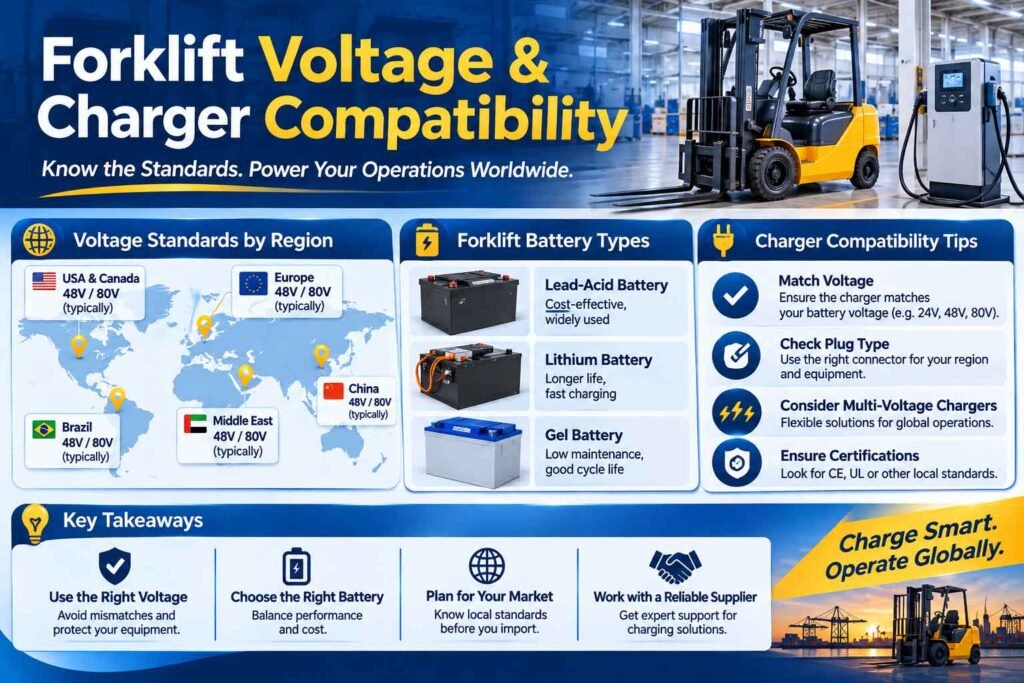
Voltage and Charger Compatibility Across Countries
Understanding Voltage and Charger Compatibility Across Countries
Why Voltage Compatibility Matters
Electric forklifts rely heavily on their batteries and chargers to function efficiently. The forklift charger voltage must match the local power supply voltage and frequency to ensure safe and effective charging. Different countries have varying electrical standards:
| Voltage Range | Frequency | Typical Regions |
|---|---|---|
| 100 – 127 V | 60 Hz | USA, Canada, Japan, parts of S. America |
| 220 – 240 V | 50 Hz | Europe, China, Australia, India, most of Asia |
Using a charger designed for a 220V supply in a 110V region (or vice versa) can cause chargers to malfunction or batteries to charge improperly, leading to shortened battery life or forklift downtime.
Plug Types and Frequency Differences
Beyond voltage, plug types and electrical frequency (50Hz vs. 60Hz) vary globally. The International Electrotechnical Commission (IEC) identifies 15 plug types (A through O), and countries may use multiple types simultaneously. For example, China accepts types A, C, and I plugs, while India uses types C, D, and M.
Frequency differences affect motor-driven equipment performance. A 60Hz motor running on 50Hz supply spins slower and may overheat, making frequency compatibility crucial for forklifts and chargers.
Forklift Charger Voltage: What Buyers Must Confirm Before Importing
When importing electric forklifts, confirming charger voltage and compatibility with the local power supply is paramount. According to expert insights from Zone Machinery and other industry leaders, buyers should verify:
- Charger Input Voltage: Is it 110V, 220V, 380V, or 415V?
- Phase Type: Single-phase or three-phase power supply?
- Frequency: 50Hz or 60Hz?
- Plug Type: Local plug or industrial socket?
- Output Voltage: Must match forklift battery voltage (e.g., 48V, 80V).
- Output Current: Determines charging speed.
- Connector Type: Must fit the battery socket securely.
- Charger Protection: Suitable for indoor or outdoor use.
- Cable Length: Standard or customized for your charging setup.
Pro Tip: Always send a photo of your local power socket or consult a local electrician before placing an order for chargers.
Lead-Acid vs. Lithium Batteries: Impact on Charger Voltage and Compatibility
Lead-Acid Batteries
- Voltage Levels: Commonly 24V, 36V, 48V.
- Charging Characteristics: Require constant voltage and current with a multi-stage charging curve (bulk, absorption, float, equalization).
- Charging Time: Longer, often 8-10 hours for a full charge.
- Maintenance: Requires watering, ventilation, and regular inspections.
- Charger Voltage: Must precisely cover the battery’s absorption and float voltage points.
Lithium-Ion Batteries (LiFePO4)
- Voltage Levels: Slightly higher nominal voltages (e.g., 51.2V for 48V lead-acid equivalent).
- Charging Characteristics: Use constant current/constant voltage (CC/CV) charging without float or equalization stages.
- Charging Time: Faster, often 2.5-3 hours due to high charging currents.
- Maintenance: Minimal, managed by battery management systems (BMS).
- Charger Voltage: Must be compatible with BMS communication and voltage cut-offs.
Important: Lithium battery chargers often require three-phase 380V input for high current charging, while lead-acid chargers can operate on single-phase 220V or 110V systems depending on capacity.
Practical Charger Voltage Examples for Forklifts
| Forklift Type | Battery Voltage | Typical Charger Output Voltage Range | Notes |
|---|---|---|---|
| Electric Pallet Truck | 24V | 28.8 – 29.4 V (Lead-Acid) | Lower voltage, smaller capacity |
| Light to Medium Forklift | 36V – 48V | 43.2 – 58.8 V | Charger must cover float and absorption voltage |
| Heavy-Duty Forklift | 80V+ | 96 – 98 V | Requires industrial-grade charger |
How Voltage and Charger Compatibility Affects Forklift Operations
Consequences of Incompatibility
- Charging Failures: Charger won’t start or stops mid-cycle.
- Battery Damage: Overvoltage or undervoltage reduces battery lifespan.
- Operational Downtime: Forklift unusable until charging issues resolved.
- Additional Costs: Electrical modifications, replacement chargers, and spare parts.
Hidden Costs to Watch For
- Electrical modifications due to voltage mismatch.
- Plug replacements for incompatible connectors.
- Downtime costs during troubleshooting.
- Operator training for proper charging protocols.
- After-sales support expenses.
Setting Up a Safe and Efficient Charging Station
A proper charging area is essential for safety and efficiency:
- Designated Charging Area: Prevents random charging and cable damage.
- Stable Power Supply: Avoids voltage fluctuations.
- Ventilation: Especially critical for lead-acid batteries to dissipate hydrogen gas.
- Fire Protection: Fire extinguishers and emergency equipment.
- Clear Signage: Warns untrained personnel.
- Trained Operators: Ensures correct charging procedures.
Regulations like OSHA 29 CFR 1910.178(g) specify these requirements for industrial trucks.
Tips for Importers and Warehouse Managers
- Confirm Local Power Specs: Voltage, phase, frequency, and plug type.
- Match Charger to Battery Voltage: Never mix incompatible chargers and batteries.
- Choose Battery Type Based on Use: Lead-acid for budget and light shifts; lithium for multi-shift and fast charging.
- Request Charger Label Photos: Verify specifications before shipment.
- Ask for Lithium Battery Shipping Documents: UN 38.3, MSDS, and customs paperwork.
- Plan Charging Area Setup: Safety and operational efficiency go hand-in-hand.
- Evaluate Supplier Battery Support: Warranty, spare parts, and technical guidance.
Conclusion: Ensuring Smooth Forklift Operations with Voltage and Charger Compatibility
Understanding voltage and charger compatibility across countries is crucial for anyone dealing with electric forklifts, especially when importing or operating in international environments. The right forklift charger voltage matching your local power supply, battery type, and application needs can mean the difference between seamless operations and costly downtime.
Before purchasing or importing forklifts, take the time to:
- Verify charger input voltage, phase, and frequency.
- Match charger output voltage and current to battery specifications.
- Consider battery chemistry and charging profiles.
- Prepare a safe and compliant charging area.
- Confirm all necessary shipping and compliance documents.
By following these guidelines, you can protect your investment, optimize productivity, and ensure your forklift fleet operates reliably across borders.
Ready to optimize your forklift charging setup? Contact your supplier today to discuss your local power supply details and get a tailored charger and battery solution that fits your operational needs perfectly.