Why Forklift Type Selection Matters More Than Most Buyers Realize
Walk into any equipment dealer and you'll hear some version of this sales pitch: 'Tell me your capacity requirement and I'll find you a truck.' That framing puts weight rating at the center of the decision — and it's the wrong starting point.
The type of forklift you choose determines your aisle width requirements, your floor specifications, your operator certification path, your fuel infrastructure, your lift height ceiling, and ultimately how much productive work the machine can actually do in your specific facility. Two forklifts with identical rated capacity can be entirely wrong for each other's environments. A 5,000 lb counterbalance truck cannot do what a 5,000 lb reach truck does — and vice versa.
This guide covers every major forklift type — grounded in OSHA's official classification system but organized around how real operations actually use and choose equipment. For each type, you'll get not just what it is, but where it genuinely excels, where it quietly fails, and what buyers consistently overlook.
The Foundation: OSHA's 7-Class System
OSHA classifies all powered industrial trucks (PITs) into seven distinct classes, organized by power source, design, and intended operating environment. Understanding this framework matters for two practical reasons: compliance and training. OSHA requires that forklift certification training be specific to the type of forklift being operated — training on a warehouse counterbalance truck does not qualify an operator to run a rough terrain forklift on a construction site.
Here is how the seven classes map onto the real world:
| Class | Official Name | Plain-English Translation |
|---|---|---|
| I | Electric Motor Rider Trucks | Sit-down or stand-up electric forklifts |
| II | Electric Motor Narrow Aisle Trucks | Reach trucks, order pickers, turret trucks |
| III | Electric Motor Hand Trucks | Powered pallet jacks, walkie stackers |
| IV | IC Engine Trucks — Cushion Tires | Indoor LPG/gas forklifts on smooth floors |
| V | IC Engine Trucks — Pneumatic Tires | Outdoor diesel/LPG forklifts |
| VI | Electric & IC Engine Tow Tractors | Tow tractors (airport tugs, etc.) |
| VII | Rough Terrain Forklifts | Construction and outdoor terrain trucks |
Most operations use equipment from Classes I, II, III, IV, V, and VII. Class VI (tow tractors) is specialized and outside the scope of most warehouse or industrial purchasing decisions.
The key insight the class system gives you: your operating environment and power source should drive the classification choice first, and individual truck type second. If you're indoors and need clean air — you're in Classes I, II, or III by default.
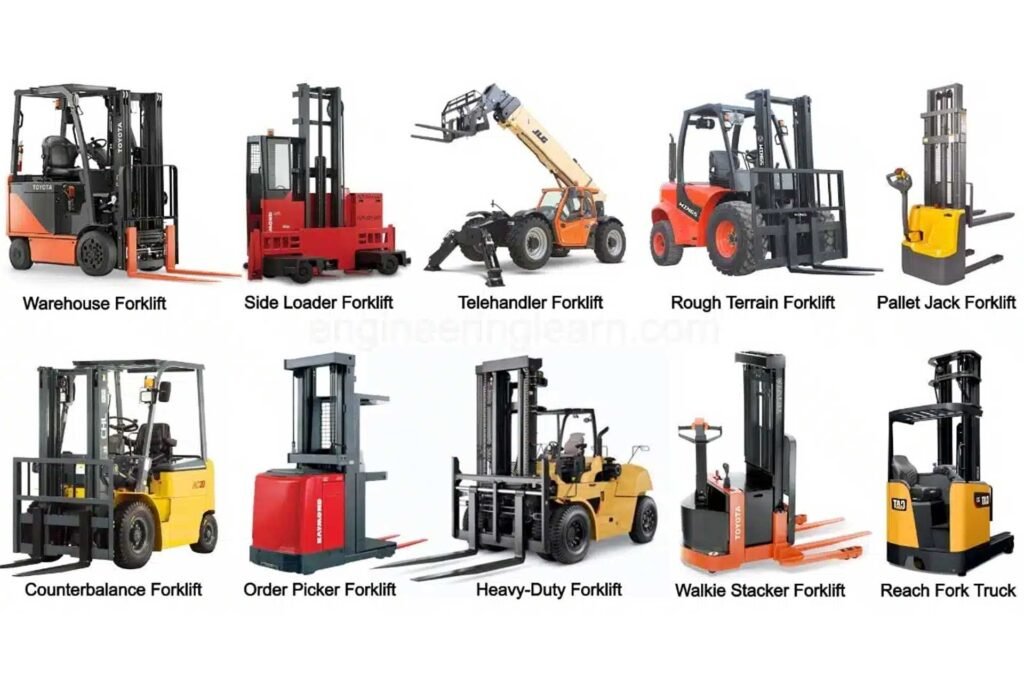
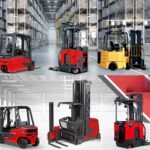
different types of forklifts
The 10 Forklift Types, Explained in Depth
1. Counterbalance Forklift
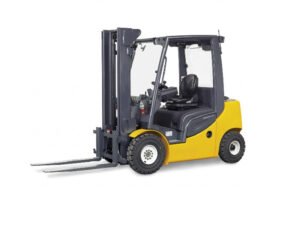
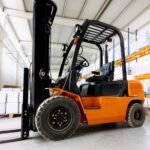
Counterbalance forklifts
OSHA Class: I (electric) or IV/V (ICE)
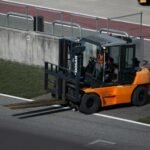
The counterbalance forklift is the mental image most people default to when they hear 'forklift': twin forks jutting from the front, a heavy weight built into the rear, an operator seated in a cab. It is by far the most common type in global use, and for many operations, the correct default choice.
The physics are elegant. The forks are permanently fixed to the front of the mast, and a heavy cast-iron counterweight at the rear offsets the weight of the load, preventing the machine from tipping forward when lifting a heavy pallet.This design allows the truck to drive directly up to a rack, shelf, or trailer without any outrigger legs or stabilizing arms — which is why it's so versatile across environments.
Typical capacities range from about 1.5 to 5+ tonnes, with lift heights generally between 4 and 7 meters. Some heavy-duty counterbalance models can handle loads well over 25,000 lbs.
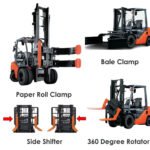
Where it excels: General warehousing, loading and unloading trailers at dock doors, manufacturing floors, outdoor yards (with pneumatic tires), and any operation where loads are varied in weight and dimension. The counterbalance truck also supports the widest variety of attachments — rotators, clamps, sweepers, bale clamps — making it genuinely multi-purpose.
Where buyers get surprised: Because of the heavy rear counterweight, counterbalance forklifts are long machines that need aisle widths of roughly 3.5–4.5 meters (about 10–13 feet) to turn safely.If your warehouse has aisle widths below that threshold, a counterbalance truck will create bottlenecks regardless of its rated capacity.
The overlooked specification: Load center distance. Every counterbalance forklift carries a capacity rating that is calibrated at a standard 24-inch load center (the horizontal distance from the fork face to the load's center of gravity). Move a bulky load whose center of gravity sits at 36 inches out, and actual safe capacity drops significantly — often by 20–30%. Always request the full rated capacity chart from your dealer, not just the headline number.
2. Reach Truck
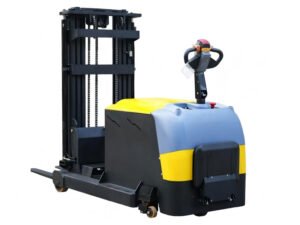
Reach Truck
OSHA Class: II (Electric Motor Narrow Aisle Truck)
The reach truck solves a specific problem that counterbalance forklifts cannot: how to work efficiently in narrow aisles while still reaching tall racking systems.
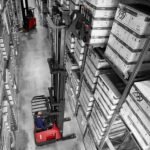
Unlike counterbalance forklifts, reach trucks do not use a rear counterweight. Instead, they use two forward-projecting base legs to stabilize the load. The forks are mounted on a pantograph mechanism — a hydraulic scissor-like device — that allows the forks to extend horizontally into a pallet rack while the truck body remains in the aisle.
This design has two major consequences. First: a reach truck can operate in aisles as narrow as 8 to 9 feet — versus the 11 to 13 feet required by a standard counterbalance forklift. By switching to reach trucks, a warehouse can often fit an entire extra row of storage racks into the same building footprint, dramatically increasing storage capacity without paying for a larger facility.
Second: reach trucks can lift to heights of 8–12 meters or more — some models exceed 40 feet — making them the standard choice for high-bay warehouses where vertical storage is the primary space efficiency lever.
The tradeoff that surprises buyers: Reach trucks have limited load capacity compared to counterbalance forklifts. The strongest reach truck models top out at about 4,500 lbs — where counterbalance trucks can lift many times that. They are also strictly indoor machines. Reach trucks have small polyurethane wheels that would get stuck or damaged on rough outdoor pavement.
The floor flatness issue nobody mentions in brochures: Reach trucks operating at heights above 20–25 feet are extremely sensitive to floor flatness. At height, minor floor undulation translates to significant load sway. Before purchasing reach trucks for high-bay operation, verify that your floor's F-number rating meets the manufacturer's specification — and if you're building a new facility, specify the floor before you specify the trucks.
Reach truck subtypes worth knowing:
- Single-reach: Extends one pallet position deep into racking — the most common type.
- Double-reach (deep-reach): Extends two positions deep, enabling double-deep pallet storage. Requires paired storage management.
- Turret truck (very narrow aisle / VNA): Can rotate its forks 90 degrees in both directions without the truck turning. Operates in aisles as narrow as 5–6 feet but requires specialized floor guidance systems (wire or rail).
3. Order Picker
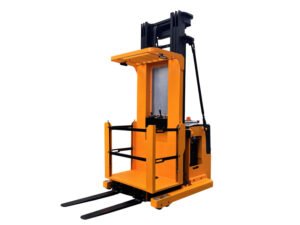
Order Picker
OSHA Class: II (Electric Motor Narrow Aisle Truck)
The order picker is an inversion of typical forklift logic: instead of the operator remaining at ground level while the forks rise, the operator platform rises with the forks, allowing workers to pick individual items from shelves at height. This makes order pickers the primary tool in e-commerce fulfillment and piece-picking environments where workers need to access specific SKUs from racking at multiple heights rather than moving whole pallets.
The safety reality that purchase decisions often underweight: Order pickers have a disproportionately high rate of operator injury related to falls. The worker is elevated on an open platform — and an unrestrained operator who leans out at 20 feet is exposed to a life-threatening fall risk. OSHA's requirements around fall protection on order pickers are clear, but budget calculations that treat the truck as a standalone purchase and the fall-arrest harness and anchor system as optional accessories are dangerously backward. The safety equipment is part of the system cost, not an add-on.
Best for: E-commerce fulfillment centers, retail distribution, pharmaceutical warehouses — any operation that picks individual items from racking rather than moving complete pallets.
4. Pallet Jack (Manual and Powered)
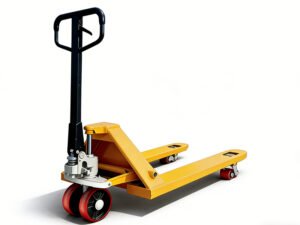
CBD Manual Pallet Jack 2–5 Ton Hydraulic Hand Pallet Truck
OSHA Class: III (Electric Motor Hand Trucks or Hand/Rider Trucks)
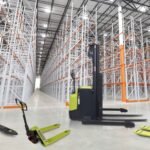
The pallet jack is the most basic powered industrial truck: no mast, no lift height beyond a few inches off the ground, designed purely to move palletized loads horizontally across flat surfaces. Manual versions are hand-pumped hydraulically; powered walkie versions add an electric motor; rider versions allow the operator to stand on a platform.
It's not glamorous, but it's systematically under-utilized as a cost-saving alternative to full forklifts in appropriate settings.
The substitution opportunity: A powered walkie-rider pallet jack ($3,000–$8,000) versus a sit-down counterbalance forklift ($22,000+) represents a 65–85% cost reduction per unit. For operations that move pallets on flat, level floors over short distances without any stacking requirement, the pallet jack handles the work equally well at a fraction of the capital and operating cost. Many operations that think they need forklifts could run on a fleet of powered pallet jacks — and should seriously evaluate that option before committing to counterbalance equipment.
Where it genuinely doesn't work: Any application requiring load stacking or lift height above about 8 inches. Pallet jacks move laterally; they don't stack.
5. Walkie Stacker
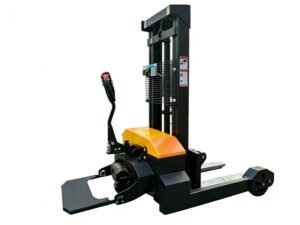
CDDO Electric Stacker 1.5–2.0 Ton Wide Leg Walkie Type
OSHA Class: III (Electric Motor Hand Trucks)
A walkie stacker is essentially a pallet jack fitted with a mast — giving it the ability to raise loads vertically, typically up to 10–15 feet, while still being operated by a walking (not riding) operator who walks alongside or behind the machine.
It sits in a useful middle ground: more capable than a pallet jack (can stack), less expensive and complex than a full reach truck or counterbalance forklift. For small warehouses, retail stockrooms, or light manufacturing operations that need occasional stacking but not the throughput or height capacity of a full forklift fleet, a walkie stacker is frequently the most cost-efficient solution.
Counterintuitive limit: Walkie stackers look like they should be able to operate in very narrow spaces — and they can navigate narrow aisles. But their stability at height is more limited than a counterbalance truck or reach truck. Check the rated capacity at the operating lift height carefully; capacity often drops sharply above 8–10 feet.
6. Sit-Down vs. Stand-Up Counterbalance: A Distinction That Matters
Within Class I and Class IV/V, buyers often treat sit-down and stand-up configurations as cosmetic variants. They aren't.
Sit-down counterbalance trucks are better for: operations involving long travel distances, outdoor or uneven surfaces (because the seated position absorbs shock better), and heavy loads requiring sustained operation over a full shift.
Stand-up (end-rider) counterbalance trucks are better for: applications requiring the operator to dismount frequently — such as in loading dock environments where the operator gets on and off the truck to hand-stage freight. Stand-up configurations eliminate the time cost of climbing in and out of a seated cab, making them significantly faster in high-dismount-frequency applications. They are generally not appropriate for long travel distances or rough surfaces.
Choosing the wrong posture configuration for a high-dismount operation (forcing operators to climb in and out of a sit-down truck dozens of times per shift) adds meaningful fatigue and time cost that accumulates across your entire fleet's working life.
7. Side Loader
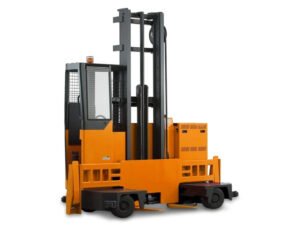
Sideloader Forklift
OSHA Class: I (electric) or IV (ICE cushion tire)
The side loader is the specialist for long, awkward loads — lumber, steel pipe, aluminum extrusions, glass panels, structural steel. The operator stands in a sideways-facing compartment, and the forks are mounted on the side of the machine rather than the front. This allows the truck to drive parallel to a rack and load or unload without needing to turn — making it capable of handling long items that a standard counterbalance forklift would have to approach from an inconvenient angle.
In a conventional counterbalance truck, a 20-foot steel beam cannot be safely handled in a standard warehouse aisle — the geometry doesn't allow it. A side loader was designed precisely for this problem.
Who genuinely needs one: Steel service centers, timber yards, aluminum distributors, glass manufacturers, and any operation regularly handling loads whose length exceeds what a standard counterbalance truck can safely manage in available aisle space.
Who probably doesn't: Anyone handling standard pallet-format loads. Side loaders are slower, more expensive, and operationally narrower in scope than counterbalance trucks. They're a specialist tool, not a general-purpose upgrade.
8. Rough Terrain Forklift
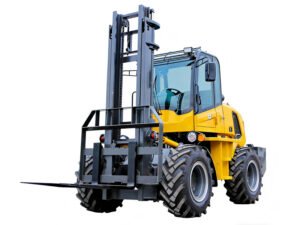
Rough Terrain Forklift
OSHA Class: VII
Rough terrain forklifts are designed for use on unimproved natural terrain and disturbed terrain at construction sites. Large, deeply treaded pneumatic tires, higher ground clearance, and powerful ICE engines (typically diesel) allow them to operate in conditions that would stop every other forklift type.
Three subtypes within Class VII:
- Straight-mast rough terrain: The most traditional form. Forks are at the front, mast raises vertically. Used primarily for unloading material deliveries at construction sites.
- Telehandler (telescoping handler): Covered separately below — technically Class VII but functionally distinct enough to warrant its own discussion.
- Truck/trailer-mounted: A portable self-propelled forklift that is typically transported to the job site mounted on a carrier attached to a truck or trailer, used to unload heavy items at the delivery destination.
The critical misuse pattern: Rough terrain forklifts are regularly pressed into mixed indoor/outdoor service because an operation has only budgeted for one type of machine. This is a poor compromise. Their large turning radius, heavy weight, and aggressive pneumatic tires cause floor damage and operational inefficiency indoors. If your operation genuinely requires both outdoor rough terrain capability and indoor warehouse work, the answer is two different machines — not one rough terrain unit doing both badly.
9. Telehandler (Telescopic Handler)
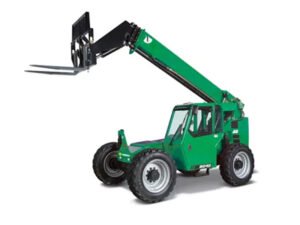
Telehandler
OSHA Class: VII
The telehandler, also known as a telescopic handler or telescopic forklift, is characterized by a telescoping boom that can extend forward, upward, or both simultaneously — allowing it to place loads at variable angles and positions that a conventional straight-mast forklift cannot reach.
The telehandler's boom supports a much wider variety of attachments than a standard forklift: pallet forks, hooks, scoops, buckets, and man baskets — giving it functionality that crosses into crane and aerial work platform territory.
A standard telehandler can lift approximately 5,500–12,000 lbs and reach heights up to 55 feet depending on model. Heavy-duty telehandlers used in construction and quarrying extend these limits considerably.
Where the telehandler wins decisively: Any job site where materials need to be placed above ground level, over obstacles, or at angles that a straight-mast forklift cannot achieve. Framing materials lifted to the second floor of a building under construction. Pallets placed on an elevated platform over a wall. Loads positioned in locations the truck itself cannot drive to.
The legitimate question buyers should ask: If your operation is outdoor-heavy and involves variable load placement, is a telehandler actually a better single investment than a conventional rough terrain forklift? In many construction and agricultural settings, the answer is yes — the telehandler's flexibility often makes it the more useful and cost-effective machine despite the higher unit price.
10. Autonomous / Automated Forklift (AGF)
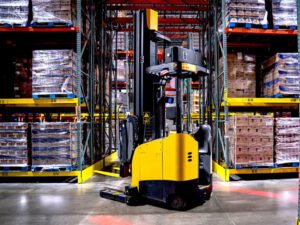
Autonomous Forklifts
OSHA Class: Varies (typically Class I or II in practice)
Autonomous forklifts use sensors, LiDAR, cameras, and advanced navigation technologies to operate with minimal human intervention. Grand View Research They represent the fastest-growing segment in the industry — Amazon, for example, has deployed autonomous material handling equipment across its fulfillment network at scale.
This category is genuinely different from the others in one important respect: the hardware is not the primary decision. Autonomous forklifts are a systems integration project. The truck is the visible part of an infrastructure investment that also includes floor markings or QR code navigation systems, warehouse management system (WMS) integration, charging infrastructure, safety zone mapping, and ongoing software maintenance.
Buyers who evaluate autonomous forklifts as a forklift purchase — comparing unit price to a conventional truck — are solving the wrong problem. The correct evaluation compares total implementation cost (hardware + integration + infrastructure + training + software licensing) against the full labor, safety, and throughput costs of the alternative.
When autonomous forklifts deliver clear ROI: High-volume operations with consistent, repetitive routes and predictable SKU profiles. Facilities running two or three shifts where labor cost is the dominant operating expense. Environments with documented forklift incident frequency where removing the human-equipment interface reduces insurance and liability costs.
When they don't (yet): Low-volume or highly variable operations. Facilities with complex floor layouts requiring frequent re-routing. Small warehouses where the implementation overhead exceeds the labor savings.
How to Match Forklift Type to Your Operation: A Practical Framework
Most mismatches happen because buyers start with the question 'what type of forklift do I need?' without first answering four prerequisite questions. Answer these first:
Question 1: Indoor or outdoor — or both? Indoor on smooth concrete: Classes I, II, or III (electric preferred). Outdoor on firm, paved surfaces: Classes IV or V (ICE or electric with pneumatic tires). Outdoor on rough, uneven terrain: Class VII. Mixed indoor/outdoor: budget for two types, not one compromise.
Question 2: What is your narrowest aisle width? Measure the narrowest aisle in your facility before speaking to any dealer.
- Under 6 feet: Very narrow aisle turret truck (Class II)
- 8–10 feet: Reach truck (Class II)
- 10–13 feet: Sit-down or stand-up counterbalance (Class I or IV/V)
- Wide open: Any type is workable; choose on other criteria
Question 3: What is your maximum required lift height?
- Up to 15 feet: Walkie stacker, counterbalance forklift
- 15–30 feet: Counterbalance forklift with appropriate mast configuration
- 30–40+ feet: Reach truck or turret truck
- Variable height with forward reach: Telehandler
Question 4: Are you moving whole pallets or picking individual items? Whole pallet movement → counterbalance, reach truck, or pallet jack depending on answers above. Individual piece picking at height → order picker. Long/awkward loads → side loader.
Side-by-Side Comparison: The Most Commonly Confused Types
| Feature | Counterbalance | Reach Truck | Order Picker | Rough Terrain |
|---|---|---|---|---|
| Aisle width needed | 10–13 ft | 8–10 ft | 8–10 ft | 12–15 ft |
| Max lift height | 15–30 ft | 30–40+ ft | 30–35 ft | 15–25 ft |
| Max capacity | 2,000–100,000+ lbs | 2,000–4,500 lbs | 2,000–3,500 lbs | 5,000–15,000+ lbs |
| Operator position | Seated (or stand-up) | Standing, sideways | Standing, elevated | Seated |
| Indoors? | ✅ Yes | ✅ Yes (smooth floors only) | ✅ Yes | ❌ Not recommended |
| Outdoors? | ✅ Yes (pneumatic tires) | ❌ No | ❌ No | ✅ Yes |
| Fuel options | Electric, LPG, diesel | Electric only | Electric only | Diesel (primarily) |
| Best use case | General purpose | High-bay, narrow aisles | Piece picking | Construction, outdoor |
The Classification Trap: Why 'Type' and 'Class' Don't Always Align Neatly
One source of genuine confusion for buyers: OSHA's class system and the industry's common naming conventions don't map onto each other cleanly. A 'reach truck' is a Class II machine — but so is an order picker and a turret truck. A 'counterbalance forklift' can be Class I (electric), Class IV (ICE with cushion tires), or Class V (ICE with pneumatic tires) depending on its power source and tire type. And technically, a powered pallet jack is a forklift under OSHA's definition, even though most people wouldn't call it one.
This matters for certification. OSHA requires that operator training be specific to the equipment being used in the actual workplace — so an operator certified on a Class I electric counterbalance truck is not automatically qualified to operate a Class II reach truck, even within the same facility. Ablesafety When planning fleet expansion or operator cross-training, factor in the certification requirements of each class being added.
What's Changing in 2026: Type-Level Trends That Affect Buying Decisions
Reach trucks and Class II equipment are growing fastest within the warehouse segment. Class 32 forklifts — which include electric pedestrian trucks and narrow-aisle warehouse equipment — are expected to dominate the global market, driven by e-commerce growth, high-density warehouse design, and the push to maximize square footage without expanding physical footprint.
ICE counterbalance (Class IV/V) is the one category in structural decline. Class 4 and 5 forklifts — ICE counterbalance units — are the only category showing negative long-term growth, with a projected 10-year CAGR of -0.5%, driven by stricter environmental regulations, TCO disadvantages relative to electric, and corporate ESG commitments accelerating fleet replacement. Interact Analysis If you are buying Class IV/V today, build a shorter resale assumption into your financial model.
Lithium-ion is replacing lead-acid across all electric types. This isn't just a trend for counterbalance trucks — it applies to reach trucks, order pickers, and powered pallet jacks equally. Lithium-ion's advantages (opportunity charging, no watering maintenance, longer cycle life, no ventilation requirement) are type-agnostic.
Autonomous capability is arriving first in Class II. The most commercially mature autonomous forklift deployments are in narrow-aisle and reach truck configurations — environments where routes are predictable, floors are controlled, and the ROI case for removing human operators is clearest.
Final Guidance: The One-Sentence Decision Filter for Each Type
- Counterbalance: You need a versatile workhorse that moves varied loads in and out of trailers and around a facility with wide aisles.
- Reach truck: Your warehouse has narrow aisles and tall racking, and you're maximizing vertical storage density.
- Order picker: Your operators need to physically access specific items from shelving at height — not move whole pallets.
- Powered pallet jack / walkie: You move pallets on flat floors and don't need to stack — you're probably spending more than you need to on a full forklift.
- Walkie stacker: You occasionally need to stack loads to moderate heights but your volume doesn't justify a full forklift.
- Side loader: You handle long, unwieldy loads — pipe, lumber, steel — that a front-facing forklift cannot manage in your aisles.
- Rough terrain forklift: Your worksite is genuinely uneven or unpaved, and the machine stays outside.
- Telehandler: You need to place loads at variable heights and angles outdoors, and fork attachment alone won't cover your use cases.
- Autonomous forklift: You have a high-volume, repetitive operation and you're ready to treat this as a systems project, not an equipment purchase.
The type of forklift you choose shapes everything downstream: your facility layout, your training program, your fuel infrastructure, your maintenance costs, and your resale value in 5–7 years. Get the type right first — then optimize for brand, capacity, and features.