Most comparisons of electric and diesel forklifts end with some version of: 'It depends on your specific needs.' That's not wrong — but it's also not useful. You came here to make a decision, not to be told the decision is complicated.
So let's be direct. Electric and diesel forklifts are not competitors in every situation. They're tools built for different jobs. The real question isn't which one is better in the abstract — it's which one is right for your specific operation, and how do you calculate that clearly.
This guide gives you a five-question framework that resolves the answer for most operations, a real TCO comparison with actual numbers, an honest look at where diesel genuinely wins, and a practical cost calculator for businesses already running diesel and considering a switch.
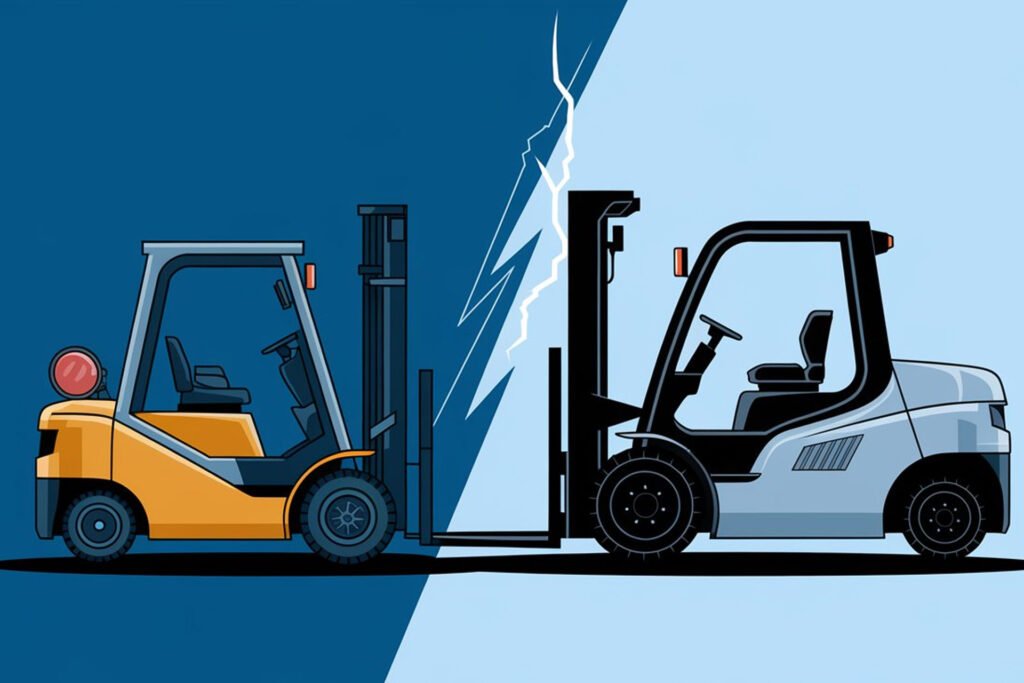
Electric vs Diesel Forklift
Before the Comparison: Stop Thinking in Absolutes
Here's something most comparison articles won't tell you: plenty of businesses run both. A distribution center uses electric counterbalance forklifts on the warehouse floor and a diesel unit in the outdoor yard. A manufacturing plant runs electric inside the facility and diesel at the loading dock for heavy inbound freight.
The 'which is better' question often has a false premise built in — that you need to pick one for everything. Sometimes you do. But sometimes the right answer is electric for 80% of your operation and diesel for the remaining 20%.
With that framing established, here's how to work out where your operation lands.
The 5 Questions That Resolve the Decision for Most Buyers
Answer these in order. For most operations, the answer becomes clear before you reach question five.
Question 1: What is your primary working environment?
Mostly indoors, enclosed facility: Electric is the correct default. Diesel and propane engines produce carbon monoxide and other combustion byproducts that accumulate in enclosed spaces. This creates real air quality and compliance problems — mandatory ventilation systems at minimum, and in food processing, pharmaceutical, or cold storage environments, outright regulatory barriers to ICE equipment. Electric produces zero exhaust at the point of use.
Mostly outdoors, unpaved or rough terrain: Diesel has the advantage. Large pneumatic tires, high ground clearance, and powerful diesel engines handle the conditions that stop electric forklifts — mud, gravel, uneven surfaces, and outdoor job sites without charging infrastructure.
Genuinely mixed — significant time both indoors and outdoors: Continue to question two. The answer depends on your shift pattern and load requirements.
Question 2: How many shifts do you run per day?
Single shift (roughly 6–8 hours of operation): Electric works well in either lead-acid or lithium-ion configuration. Standard overnight charging covers single-shift needs without any operational complexity.
Two shifts: Electric with lithium-ion batteries remains viable — lithium-ion charges in 1–3 hours and supports opportunity charging during breaks, making two-shift operation manageable with one battery per truck. Lead-acid is problematic for two-shift operation without a significant battery infrastructure investment.
Three shifts or continuous operation: This is where the calculation gets genuinely competitive. Diesel can refuel in minutes and run continuously. Electric lithium-ion can manage three shifts with fast charging and disciplined charging schedules, but requires more planning and potentially more charging infrastructure investment. For truly continuous, uninterrupted outdoor heavy-duty operation, diesel retains a practical advantage.
Question 3: What is your maximum load requirement?
Under 12,000 lbs (approximately 5.5 tons): Electric counterbalance forklifts cover this range fully. Most standard warehouse and distribution operations fall well within it — the typical maximum load for general warehousing is 6,000–8,000 lbs.
12,000–25,000 lbs: This is a transition zone. Heavy-duty electric forklifts exist at this capacity range, but selection is narrower and pricing is high. Diesel typically offers more options and more established performance at these weights.
Above 25,000 lbs: Diesel is the practical choice. Port operations, steel mills, lumber yards, heavy manufacturing — these applications are diesel territory, and the electric alternatives at this capacity range are either limited or not yet commercially mature.
Question 4: What is your ownership horizon?
Under 3 years: Diesel's lower purchase price is a genuine advantage on short time horizons. The fuel and maintenance savings of electric don't accumulate fast enough to overcome the upfront premium within three years at moderate utilization.
3–5 years: This is where the crossover happens for most operations. Electric's lower fuel and maintenance costs begin to recover the upfront premium somewhere in year two to four depending on utilization. By year five, most standard operations are ahead on electric.
5+ years: Electric's total cost of ownership advantage is substantial over long ownership horizons. The fuel savings alone — $3,000–$8,000 per truck per year at standard utilization — compound significantly over five to seven years of ownership.
Question 5: Are you operating in a regulated market?
California: California's Air Resources Board has mandated that new internal combustion forklifts cannot be sold or leased starting in 2026. If you operate in California, this is not a preference question — it's a compliance question. Buying diesel today means buying into a market where replacement options will be restricted and resale values are declining.
European Union: The EU's Green Industry Plan targets zero-emission logistics equipment across European markets by 2030. Fleet replacement cycles are already being affected. Businesses buying diesel equipment today in EU markets are buying into an accelerating depreciation curve.
Other markets: Regulations are less immediate but the direction is consistent globally. The resale market for diesel forklifts is narrowing in most developed markets. This affects the residual value calculation on any diesel equipment purchased today.
The TCO Comparison: Where the Numbers Actually Land
This is the calculation most buyers say they want to do but rarely do in full. Here's a realistic five-year total cost of ownership comparison for a standard 3-ton counterbalance forklift running one shift per day, five days per week (approximately 2,000 hours per year).
| Cost Category | Electric (Lithium-Ion) | Diesel |
|---|---|---|
| Purchase price (all-in) | $35,000–$48,000 | $20,000–$30,000 |
| Annual fuel / energy cost | $3,000–$6,000 | $8,000–$15,000 |
| Annual maintenance cost | $800–$1,500 | $3,500–$5,000 |
| 5-year fuel / energy total | $15,000–$30,000 | $40,000–$75,000 |
| 5-year maintenance total | $4,000–$7,500 | $17,500–$25,000 |
| 5-year total cost | $54,000–$85,500 | $77,500–$130,000 |
| Typical breakeven point | Year 2–4 | — |
The pattern is consistent across capacity ranges and configurations: diesel costs less on day one, electric costs less over time. The crossover point varies depending on utilization, local fuel prices, and electricity rates — but for most operations running standard hours, electric reaches breakeven well within the five-year ownership period.
What moves the breakeven point earlier (favoring electric faster):
- High utilization — more hours per day means more fuel savings accumulating
- High local diesel or propane prices
- Multi-shift operation where diesel maintenance costs escalate faster
- Regulatory markets where diesel faces compliance costs
What moves the breakeven point later (diesel stays competitive longer):
- Low utilization — under 4 hours per day, fuel savings don't accumulate quickly
- Low local diesel prices
- Short ownership horizon of 2–3 years
- Remote locations where electric infrastructure investment is high
Where Diesel Genuinely Wins: An Honest Assessment
Most articles written from an electric forklift perspective understate diesel's genuine advantages. That's a mistake — it reduces credibility and doesn't help buyers make good decisions. Here's where diesel is the right answer.
Super-heavy applications above 15,000 lbs
At very high capacities — ports, steel service centers, timber yards, heavy manufacturing — diesel still dominates. The combination of high torque, rapid refueling, and proven performance at extreme loads makes diesel the established choice for operations that genuinely need this level of capability.
Remote sites with no charging infrastructure
A construction site in a rural location, an agricultural operation in the field, any worksite where reliable electricity is unavailable or impractical — diesel wins by default. Electric requires infrastructure. Where that infrastructure doesn't exist and the cost to create it exceeds the operational savings, diesel is simply the practical choice.
Continuous outdoor heavy-duty operation
For operations that need to run equipment hard, continuously, in outdoor conditions without pause — think quarrying, large-scale construction, port terminal operations — diesel's ability to refuel in five minutes and keep running gives it a genuine operational advantage that electric lithium-ion, despite its progress, hasn't fully overcome for the most intensive applications.
Extreme cold environments with lead-acid fleets
Lead-acid battery performance drops significantly below freezing. Diesel engines handle cold temperatures more consistently. If you're running lead-acid electric equipment in sub-zero cold storage or outdoor winter conditions, diesel may actually be more reliable. Note: lithium-ion handles cold substantially better than lead-acid — this disadvantage largely disappears with the right battery chemistry.
For Businesses Already Running Diesel: The Switch Calculation
This section is for a specific reader: you're already operating diesel forklifts and wondering whether switching to electric makes financial sense. Here's how to actually calculate it.
The Switch Cost Formula:
Net switching cost = (Electric purchase price − Diesel trade-in value + Charging infrastructure investment) − (Annual savings × Years of ownership)
Let's run a real example.
You have a diesel forklift currently worth $8,000 in trade-in value. A comparable electric lithium-ion replacement costs $40,000 all-in. Installing a charging station costs $2,000.
Net upfront switching cost: $40,000 − $8,000 + $2,000 = $34,000
Annual savings (fuel + maintenance at standard utilization):
- Fuel savings: ~$6,000/year
- Maintenance savings: ~$2,500/year
- Total annual savings: ~$8,500/year
Payback period: $34,000 ÷ $8,500 = approximately 4 years
After year four, you're saving $8,500 per year in pure operating cost reduction. Over a 7-year ownership horizon, the switch generates net savings of roughly $25,500 per truck — before accounting for any residual value difference or regulatory compliance value.
Variables that change this calculation for your operation:
- Your actual diesel fuel consumption (higher usage = faster payback)
- Local electricity rates (lower electricity costs = more annual savings)
- Your trade-in value on existing equipment (higher trade-in = lower net switching cost)
- Charging infrastructure requirements (some facilities need minimal investment; others need more)
- Whether you're in a regulated market (compliance value accelerates the effective ROI)
Run this calculation with your actual numbers before making a decision. The formula is simple; the inputs are specific to your operation.
The 2026 Context: Why This Decision Has a Time Dimension
Five years ago, this comparison was genuinely more balanced. Today, several external factors have shifted the analysis in ways that affect the long-term value of whichever choice you make.
Diesel equipment is depreciating faster in regulated markets
The resale market for diesel forklifts in California, Europe, and increasingly other developed markets is contracting. Equipment that would have held its value well five years ago is now facing a narrowing pool of buyers at resale. If your ownership horizon extends beyond three to four years in these markets, the residual value calculation on diesel equipment has changed materially.
Lithium-ion costs have dropped substantially
The cost of lithium-ion batteries has fallen by more than 40% over the past five years. The price premium that once made electric forklifts a difficult financial case at low utilization is significantly smaller than it was. At current pricing, the breakeven calculation on electric versus diesel is favorable for a wider range of operations and utilization profiles than it was even three years ago.
Charging infrastructure is becoming easier and cheaper
Fast-charging technology has improved significantly. Modern lithium-ion systems can restore 80% capacity in 60–90 minutes. Charging station installation costs have come down as more suppliers have entered the market. The infrastructure barrier that once made electric impractical for multi-shift or continuous operations is lower than it has ever been.
The regulatory direction is not reversing
Emissions regulations on industrial equipment are tightening, not loosening, across major global markets. Businesses that invest in electric fleets today are buying aligned with regulatory direction. Businesses that invest in diesel today are buying against it — which affects not just compliance costs but equipment resale values over the ownership period.
Decision Matrix: Your Situation at a Glance
Use this table as a starting point, not a final answer. The questions above give you the nuance; this gives you the direction.
| Your Operating Situation | Recommended Direction |
|---|---|
| Indoor warehouse, single shift | Electric — lead-acid or lithium-ion |
| Indoor warehouse, two or three shifts | Electric — lithium-ion |
| Food / pharmaceutical / cold storage | Electric — lithium-ion |
| Mixed indoor / outdoor, loads under 8,000 lbs | Electric with pneumatic tires |
| Mixed indoor / outdoor, loads 8,000–12,000 lbs | Electric (evaluate infrastructure) or diesel |
| Outdoor heavy-duty, loads above 15,000 lbs | Diesel |
| Remote site, no charging infrastructure | Diesel |
| California or EU regulated market | Electric — transition now rather than later |
| Construction site, continuous outdoor operation | Diesel |
| Short ownership horizon (under 3 years) | Diesel may be lower TCO; run the numbers |
| Long ownership horizon (5+ years) | Electric almost always wins on TCO |
Choosing an Electric Forklift Supplier: What to Look For
If your answers point toward electric — which they do for the majority of standard warehouse, distribution, and manufacturing operations — the next question is where to source equipment that combines quality, price, and reliable after-sales support.
The criteria that matter most, in order:
All-in pricing transparency. Truck price plus battery plus charger. Many suppliers quote the truck alone. The battery and charger can add $8,000–$20,000 to the real cost. Get the full number before comparing.
Battery configuration flexibility. Your shift pattern and duty cycle should determine your battery specification — not the supplier's standard catalog. A supplier who asks about your operation before recommending a battery is more valuable than one who sells the same configuration to everyone.
Certifications applicable to your market. CE certification for European buyers. ISO 9001 quality management as a baseline indicator of manufacturing consistency.
Genuine customization capability. Mast height, tire type, attachment compatibility, cab configuration — real build-to-order options, not just a catalog with fixed variants.
After-sales support you can actually reach. Parts availability, technical documentation, and responsive support after delivery. This matters more than almost anything else over the life of the equipment.
Where Maoxiang Fits
Hebei Maoxiang Technology Co., Ltd. manufactures CE-certified electric counterbalance forklifts from 0.6 to 5 tons — covering the full capacity range where electric genuinely outperforms diesel, with lithium-ion as the primary engineering focus.
For buyers whose decision matrix points to electric, Maoxiang offers the combination that most buyers are actually looking for: international certification standards, genuine customization capability, battery configurations built to customer specification, competitive pricing that reflects real manufacturing efficiency rather than compromised specifications, and after-sales support structured for global customers.
For buyers in the mixed zone — operations that need both electric and diesel capability — Maoxiang's electric range covers the indoor and moderate-duty outdoor applications, while diesel or LPG equipment handles the heavy outdoor work. Many operations run exactly this kind of split fleet.
The Bottom Line
Electric forklifts are better for most indoor and mixed operations on a five-year total cost basis. Diesel forklifts are better for heavy outdoor applications, remote sites, and very high capacity requirements. The answer is not the same for every operation — but it's also not as complicated as most comparison articles make it seem.
Five questions determine where you land. A straightforward TCO calculation confirms whether the numbers support that direction. And for businesses already running diesel, the switch calculation tells you whether the timing makes financial sense now or in the near future.
The buyers who make the wrong choice are almost always the ones who evaluated purchase price without running the five-year numbers, or who chose diesel for inertia — because that's what they've always used — without checking whether the economics still support that choice at current fuel prices, maintenance costs, and equipment pricing.
Run the numbers for your specific operation. The answer is usually clearer than it looks from the outside.