Quick Answer: Which Voltage Do You Need?
| Truck Type | Typical Voltage |
|---|---|
| Manual pallet jack (no battery) | — (manual) |
| Electric pallet jack (walkie) | 24V |
| Walkie stacker | 24V |
| Stand-on pallet truck (rider) | 24V |
| 3-wheel counterbalance (1–1.5 ton) | 48V |
| 4-wheel counterbalance (1.5–2.5 ton) | 48V |
| 4-wheel counterbalance (2.5–3.5 ton) | 72V |
| 4-wheel counterbalance (3.5–5 ton) | 72V / 80V |
| Heavy counterbalance (5+ ton) | 80V / 96V |
| Reach truck | 48V / 72V |
| Turret truck (VNA) | 80V |
| AGV / AMR | 24V / 48V |
The one rule: Never guess. Check the data plate or the existing battery label. The truck's controller, motors, charger, and connectors are all built around one voltage. Match it exactly.
How to Match the Right Battery to Your Truck
The Standard Voltages, Explained
24V — Small Equipment
Used in: Pallet jacks, walkie stackers, small AGVs, mini order pickers.
Why: Small motors need low voltage. A 24V system is simpler, cheaper, and lighter — perfect for equipment that moves a pallet a few meters at a time.
Battery types:
- Lead-acid: 2V cells × 12 = 24V
- Lithium: often 7S (7 cells × 3.2V) or 8S configurations
36V — The Odd One (Getting Rare)
Used in: Some older 3-wheel counterbalance models and mid-size pallet trucks.
Why: A transitional voltage. Most manufacturers moved to 48V years ago. If you have a 36V truck, parts and batteries are getting harder to find — budget for a conversion or replacement.
48V — The Workhorse
Used in: Most 1–2.5 ton counterbalance forklifts, reach trucks, order pickers.
Why: The sweet spot for mid-size warehouse equipment. Enough power for lifting and travel, low enough current for reasonable cable sizes and component costs.
Battery types:
- Lead-acid: 2V cells × 24 = 48V
- Lithium: 15S (48.0V nominal) — the most common lithium pack on the market
72V — Heavy Counterbalance
Used in: 2.5–5 ton counterbalance forklifts, larger reach trucks.
Why: Higher voltage = lower current for the same power. Less heat, thinner cables, more efficient at heavy loads. This is the standard for serious lifting work.
80V — High-Performance / VNA
Used in: Turret trucks, high-performance 3–5 ton counterbalance, fast-charge applications.
Why: The voltage that enables 18 m lift heights and high-speed travel in VNA warehouses. 80V is a Maoxiang/MiMA specialty — the MCC16-U turret truck runs on 80V.
96V — Heavy Duty
Used in: 5+ ton counterbalance forklifts, container handlers.
Why: Maximum power for the heaviest lifts. Fewer models use it because the components get expensive — but when you need to lift 8 tons all day, 96V is the platform.
How to Check Your Forklift's Voltage (30 Seconds)
Method 1 — The data plate (most reliable):
The data plate lists the battery specification. Look for 'Battery voltage' or 'V' — e.g., '80V / 560Ah.'
Method 2 — The existing battery label:
Every battery has a label with voltage and Ah. Check the side of the battery or the connector.
Method 3 — Count the cells (lead-acid):
A lead-acid battery is made of 2V cells connected in series.
| Number of Cells | Voltage |
|---|---|
| 12 | 24V |
| 18 | 36V |
| 24 | 48V |
| 36 | 72V |
| 40 | 80V |
| 48 | 96V |
Method 4 — Measure with a multimeter:
A charged lead-acid battery reads about 10–15% above nominal:
- 24V battery → ~26–28V charged
- 48V battery → ~52–56V charged
- 80V battery → ~87–92V charged
Warning: If you measure the battery directly, expect high DC voltage (up to 100V). Only touch the terminals with insulated probes and proper PPE.
The Danger of Wrong Voltage
| Mistake | Result |
|---|---|
| 48V battery into a 24V truck | Controller sees overvoltage → protection shuts down, or components fry |
| 24V battery into a 48V truck | Truck barely moves, motors stall, controller errors |
| 80V battery into a 72V truck | Overvoltage — controller damage, motor overspeed, fire risk |
| 72V battery into an 80V truck | Underpowered — won't lift rated capacity |
It's not just the battery. The charger must match too — charging a 48V pack with a 72V charger will overcharge and destroy the cells (or start a fire). Always match: battery voltage = truck system voltage = charger voltage.
Voltage vs Amp-Hours — What Matters for Runtime
Voltage is the system spec. Amp-hours (Ah) is the runtime spec. They work together:
Energy = Voltage × Amp-hours (Wh)
| Battery | Energy | Approx. Runtime (2-ton forklift) |
|---|---|---|
| 48V × 400Ah | 19.2 kWh | 5–6 hours continuous |
| 48V × 560Ah | 26.9 kWh | 7–8 hours |
| 72V × 400Ah | 28.8 kWh | 8–9 hours |
| 80V × 560Ah | 44.8 kWh | 10–12 hours |
You cannot change voltage (that's fixed by the truck). But you CAN choose amp-hours — a larger Ah battery fits the same voltage system and gives more runtime, within the physical battery compartment size.
Rule: Choose the largest Ah that fits the battery compartment and the truck's counterweight spec. But check the battery weight against the data plate — a heavier battery changes the counterweight and can invalidate the capacity rating.
Voltage and Lithium Conversions
Converting a lead-acid truck to lithium is popular — and it changes the voltage math slightly.
| Lead-Acid System | Lithium Pack (LiFePO₄) | Cells in Series |
|---|---|---|
| 24V | 7S (22.4V nominal) or 8S (25.6V) | 7–8 |
| 48V | 15S (48.0V) | 15 |
| 72V | 22S (70.4V) | 22 |
| 80V | 24S (76.8V) or 25S (80.0V) | 24–25 |
Key point: A lithium pack has a different voltage curve than lead-acid. Most modern controllers and chargers handle the difference automatically — but you must confirm compatibility with the truck's controller and charger before converting. A lithium pack on an old lead-acid-only charger is a fire risk.
Ask the supplier: 'Does this lithium pack have CAN BMS communication with my controller?' If the answer is no, the truck can't monitor state of charge properly and may shut down unexpectedly at 30% remaining.
How to Order the Right Battery
When you order a forklift battery, provide:
| Information | Example |
|---|---|
| Truck model | CPD20 |
| Serial number | 202603-0047 |
| Voltage | 48V |
| Battery compartment dimensions (L×W×H) | 980 × 480 × 620 mm |
| Current battery Ah | 560Ah |
| Battery weight (must match counterweight spec) | 850 kg |
| Connector type | Anderson SB350 |
| Chemistry preference | Lithium (LiFePO₄) or lead-acid |
| Charger compatibility | Existing charger voltage and type |
Give all of these and the supplier can quote a drop-in battery. Miss the dimensions and you get a battery that doesn't fit.
The Bottom Line
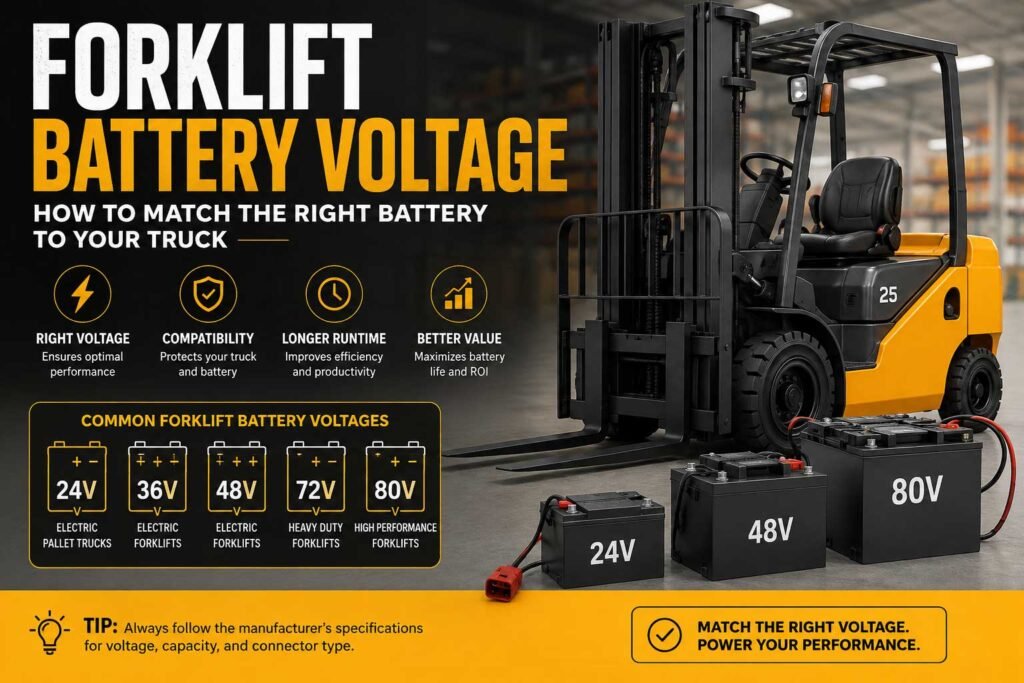
Forklift battery voltage is the one spec you cannot guess or upgrade. It's fixed by the truck's design: 24V for pallet jacks, 48V for standard warehouse trucks, 72V/80V for heavy and VNA equipment, 96V for the big machines.
Check the data plate. Match the voltage exactly. Choose the largest Ah that fits. And if you're converting to lithium, confirm controller and charger compatibility first.
The truck tells you the voltage — the only decision you make is Ah capacity and chemistry.
About the Author
Edward handles export sales at Hebei Maoxiang Technology, helping international buyers with forklift pricing, configuration, shipping, and export documentation. He has helped customers in 80+ countries match the right battery to the right truck — and saved more than one buyer from an expensive voltage mismatch.
Hebei Maoxiang Technology Co., Ltd.
- Web: forkliftlift.com
- Email: sales@maoxiang-tech.com
- Electric forklifts | Reach trucks | Turret trucks | Pallet jacks | Batteries (lead-acid & lithium) | Chargers
- FOB Tianjin | CE certified | 20–35 day lead | 24/7 quote support