Choosing the right forklift mast is about more than selecting the highest lifting height available. The right mast must match your rack height, building clearance, load requirements, operating environment, and the way the forklift will actually be used.
A mast that is too short may prevent you from reaching the highest storage position. A mast that is unnecessarily tall can create clearance problems, reduce visibility, and add cost without providing any practical benefit.
Before ordering a forklift, consider these seven factors to determine which mast configuration is right for your application.
How to Choose a Forklift Mast
1. Start With the Required Fork Height
The first question to answer is simple:
How high do you actually need to place your loads?
Start with the highest rack beam or storage position that the forklift must service. Then consider the height of the pallet and load, as well as the additional clearance needed to place or retrieve the load safely.
For example, if your highest storage position requires the forks to reach approximately 4.5 meters, choosing a forklift with a maximum lift height of exactly 4.5 meters may leave little room for practical operation.
The required lift height should therefore be based on the actual storage task rather than simply matching the forklift to the height of the rack.
Before selecting a mast, measure:
- Highest rack beam
- Highest pallet storage position
- Pallet and load height
- Required clearance above the load
- Required fork height during loading and unloading
Tip: Measure the actual operating height rather than relying only on the nominal height of your warehouse racking.
2. Check the Lowest Clearance on the Travel Route
A forklift may need to lift high inside the warehouse, but it also has to travel safely through doors, loading areas, and other restricted spaces.
This is where the mast's lowered height becomes critical.
Measure the lowest overhead obstruction along the forklift's normal route, including:
- Warehouse doorways
- Dock doors
- Container entrances
- Trailer entrances
- Ceiling beams
- Sprinkler systems
- Lighting fixtures
- Other overhead structures
The mast's lowered height must remain below the lowest clearance that the forklift needs to pass through.
This can create an important trade-off:
You may need a high lifting height without having a high lowered mast.
That is one reason multi-stage masts are commonly used in warehouses with high racking but limited overhead clearance.
3. Decide How Much Free Lift You Need
Free lift becomes particularly important when a forklift operates inside a confined space.
With sufficient free lift, the forks can rise a useful distance before the mast itself extends significantly upward. This allows the operator to raise a load while keeping the extended mast within the available overhead clearance.
High free lift can be especially useful for:
- Shipping containers
- Trailers
- Low-ceiling warehouses
- Rail cars
- Areas with overhead obstructions
For example, if a forklift frequently loads pallets inside a standard-height trailer, maximum lift height may not be the main concern. What matters is whether the forks can reach the required working height without the mast extending into the roof area.
Therefore, don't simply ask:
'How high can the forklift lift?'
Also ask:
'How high can the forks lift before the mast needs to extend?'
If the forklift will frequently operate in low-clearance environments, specify the required free lift when requesting a quotation.
4. Choose the Right Mast Stage
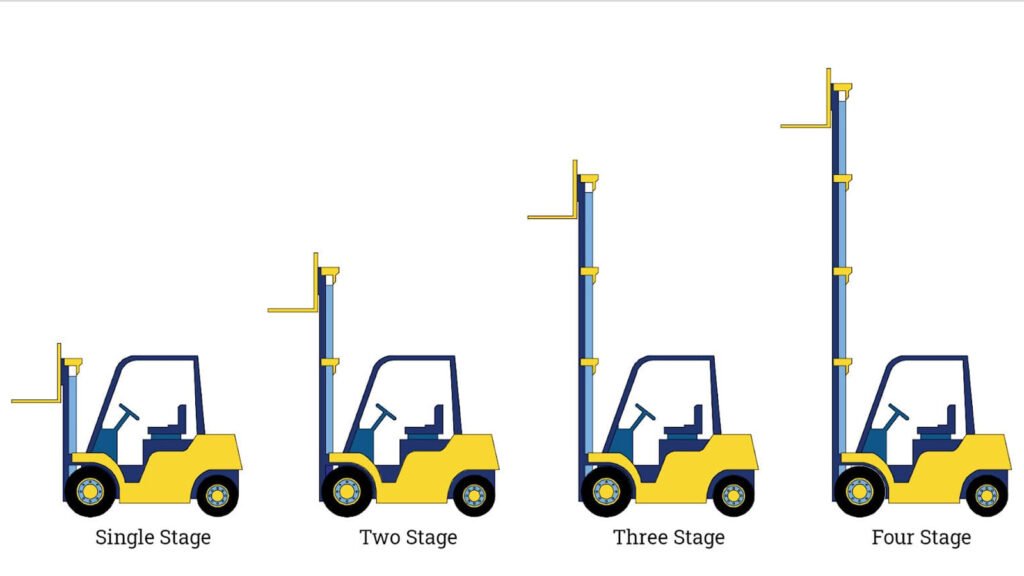
Forklift masts are commonly available in simplex, duplex, triplex, and, for specialized applications, quad configurations.
The choice should be based on the combination of required lift height and available clearance.
| Application | Typical Mast Choice |
|---|---|
| Low lifting requirements | Simplex |
| General warehouse operations | Duplex |
| High rack storage | Triplex |
| High lift with restricted overhead clearance | Triplex |
| Very high or specialized lifting | Quad or specialized mast |
Simplex Mast
A simplex mast uses a single-stage structure and is generally suitable for applications where the required lifting height is relatively low.
It can be a practical choice when high stacking capability is not required and the application favors a simple mast configuration.
Duplex Mast
A duplex mast is a common choice for general warehouse operations.
It provides more lifting height than a simplex mast while remaining relatively straightforward for everyday material handling.
For warehouses with moderate-height racking and conventional clearance conditions, a duplex mast may be sufficient.
Triplex Mast
A triplex mast uses three stages and is commonly selected when the forklift needs to achieve greater lift heights while maintaining a relatively low lowered height.
It is particularly useful for:
- High-bay warehouses
- Tall pallet racking
- Container loading
- Trailer loading
- Applications requiring high free lift
Quad Mast
Quad masts are used for more specialized applications where very high lifting capability is required.
They are not automatically the best choice simply because they offer greater lift height. The additional mast sections can affect visibility, complexity, and overall equipment cost.
The goal is not to choose the tallest mast. The goal is to choose the lowest-capability mast that safely meets your actual requirements.
5. Check Forklift Capacity at the Required Lift Height
This is one of the most important points when choosing a mast.
The capacity shown on a forklift's nameplate does not mean that the machine can lift that same weight under every operating condition.
Actual capacity can be affected by:
- Lift height
- Load center
- Load dimensions
- Attachment weight
- Attachment type
- Mast configuration
For example, a forklift may be rated at 2,500 kg under a specified load center and configuration, but its allowable capacity can be lower under a different operating condition or with certain attachments.
This is particularly important for high-level racking.
If your operation requires lifting a 2,000 kg load to 5 meters, don't simply search for a forklift advertised as a '2-ton' or '2.5-ton' machine.
Ask the supplier:
What is the rated capacity at my required lift height and load center?
The answer should be based on the manufacturer's capacity data for the specific forklift and mast configuration.
6. Consider Visibility and Working Conditions
Mast selection also affects operator visibility.
As the number of mast stages increases, the operator may have more mast components, chains, cylinders, and other structures in the forward field of view.
This can become particularly important when operating:
- In narrow aisles
- Around pedestrians
- In high-traffic warehouses
- Near loading docks
- At high lifting heights
If visibility is a major concern, ask the manufacturer about the mast design and available visibility options rather than selecting a mast based only on lifting height.
For applications involving frequent high-level pallet placement, the operator should have a clear view of the load and rack whenever practical.
7. Match the Mast to the Actual Application
The final step is to consider how the forklift will be used throughout the day.
Two warehouses with the same rack height may require completely different mast configurations.
For example:
Warehouse A
- 3.5 m rack height
- High ceiling
- No containers
- No restricted doorways
- Moderate loads
A standard duplex mast may be sufficient.
Warehouse B
- 6 m rack height
- Standard-height doorways
- Frequent container loading
- Heavy pallets
- Limited overhead clearance
A triplex mast with appropriate free lift may be a better solution.
The correct mast is therefore determined by the combination of lifting height, clearance, capacity, and operating conditions, not by one specification alone.
Forklift Mast Selection Checklist
Before requesting a quotation, prepare the following information:
Storage Requirements
- Highest rack beam: ______
- Highest pallet position: ______
- Maximum load height: ______
- Required fork height: ______
Clearance Requirements
- Lowest warehouse doorway: ______
- Lowest dock door: ______
- Container/trailer entry height: ______
- Lowest overhead obstruction: ______
Load Requirements
- Maximum load weight: ______
- Load center: ______
- Pallet dimensions: ______
- Attachment type and weight: ______
Operating Conditions
- Indoor or outdoor use
- Warehouse aisle width
- Container/trailer loading
- Frequency of high-level lifting
- Pedestrian traffic
- Surface conditions
Once these specifications are known, the forklift supplier can recommend the appropriate mast configuration and confirm the actual capacity at the required lift height.
Common Mistakes When Choosing a Forklift Mast
Choosing the Highest Mast Available
A taller mast is not automatically better.
If you only need to lift to 4 meters, purchasing equipment designed for 7 or 8 meters may add unnecessary cost and complexity.
Choose according to the actual application.
Looking Only at Maximum Lift Height
Maximum lift height tells you how high the forks can reach, but it doesn't tell you whether the forklift can pass through your doors or operate inside a container.
Always consider lowered height and free lift as well.
Ignoring Capacity at Height
A forklift's headline capacity is not enough to determine whether it can safely handle your load at the required elevation.
Always confirm capacity for your actual load center and lift height.
Forgetting About Attachments
An attachment can change the forklift's effective capacity and load center.
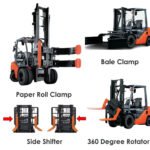
If you plan to use clamps, booms, side shifters, fork extensions, or other attachments, include them when specifying the forklift.
Choosing the Mast Before Measuring the Facility
The forklift should fit the working environment—not the other way around.
Measure the rack height, doorway clearance, loading areas, and overhead obstructions before finalizing the mast specification.
A Simple Way to Choose the Right Forklift Mast
You can think of mast selection as a four-step process:
Step 1 — Determine the required fork height
How high must the forks actually reach?
↓
Step 2 — Measure the lowest clearance
What is the lowest point the forklift must pass under?
↓
Step 3 — Determine free-lift requirements
Will the forklift operate inside containers, trailers, or other low-clearance areas?
↓
Step 4 — Confirm capacity at height
Can the forklift safely handle your actual load at the required lift height and load center?
If all four requirements are satisfied, you are much closer to the correct mast specification.
Final Thoughts
Choosing a forklift mast is a balancing exercise between lift height, lowered height, free lift, capacity, visibility, and operating conditions.
The best mast is not necessarily the one with the greatest lifting height. It is the one that allows the forklift to reach your required storage positions, pass safely through your facility, handle your actual loads, and operate efficiently in the conditions where it will be used.
Before ordering, give your forklift supplier the actual rack height, lowest clearance, load weight, load center, and operating environment. With these details, the supplier can recommend the appropriate mast type and verify the forklift's capacity for your application.
When in doubt, specify the application first and the mast second.