The Data Plate — Where to Find It
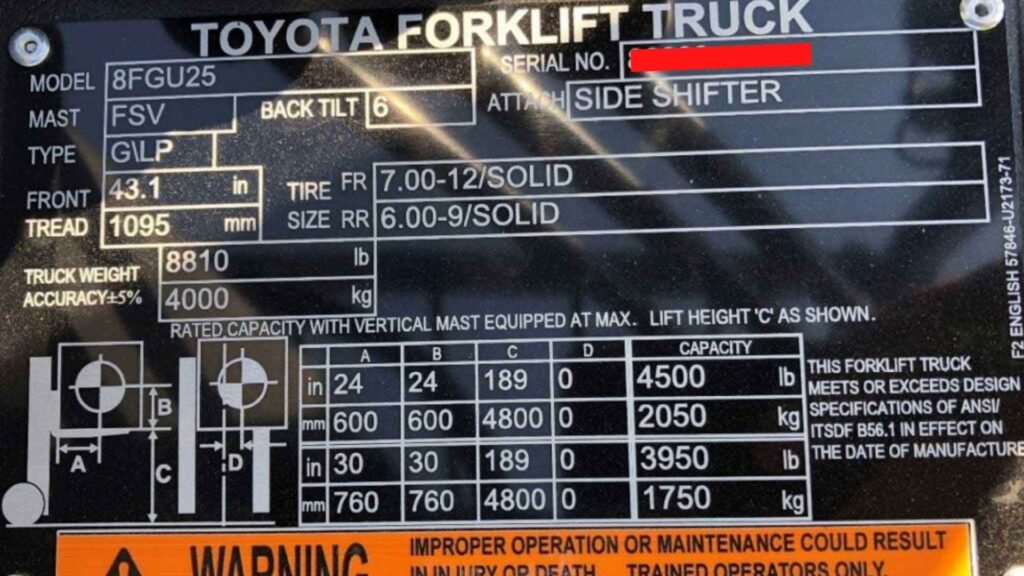
Every counterbalance forklift has a metal nameplate or data plate permanently attached to the chassis. Look for it in one of these locations:
- Steering column — most common location on electric forklifts
- Inside the overhead guard — toward the front, bolted to the guard structure
- Side of the chassis — near the battery compartment or counterweight
- Under the hood / engine cover — on internal combustion models
If the data plate is missing, faded to unreadable, or has been painted over, the forklift's rated capacity is legally unverifiable in most jurisdictions. Do not operate it until the manufacturer or a certified dealer provides a replacement plate.
how can you check the load capacity of a forklift
What the Data Plate Tells You
A standard data plate (OSHA / ANSI / ISO format) shows:
| Field | Example | What It Means |
|---|---|---|
| Model number | CPD20 | Identifies the truck series and configuration |
| Serial number | 202603-0047 | Unique ID. Use this for parts lookup and certification records |
| Load capacity | 2,000 kg | Max load at the specified load center |
| Load center | 500 mm | Distance from fork face to load's center of gravity |
| Max lift height | 3,000 mm | Fork height at full mast extension |
| Mast type | Triplex / 3-stage | Number of mast stages affecting free lift and max height |
| Tire type | Solid / Pneumatic | Affects ride height and stability characteristics |
| Battery weight | 850 kg | Counterweight contribution — important if replacing battery |
| Attachment capacity reduction | See attachment label | Some plates list reduction factors for side-shifter, clamp, etc. |
| Year of manufacture | 2026 | Determines compliance standard and remaining service life |
The two numbers that matter most: Load capacity + load center. If you only check two things, check these.
How to Read the Capacity Line
The capacity line on the plate will look like one of these:
Example 1 (standard):
2,000 kg @ 500 mm load center
This means: the forklift is rated to lift 2,000 kg only if the load's center of gravity falls within 500 mm of the fork face.
Example 2 (multiple ratings):
2,000 kg @ 500 mm — 3,000 mm lift 1,600 kg @ 500 mm — 4,500 mm lift 1,200 kg @ 500 mm — 6,000 mm lift
Some data plates list multiple capacity ratings for different lift heights. The higher you lift, the less you can carry — because the mast itself adds instability at elevation.
Example 3 (with attachment):
1,800 kg @ 500 mm with side-shifter (Model S-1000)
If a non-standard attachment is installed, the manufacturer or dealer must provide a reduced-capacity label or a separate attachment data plate.
How to Check a Used Forklift's Capacity
New forklifts come with a fresh data plate. Used forklifts are where checking matters.
Step 1 — Find the data plate
Is it legible? If the plate is scratched, painted over, or missing, stop here. Contact the manufacturer with the serial number to order a replacement plate.
Step 2 — Confirm the mast matches the plate
A used forklift may have been re-masted. Does the mast on the truck match the mast type and lift height listed on the data plate? If someone swapped a 3-stage mast onto a truck originally equipped with a 2-stage, the capacity changes. The data plate is no longer valid.
Step 3 — Confirm the tires match the plate
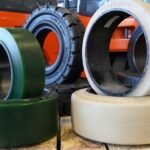
Capacity is calculated with a specific tire type and size. If a forklift originally had pneumatic tires and someone installed solids, the ride height changes by 50–100 mm. That shifts the stability triangle. The data plate is no longer accurate.
Step 4 — Confirm the battery weight
Electric forklifts use the battery as part of the counterweight. If the original battery was 850 kg and the replacement is 700 kg (cheaper, lower capacity), the forklift has less counterweight. It will tip forward at a lower load than the plate says.
Weigh the battery or check its label. If it doesn't match the data plate specification, the capacity listed is not trustworthy.
Step 5 — Look for modification decals or added counterweight
Some operations bolt extra steel plates to the counterweight to compensate for attachments or different batteries. If the counterweight has visible added mass, the data plate likely does not account for it.
The Load Capacity Chart (Auxiliary Label)
Some forklifts also have a load capacity chart decal visible from the operator seat. This shows:
- Capacity at different lift heights
- Capacity with different attachments
- Capacity with the mast tilted forward vs back
- Operating limits (never exceed these numbers)
This chart is not a replacement for the data plate — it's an operator reference. But if the chart says one thing and the data plate says another, the data plate wins.
Quick Field Check — 'Does This Forklift Lift the Load I Have?'
| Step | What to Do |
|---|---|
| 1 | Find the data plate. Note the rated capacity and load center. |
| 2 | Measure your pallet length in the direction of fork entry. Divide by 2. That's your actual load center. |
| 3 | If your load center is larger than the rated load center, reduce the rated capacity proportionally (roughly 15% per 100 mm excess). |
| 4 | Weigh your load. If it exceeds the adjusted capacity, do not lift it. |
Example:
- Data plate says: 2,000 kg @ 500 mm load center
- Your pallet: 1,200 mm long → 600 mm load center
- Effective capacity: ~1,700 kg
- Your load: 1,800 kg
- Do not lift it. You need a larger forklift or a shorter pallet.
When You Legally Need to Re-Rate a Forklift
A re-rating (also called re-certification or capacity re-sticker) is required when:
| Change | What Happens |
|---|---|
| Mast replacement | New capacity calculation required |
| Carriage replacement | Changes load center distance |
| Attachment added/removed | Capacity changes by attachment thickness + weight |
| Battery replacement (electric) | Counterweight changes |
| Tire type change | Ride height changes |
| Counterweight modified | Stability triangle shifts |
| Overhead guard removed/replaced | Weight distribution changes |
Re-rating must be done by the manufacturer or a qualified engineer. A sticker from the maintenance department is not valid. In most jurisdictions, operating a modified forklift without a valid data plate is an OSHA violation and voids insurance coverage.
Quick Checklist (30 Seconds)
- Locate the data plate on the chassis
- Check: is it legible? (If no, stop and replace)
- Check: load capacity and load center — do they match your loads?
- Check: is the mast original and matching the plate?
- Check: are the tires original size and type?
- Check: does the battery weight match the specification?
- Check: are there aftermarket attachments that shift the load center?
- If used: are there any modifications not shown on the plate?
The Bottom Line
Checking a forklift's load capacity takes 30 seconds if the data plate is intact. Read the two numbers: capacity + load center. Compare them against your actual pallet length and weight. If they don't match, you need a different truck or a capacity re-rating.
A missing or illegible data plate means the forklift has no certified capacity. Do not operate it until it's re-plated by the manufacturer.
Every forklift on forkliftlift.com ships with a factory data plate matching the actual configuration — mast, tires, battery, and attachments all accounted for in the rated capacity. New or custom-configured, the plate matches the truck.
Hebei Maoxiang Technology Co., Ltd.
- Web: forkliftlift.com
- Electric forklifts | Diesel forklifts | Reach trucks | Pallet jacks | Sideloaders
- FOB Tianjin | CE certified | 20–35 day lead