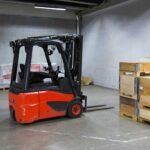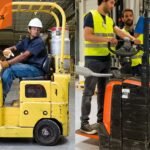
Turning radius is the smallest circular space a forklift needs to complete a full turn, typically measured from the center of the rear axle to the outer edge of the turning path. It directly determines whether a forklift can maneuver through your aisles, doorways, and loading docks — and choosing the wrong turning radius is one of the most common (and expensive) forklift buying mistakes. Here's what actually determines it, and how to get the number that matters for your specific layout.
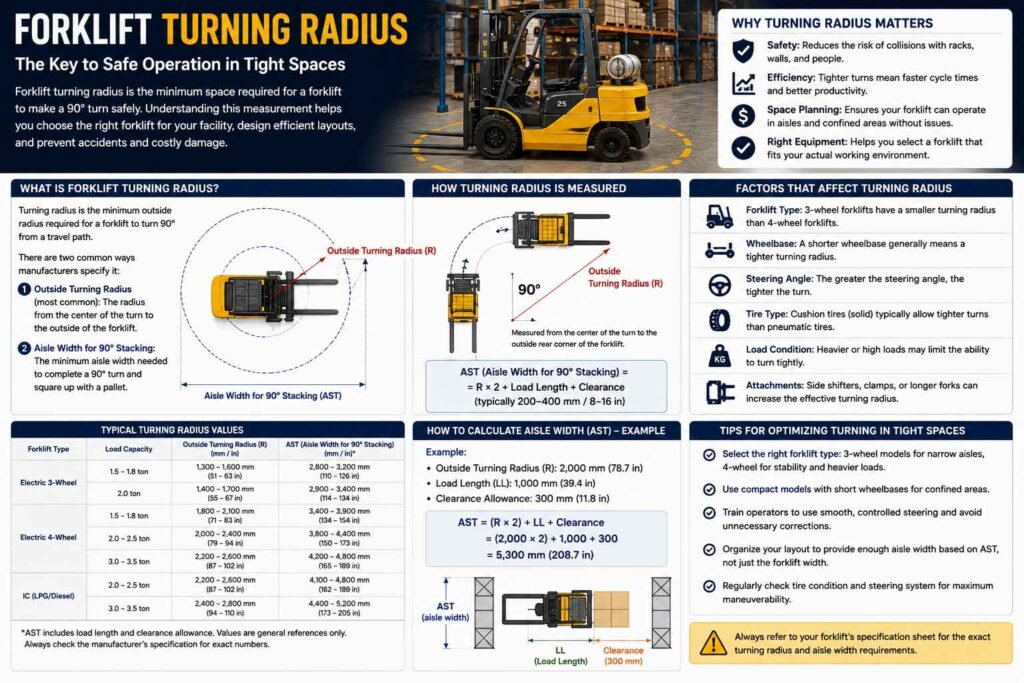
Forklift Turning Radius
Why Turning Radius Gets Overlooked — and Why That's a Problem
Buyers tend to focus on load capacity, lift height, and price, treating turning radius as a secondary detail. But a forklift that can lift 5,000 lbs to 20 feet is useless if it can't turn around in your narrowest aisle. Unlike load capacity or mast height, turning radius problems don't show up on a spec sheet comparison — they show up on day one, when an operator realizes they can't complete a three-point turn without hitting a rack.
This is why turning radius should be one of the first specs checked against your facility, not the last.
What Actually Determines Turning Radius
1. Wheelbase
The distance between the front and rear axles is the single biggest factor. A shorter wheelbase generally means a tighter turning radius, which is why compact warehouse forklifts are built with shorter frames than heavy-duty outdoor models.
2. Overall Forklift Length
Longer forklifts — especially those with extended forks or attachments — need more room to complete a turn, even if the wheelbase itself is short.
3. Steering Design
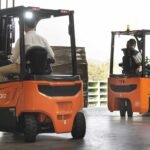
Most counterbalance forklifts steer from the rear wheels, which is actually what allows for tighter turns than front-wheel steering would — the rear end swings out around the front axle as the pivot point. This is why forklifts can turn more sharply than a car of similar size, but it also means operators need to be more aware of rear-end swing in tight aisles.
4. Forklift Class and Type
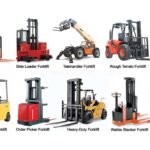
- Counterbalance forklifts: Larger turning radius due to the counterweight and longer frame.
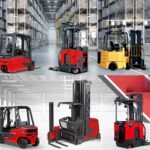
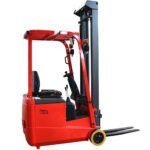
- Reach trucks: Designed with very tight turning radii for narrow-aisle warehouse work.
- Order pickers and narrow-aisle forklifts: Built specifically to operate in aisles as tight as 6–8 feet, using turning radii far smaller than standard counterbalance models.
Typical Turning Radius by Forklift Type
| Forklift Type | Typical Turning Radius |
|---|---|
| Compact electric warehouse forklift | 60–80 inches |
| Standard counterbalance forklift (3–5 ton) | 80–110 inches |
| Heavy-duty diesel forklift (7+ ton) | 120–160+ inches |
| Reach truck | 55–70 inches |
| Narrow-aisle/VNA forklift | Often under 60 inches |
These numbers vary by manufacturer and configuration, so always check the specific model's spec sheet rather than relying on class averages when making a final decision.
How to Calculate the Aisle Width You Actually Need
Manufacturers often publish a related spec called right-angle stacking aisle width, which tells you the minimum aisle width needed for a forklift to turn 90 degrees and place a load into racking — this is usually more useful than raw turning radius alone.
A simplified way to think about it:
Minimum Aisle Width ≈ Turning Radius + Load Length + Clearance Margin
For example, a forklift with an 85-inch turning radius carrying a 48-inch pallet will need meaningfully more than 85 inches of aisle width to maneuver safely — manufacturers typically build in clearance margins of 6–12 inches for safe operation, so always check the published right-angle stacking figure rather than calculating from turning radius alone.
Common Mistakes Buyers Make
- Measuring aisles once and assuming they're uniform: Racking, columns, and dock doors can narrow effective aisle width at specific points — measure the tightest point, not the average.
- Ignoring load length: A forklift with a great turning radius empty can struggle significantly once carrying a long or wide load, since the load extends the effective turning arc.
- Comparing turning radius across different measurement methods: Some manufacturers measure from the outside of the front tires, others from the rear axle centerline — always confirm what's being measured before comparing two forklifts side by side.
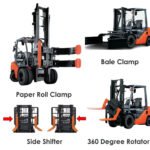
- Overlooking attachments: Fork extensions, clamps, or other attachments add length and can significantly increase the effective turning radius beyond the base spec.
Questions to Ask Before Buying
- What is the narrowest aisle width in your facility, measured at its tightest point?
- What is the longest or widest load the forklift will regularly carry?
- Does the manufacturer's turning radius spec include or exclude the load/forks?
- Will the forklift need to turn near racking, columns, or other fixed obstacles regularly?
- Would a narrow-aisle or reach truck better suit your layout than a standard counterbalance model?
Conclusion
Turning radius isn't a spec to skim past — it's often the deciding factor in whether a forklift can actually function in your space, regardless of how well it performs on paper elsewhere. Measuring your tightest aisles and cross-checking them against a forklift's real turning radius and right-angle stacking width — not just its class average — is the difference between a forklift that fits your operation and one that gets stuck on its first shift.