AGVs (Automated Guided Vehicles) typically cost between $25,000 and $150,000+ per unit depending on type, payload capacity, and navigation technology — but the sticker price is often the smallest part of the total investment. Implementation, infrastructure, software, and integration frequently add 30–100% on top of the base unit cost. Anyone searching this term is almost certainly trying to build a real budget, not just get a ballpark number, so here's what actually drives the cost and where the hidden expenses show up.
How Much Does an AGV Cost
Why a Single Price Tag Doesn't Exist
AGV pricing varies more than almost any other material handling equipment category, because 'AGV' covers a wide range of vehicle types, navigation systems, and payload capacities — a small tugger AGV and a heavy-duty forklift AGV aren't remotely comparable purchases. Anyone quoted a single number without qualifying which type of AGV, what payload, and what navigation technology is being priced should treat that number with real skepticism.
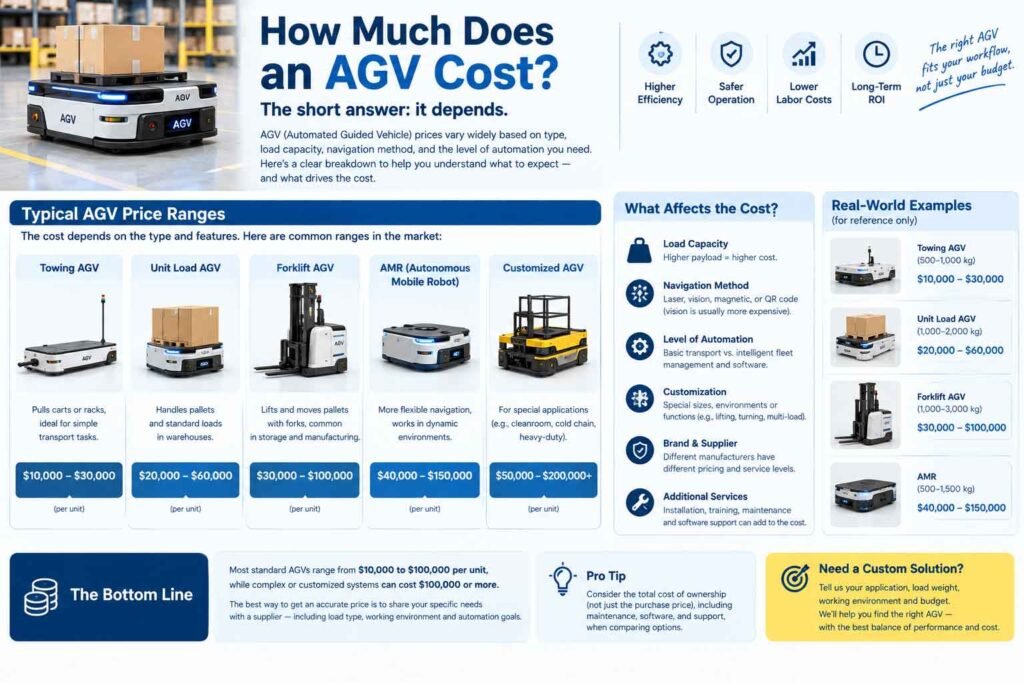
Typical AGV Cost by Type
| AGV Type | Typical Price Range | Common Use |
|---|---|---|
| Tugger/tow AGV | $25,000 – $60,000 | Towing carts between workstations |
| Unit load AGV (pallet handling) | $40,000 – $100,000 | Moving palletized loads point-to-point |
| Forklift AGV (autonomous forklift) | $80,000 – $150,000+ | Lifting and placing loads into racking |
| Assembly line AGV | $30,000 – $80,000 | Delivering components in manufacturing |
| Heavy-duty/custom AGV | $100,000 – $250,000+ | Specialized industrial or automotive applications |
These ranges reflect the vehicle itself. As covered below, the total project cost is usually meaningfully higher.
What Actually Drives the Price Within Each Category
Navigation Technology
- Wire-guided/magnetic tape: Older, cheaper technology, but inflexible — changing the route means physically altering the floor. Lower unit cost but higher long-term rigidity cost.
- Laser-guided (SLAM/natural feature navigation): More expensive per unit, but far more flexible — routes can be changed in software rather than by re-installing floor infrastructure. This is now the dominant technology for new deployments.
- Vision-based navigation: Increasingly common, generally priced similarly to laser-guided systems, with growing capability to handle dynamic environments and obstacles.
Payload Capacity
Payload capacity scales cost significantly. A tugger AGV rated for a few hundred kilograms costs far less than a heavy-duty AGV rated for several tons, since higher capacity requires more robust drivetrains, batteries, and structural components.
Fleet Management Software
Running more than one or two AGVs typically requires fleet management software to coordinate traffic, charging, and task assignment. This is often licensed separately from the vehicle hardware and can be a recurring cost (subscription-based) rather than a one-time purchase — a detail that catches many first-time buyers off guard when budgeting.
Charging Infrastructure
AGVs need a charging strategy — either battery swap stations, opportunity charging docks, or automated charging contacts. This infrastructure is rarely included in the base unit price and can add meaningfully to the total project cost, especially for multi-shift operations requiring redundant charging capacity.
The Hidden Costs Most Buyers Underestimate
1. Site Assessment and Facility Preparation
Before deployment, most vendors conduct a site survey to map routes, identify obstacles, and confirm floor conditions. Facility changes — like clearing permanent obstructions or improving floor surfaces — may be needed and are rarely included in the vehicle quote.
2. Integration with Existing Systems (WMS/ERP)
AGVs that need to communicate with a warehouse management system or ERP require software integration work, which can range from straightforward to substantial depending on how customized the existing systems are.
3. Fleet Management Software Licensing
As noted above, this is frequently a separate line item — sometimes a one-time license, sometimes an ongoing subscription per vehicle or per fleet.
4. Installation and Commissioning
Getting AGVs calibrated, tested, and running reliably in a live environment takes vendor time on-site, which is typically billed separately from the hardware.
5. Operator and Maintenance Staff Training
Staff need training not just to work alongside AGVs safely, but often to perform basic troubleshooting and maintenance — a cost that's easy to overlook when budgeting purely for hardware.
6. Ongoing Maintenance and Support Contracts
Many vendors offer (or require) annual maintenance and software support contracts, typically priced as a percentage of the unit cost per year — commonly in the range of 5–15% annually, though this varies by vendor and contract terms.
AGV vs. AMR: A Cost Note Worth Understanding
AGVs (which follow fixed paths via wires, tape, or defined routes) are increasingly being compared against AMRs (Autonomous Mobile Robots, which navigate dynamically without fixed infrastructure). AMRs are often marketed as having lower upfront infrastructure cost since they don't require the same fixed-path installation, but they can carry higher per-unit hardware and software costs. If you're comparing quotes and one is significantly cheaper than another, confirm whether you're actually comparing AGV to AGV, or AGV to AMR — the underlying technology affects both the cost structure and the long-term flexibility trade-off.
How to Estimate Total Project Cost, Not Just Unit Price
A reasonable way to budget:
Total Project Cost ≈ (Unit Cost × Number of Vehicles) + Fleet Software + Infrastructure + Integration + Installation + First-Year Support
For a small deployment (2–3 unit load AGVs), total project cost including implementation can often run 1.5–2x the combined hardware price alone. For larger, more customized deployments, this multiplier can be even higher depending on integration complexity.
Questions to Ask Vendors Before Comparing Quotes
- Does this quote include fleet management software, or is it licensed separately?
- What navigation technology is being quoted, and how does that affect future route flexibility?
- Is charging infrastructure included, or is that a separate cost?
- What does the site assessment process cost, and is it credited toward the final purchase?
- What's included in the first year of support, and what does renewal cost afterward?
- What's the expected payback period based on labor savings for our specific application?
Is an AGV Worth the Cost?
For operations with repetitive, predictable material movement — especially multi-shift facilities — AGVs often pay back their investment through reduced labor costs and consistent throughput, with payback periods commonly cited in the range of 1–3 years depending on labor costs, shift structure, and utilization. Facilities with highly variable layouts, low-volume movement, or space too tight for reliable AGV routing may find the total investment harder to justify compared to sticking with traditional forklifts or manual material handling.
Conclusion
The unit price of an AGV is only the starting point of the real cost conversation. Navigation technology, payload capacity, fleet software, charging infrastructure, and integration work all add to the total investment — often substantially. Buyers who request a full project quote (not just hardware pricing) and clarify what's included versus billed separately are far better positioned to compare vendors accurately and avoid budget surprises after signing a contract.