forklift mast types
What Is a Forklift Mast?
- Maximum lift height
- Free lift capability
- Operational safety
- Warehouse throughput
Key Components of a Forklift Mast
- Mast Rails: Interlocking steel channels guiding vertical movement, providing stability and rigidity.
- Carriage: The platform sliding along the rails that holds the forks or attachments.
- Forks: Load-bearing arms that directly lift pallets or materials.
- Lifting Cylinder: Hydraulic cylinder powering the vertical movement.
- Tilting Cylinder: Controls forward/backward tilt for load stability.
- Lifting Chain: Heavy-duty chain that multiplies lifting force.
- Pulley (Block): Guides the lifting chain for smooth operation.
- Mast Rollers & Bearings: Reduce friction and wear, ensuring smooth travel.
- Guide Rails & Gaskets: Maintain alignment and protect components.
- Hydraulic Seals: Prevent fluid leakage, maintaining performance.
Common Forklift Mast Types in 2026
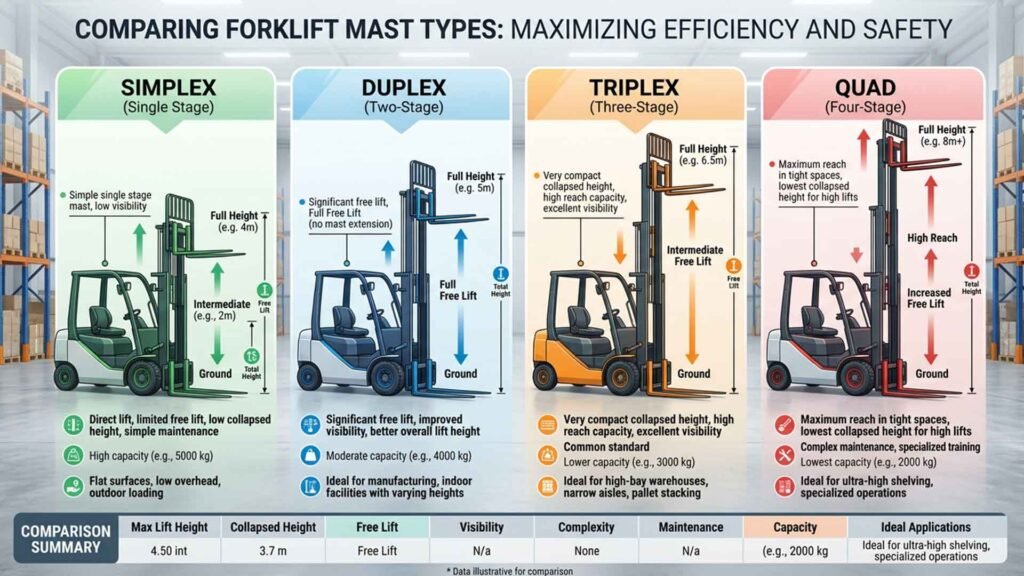
1. Single-Stage Mast (Simplex Mast)
- Structure: One fixed set of rails.
- Lift Height: Typically under 3 meters.
- Free Lift: None.
- Best For: Low-height applications such as basements, small warehouses, or light-duty tasks.
- Advantages: High rigidity, low cost, simple design.
- Limitations: Limited lift height and no free lift make it unsuitable for modern high-racking environments.
2. Two-Stage Mast (Duplex Mast)
- Structure: Two sets of telescoping rails.
- Lift Height: Approximately 3.5 to 5 meters.
- Free Lift: Limited or partial free lift.
- Best For: General warehousing, loading docks, and stacking tasks.
- Advantages: Balanced lift and lowered height, good visibility, moderate complexity.
- Considerations: Verify actual free lift if working inside containers or trailers.
3. Three-Stage Mast (Triplex Mast)
- Structure: Three nested telescoping rails.
- Lift Height: Around 4 to 6.5 meters or more.
- Free Lift: Full free lift (1.5 to 2 meters) common.
- Best For: High-racking warehouses, container loading/unloading, low headroom environments.
- Advantages: High lift with compact lowered height, versatile.
- Trade-offs: More complex maintenance, potentially reduced visibility.
4. Four-Stage Mast (Quadruplex Mast)
- Structure: Four telescoping stages.
- Lift Height: 6 to 8.5 meters or higher.
- Free Lift: High free lift.
- Best For: Ultra-high racking, cold storage, automated warehouses.
- Advantages: Maximum reach.
- Drawbacks: Complex, heavier, higher maintenance, and visibility challenges.
Understanding “Free Lift” vs. “Standard Lift”
- Free Lift: The height the forks can be raised without the mast extending vertically. Essential for operations inside containers, trailers, or low-ceiling areas.
- Standard Lift: The total lift height including mast extension.
How to Choose the Right Forklift Mast: 5 Expert Tips
1. Free Lift Height
2. Lowered (Folded) Height
3. Rated Load and Operational Intensity
4. Maximum Fork and Extended Mast Height
5. Brand and After-Sales Support
Forklift Mast Types Comparison Table (2026)
| Mast Type | Lift Height Range | Free Lift | Best For | Key Advantages | Limitations |
|---|---|---|---|---|---|
| Single-Stage | 2.5 - 3.5 m | None | Low clearance, simple tasks | Rigid, low cost | Limited lift, no free lift |
| Two-Stage | 3.5 - 5.0 m | Limited | General warehousing | Balanced height & passability | Moderate complexity |
| Three-Stage | 4.0 - 6.5 m | Full (1.5 - 2.0 m) | Container/truck loading, low headroom | Versatile, high ROI | Complex maintenance, visibility |
| Four-Stage | 6.0 - 8.5 m | High | Ultra-high racking, cold storage | Maximum reach | Heavy, complex, higher maintenance |
FAQs About Forklift Mast Types
Q1: What is a mast on a forklift?
A mast is the vertical lifting assembly that raises and lowers the forks, consisting of rails, hydraulic cylinders, chains, and the carriage.
Q2: What’s the difference between a single-stage and a three-stage mast?
A single-stage mast has one fixed rail and limited lift height with no free lift, while a three-stage (triplex) mast has three telescoping rails, offering higher lift and full free lift for low-clearance operations.
Q3: Are lifting height and mast extended height the same?
No. Lifting height is the distance from the ground to the fork tips when fully raised. Mast extended height is the total height of the mast at full extension, usually higher than lifting height.
Q4: Can forklift masts be changed after purchase?
Changing a mast post-delivery is complex due to compatibility, hydraulic systems, and capacity ratings. It’s best to confirm mast specifications before purchase.