In the fast-paced world of warehousing and material handling, selecting the right forklift is a critical decision that impacts operational efficiency, safety, and long-term costs. While the upfront purchase price often grabs attention, the forklift total cost of ownership (TCO)—which includes energy consumption, maintenance, and battery replacement—plays a far greater role in determining the true value of your investment. This article dives deep into these key cost drivers, comparing electric forklifts with internal combustion (IC) models, and explores how battery technology influences the economics of forklift fleets.
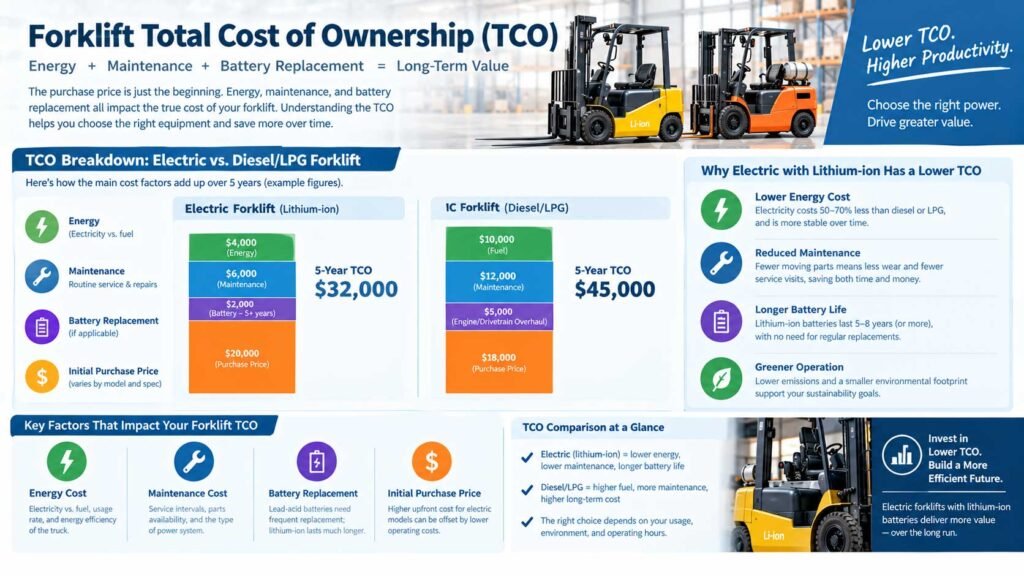
Forklift Total Cost of Ownership
Understanding Forklift Total Cost of Ownership (TCO)
TCO is a comprehensive metric that captures all expenses associated with owning and operating a forklift over its lifecycle, typically 5 to 7 years. It goes beyond the sticker price to include:
- Initial purchase and financing costs
- Energy or fuel consumption
- Scheduled and unscheduled maintenance
- Battery replacement and charging infrastructure
- Labor costs related to operation and maintenance
- Facility costs such as ventilation and battery rooms
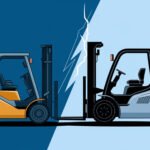
Ignoring TCO can lead to costly surprises and suboptimal equipment choices. For example, electric forklifts often have higher upfront costs but significantly lower operating expenses compared to IC forklifts.
Energy Costs: Electric vs. Internal Combustion Forklifts
Energy consumption is one of the most visible ongoing expenses in forklift operation. Here’s how electric and IC forklifts compare:
- Electric Forklifts: Powered by rechargeable batteries, electric forklifts consume electricity at a fraction of the cost of fuel. According to industry data, electricity costs for electric forklifts can be as low as 10-20% of the fuel costs for IC forklifts. For instance, recharging an electric forklift battery may cost around $4 per charge, while a 10-gallon tank of LPG for an IC forklift can cost between $15 and $35.
- Internal Combustion Forklifts: These forklifts run on diesel, LPG, or CNG and have higher fuel costs, especially with fluctuating diesel prices and stricter emissions regulations. Fuel efficiency is generally lower, with diesel engines converting only 30-35% of fuel energy into mechanical work compared to electric motors’ 85-90%.
Key Insight: Over a typical 2,500 to 4,000 hour annual operation, electric forklifts can save thousands of dollars in energy costs alone, making them more economical over the forklift’s lifespan.
Maintenance Costs: Simplicity vs. Complexity
Maintenance is another critical component of forklift TCO, and electric forklifts generally have the edge here.
- Electric Forklifts: With fewer moving parts, no oil changes, and less wear on components like brakes (thanks to regenerative braking), maintenance costs are typically 30-40% lower than IC forklifts. Annual maintenance for electric models averages between $1,800 and $2,500.
- Internal Combustion Forklifts: Require regular oil changes, filter replacements, exhaust system upkeep (such as catalytic converters), and more frequent brake servicing. These add up to annual maintenance costs of $3,000 to $5,000 or more.
Electric forklifts also benefit from enclosed motors and controllers, which protect critical components from dust and debris, reducing downtime and repair costs.
Battery Replacement: The Heart of Electric Forklift Economics
Battery technology is a pivotal factor in electric forklift TCO, influencing both performance and costs.
Lead-Acid vs. Lithium-Ion Batteries
- Lead-Acid Batteries: Traditionally the standard, lead-acid batteries have lower upfront costs ($3,500 to $8,000 for a 48V battery) but require extensive maintenance, including weekly watering, acid spill management, and dedicated ventilated battery rooms to handle hydrogen gas emissions. Their lifecycle is typically 1,200 to 1,500 charge cycles (3-5 years), necessitating multiple replacements over the forklift’s service life.
- Lithium-Ion Batteries: Although costing 2.5 to 3 times more upfront ($8,000 to $18,000 for a comparable battery), lithium-ion batteries offer 3,000 to 5,000 charge cycles (7-10 years lifespan), require zero watering or maintenance, and eliminate the need for dedicated battery rooms. They support opportunity charging—partial charges during breaks—allowing continuous multi-shift operation without battery swaps.
Cost-Per-Hour Advantage: When factoring in maintenance labor, energy efficiency, replacement frequency, and infrastructure costs, lithium-ion batteries deliver 30-40% lower cost per operating hour over five years compared to lead-acid batteries.
Charging Infrastructure and Operational Efficiency
Charging infrastructure is often an overlooked but significant cost factor:
- Lead-Acid Charging: Requires large, OSHA-compliant battery rooms with ventilation, acid containment, and safety equipment. This can cost between $30,000 and $80,000 for a 20-truck fleet, plus ongoing ventilation and monitoring expenses. Battery swaps during shift changes cause downtime, reducing productivity.
- Lithium-Ion Charging: Requires only compact charging stations with three-phase power drops, costing approximately $3,000 to $8,000 per station. No dedicated battery room is necessary, freeing valuable warehouse space and reducing capital expenditure. Opportunity charging enables trucks to stay productive during breaks, increasing fleet utilization and potentially reducing fleet size by up to 15%.
Environmental and Operational Benefits of Electric Forklifts
Electric forklifts provide zero emissions at the point of use, a critical advantage for indoor operations such as food processing, pharmaceuticals, and cold storage. They eliminate carbon monoxide, nitrogen oxides, hydrocarbons, and particulate emissions associated with IC forklifts, improving air quality and worker safety.
Additionally, electric forklifts operate more quietly (75-80 dB vs. 90-95 dB for diesel), reducing noise pollution and operator fatigue.
Real-World TCO Comparisons
Example: 5,000 lb Capacity Forklift Over 5 Years
| Cost Component | Electric Forklift (AC) | Internal Combustion (LPG) |
|---|---|---|
| Purchase Price | $25,000 - $35,000 | $20,000 - $28,000 |
| Energy/Fuel Cost | $3,600 (electricity) | $10,500 (fuel) |
| Maintenance Cost | $9,000 - $12,500 | $17,500 - $25,000 |
| Battery Replacement | $12,000 (lithium-ion) | N/A |
| Operator Labor | $200,000 (5 years) | $200,000 |
| Total Cost of Ownership | ~$271,000 | ~$296,500 |
This demonstrates that despite a higher initial investment, electric forklifts offer substantial savings in energy and maintenance, resulting in a lower TCO.
Tips for Reducing Forklift TCO
- Choose the Right Battery Technology: For multi-shift operations, lithium-ion batteries offer the best value through longer life, lower maintenance, and opportunity charging.
- Implement Regenerative Braking: Electric forklifts with AC motors can reclaim energy during braking, extending battery life and reducing energy costs.
- Plan Charging Infrastructure: Invest in efficient charging stations and optimize charging schedules to minimize downtime.
- Regular Preventive Maintenance: Keep forklifts in top condition to avoid costly repairs and downtime.
- Consider Fleet Size and Utilization: Efficient battery management and charging can reduce the number of forklifts needed.
Conclusion: Making an Informed Forklift Investment
Understanding the forklift total cost of ownership: energy, maintenance, battery replacement is essential for making smart equipment decisions that enhance productivity and profitability. Electric forklifts, especially those equipped with lithium-ion batteries, offer compelling advantages in energy efficiency, lower maintenance, and environmental compliance. While the upfront cost may be higher compared to internal combustion models, the long-term savings and operational benefits often outweigh initial expenses.
Warehouse managers and supply chain professionals should conduct detailed TCO analyses tailored to their specific operations, factoring in shift patterns, energy costs, maintenance labor, and infrastructure needs. By doing so, they can select forklifts that not only meet immediate requirements but also deliver sustainable value over their service lives.
Ready to optimize your forklift fleet? Explore the latest electric forklift models with advanced battery technologies and calculate your TCO today to unlock hidden savings and operational excellence.