In today’s fast-paced industrial and logistics environments, forklifts are more than just lifting machines—they are critical assets tailored to meet specific operational needs. Off-the-shelf forklifts may not always suffice, especially when unique working conditions, specialized cargo, or space constraints come into play. This is where OEM forklift customization becomes a game-changer. But what exactly can be changed in an OEM forklift? How does customization enhance efficiency, safety, and productivity? This article dives deep into the world of OEM forklift customization, exploring what modifications are possible and how they benefit businesses across various industries.
OEM Forklift Customization
What Is OEM Forklift Customization?
OEM (Original Equipment Manufacturer) forklift customization refers to the process where manufacturers modify standard forklift models to meet the particular requirements of a customer. Unlike aftermarket modifications, OEM customizations are integrated during production or assembly, ensuring that the forklift maintains its structural integrity, safety certifications, and optimal performance.
Customization can range from simple branding changes like colors and logos to complex engineering alterations such as mast height adjustments, battery configurations, and specialized attachments.
Why Choose OEM Forklift Customization?
- Tailored to Specific Needs: Customize forklifts to handle unique cargo types, working environments, or operational workflows.
- Enhanced Safety: Modify designs to reduce workplace hazards, especially when handling heavy or awkward loads.
- Improved Efficiency: Optimize forklifts for faster handling, better maneuverability, and reduced downtime.
- Branding and Identity: OEM customization allows companies to display their logos and colors, strengthening brand presence.
- Compliance and Certification: OEM customizations maintain CE certifications and other safety standards, ensuring legal compliance.
Key Areas of OEM Forklift Customization
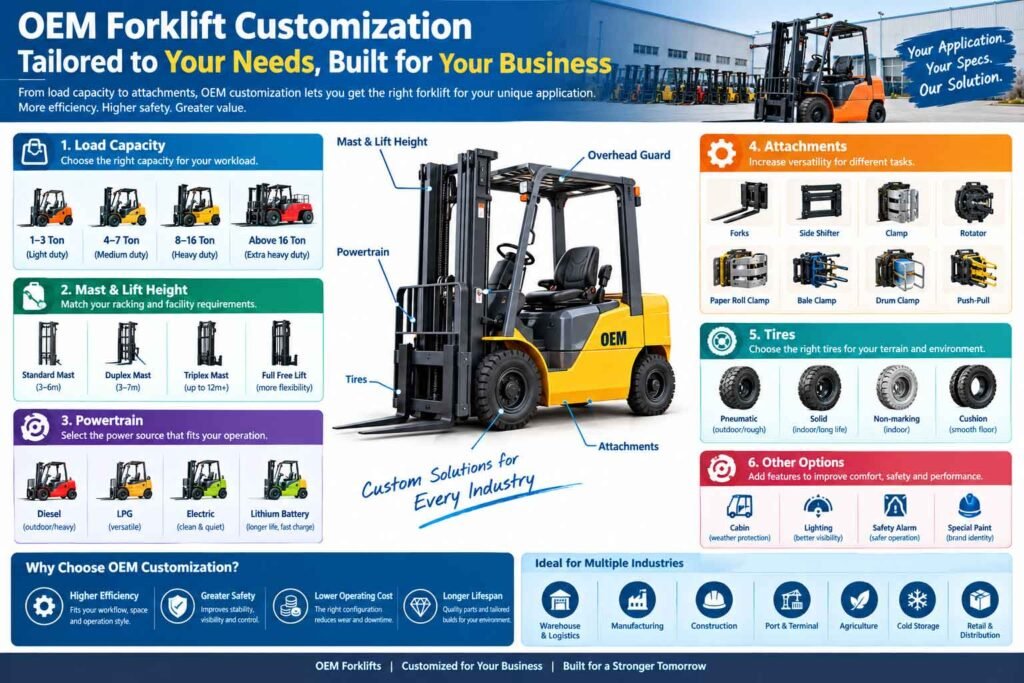
1. Load Capacity and Fork Dimensions
One of the most common customizations is adjusting the forklift’s load capacity to suit heavier or lighter materials. For example, manufacturers like Mima (米玛) offer forklifts with capacities ranging from 1.5 tons to as high as 30 tons, tailored to specific industry needs such as mold handling or heavy-duty pallet transport.
Fork length and width can also be customized to accommodate unusual pallet sizes or cargo dimensions. Extensions or wider forks help stabilize long or bulky loads, improving safety during transport.
2. Mast Height and Type
The mast determines how high the forklift can lift loads. OEM customization allows for:
- Adjustable mast height: From standard 3 meters to up to 6 meters or more, depending on warehouse rack heights.
- Mast stages: Customers can choose between 2-stage or 3-stage masts, affecting lift height, lowered height, and visibility.
- Specialized masts: For narrow aisles or cold storage, masts can be modified to fit tighter spaces or withstand low temperatures.
3. Powertrain and Battery Options
Forklifts can be powered by diesel, electric (lead-acid or lithium batteries), or LPG. OEM customization allows buyers to select:
- Engine brands and power: Diesel forklifts can come with different engine options based on local market preferences and maintenance capabilities.
- Battery type and capacity: Electric forklifts can be customized with lithium or lead-acid batteries, tailored charger voltages (110V, 220V, 380V), and battery capacities to match daily workload requirements.
- Hybrid systems: Some models integrate hybrid powertrains for enhanced fuel efficiency and lower emissions.
4. Tires and Wheels
The working ground heavily influences tire choice:
- Pneumatic tires: Suitable for outdoor rough terrain.
- Solid tires: Ideal for indoor warehouses with smooth floors.
- Special tires: Customized tires with enhanced durability or anti-slip features for dusty or uneven environments.
5. Attachments and Accessories
OEM forklift customization includes a wide range of attachments to handle diverse cargo types:
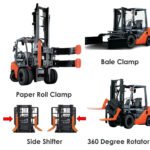
- Clamps: Paper roll clamps, carton clamps, or multi-purpose clamps.
- Fork extensions: To handle longer pallets or loads.
- Side shifters and fork positioners: For precise load placement without moving the entire forklift.
- Specialty attachments: Such as mold handling platforms, rotating forks, or adjustable arms, designed for industries like automotive parts, textiles, or single-crystal silicon handling.
6. Body and Frame Modifications
Manufacturers can alter the forklift’s frame or body to fit specific operational constraints:
- Narrow chassis: For tight aisles or narrow warehouse lanes.
- Reinforced frames: To handle heavy or uneven loads.
- Four-way drive systems: For enhanced maneuverability in cramped spaces.
- Custom paint and branding: Color schemes and logos tailored to the customer’s brand identity.
7. Safety Features
Safety is paramount in forklift operations. OEM customizations can include:
- Enhanced stability systems: Auxiliary stabilizer arms or lateral bars to prevent tipping.
- Hydraulic safety locks: For secure load handling.
- Ergonomic controls: Joystick levers, adjustable seats, and improved visibility.
- Safety sensors and alarms: To alert operators of obstacles or overloads.
Industry-Specific OEM Forklift Customization Examples
Mold Handling in Automotive and Injection Molding
Mima’s specialized mold handling forklifts can carry loads from 1 to 20 tons, equipped with hydraulic push-pull systems and safety locks to facilitate quick, safe mold changes. This drastically reduces downtime and improves safety in automotive parts manufacturing.
Textile Industry
Custom forklifts with adjustable clamp arms and auxiliary support legs help handle delicate and heavy textile rolls, reducing damage and increasing operational efficiency.
Paper and Carton Handling
Forklifts with “TBB” style clamp attachments are designed to handle large, easily deformable cartons, minimizing damage and optimizing warehouse space usage.
Heavy-Duty and Large Load Handling
For loads reaching up to 30 tons, OEM forklifts can be custom-built with reinforced frames, enhanced hydraulic systems, and specialized attachments to replace traditional cranes or trucks, offering faster and safer material handling.
OEM Forklift Customization Process: What to Expect
- Needs Assessment: The manufacturer evaluates your operational environment, load types, aisle widths, and safety requirements.
- Design Proposal: CAD renderings and technical drawings are shared for approval.
- Prototype and Testing: Custom forklifts undergo safety and performance tests, including stability and load tests.
- Certification: CE and other relevant certifications are maintained or updated post-modification.
- Delivery and Support: Manufacturers provide training, spare parts, and after-sales support to ensure smooth operation
WE offers extensive customization solutions, including electric forklifts tailored for industries like single-crystal silicon extraction, paper carton handling, and heavy mold transport, highlighting the importance of matching forklift design to specific cargo and working conditions.
Conclusion: Unlocking the Full Potential of Your Forklift with OEM Customization
OEM forklift customization transforms standard forklifts into powerful, tailored solutions that address unique operational challenges. Whether it’s adjusting load capacity, modifying mast height, selecting the right powertrain, or integrating specialized attachments, customization enhances safety, efficiency, and productivity.
If you’re looking to optimize your material handling processes, reduce downtime, and gain a competitive edge, consider partnering with a reputable OEM forklift manufacturer. Discuss your specific needs, explore customization options, and invest in a forklift that’s built to perform exactly the way you need it.