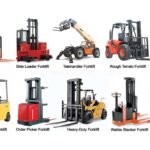
In high-throughput warehousing, the choice between a Stand-up (Reach) and a Sit-down Counterbalance forklift can alter your facility's capacity by up to 30%. This isn't just about operator comfort; it’s a strategic decision involving Aisle Width (AST), Cycle Times, and Safety Psychographics.
This guide provides a technical and operational breakdown to help you select the right fleet for your 2026 logistics goals.
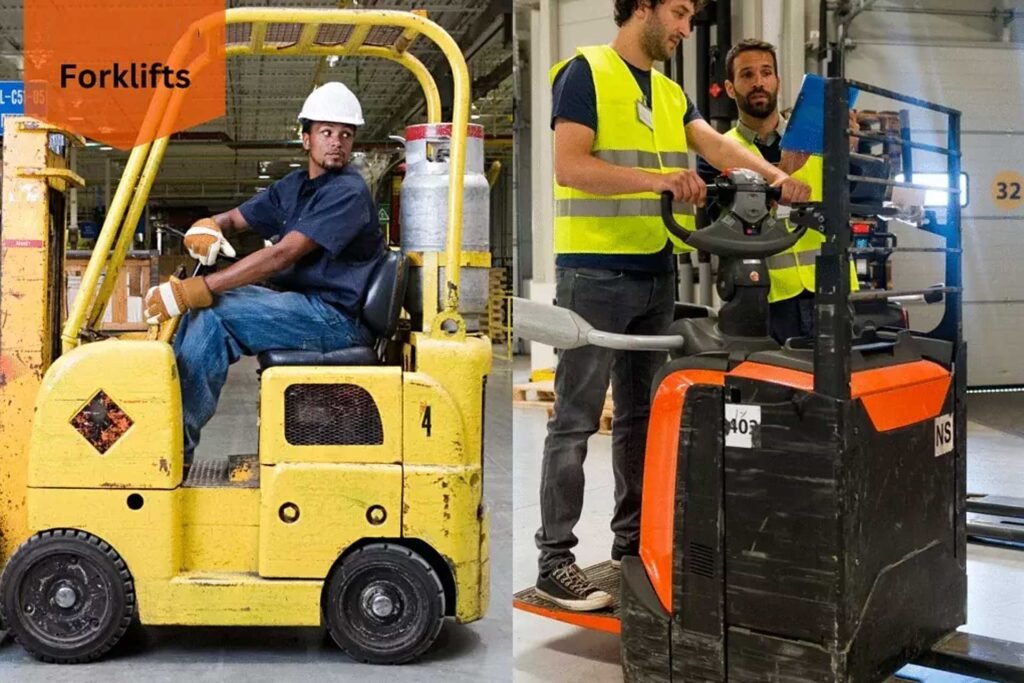
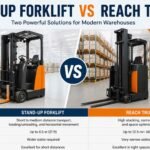
Stand Up Forklift vs Sit Down Forklift
1. The Operational DNA: Quick Comparison
| Feature | Stand-Up Forklift | Sit-Down Forklift |
| Aisle Requirement | Narrow (8–10 feet) | Wide (11–13+ feet) |
| Operator Mobility | High (Easy on/off) | Low (Best for long drives) |
| Visibility | Superior (Side-stance) | Good (Forward-facing) |
| Primary Use | High-density racking | Loading docks / Cross-docking |
| Turning Radius | Extremely tight | Larger footprint |
2. When to Choose Stand-Up: The 'Space-Saver' Logic
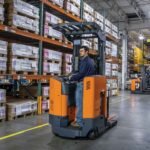
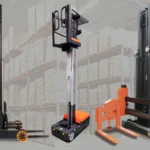
Stand-up forklifts (often called Reach Trucks) are engineered for Narrow Aisle (NA) environments.
Space Optimization: Because they lack a long rear counterbalance, they can operate in aisles 2-3 feet narrower than sit-down models. This allows you to add more racking rows in the same square footage.
The 'On-Off' Efficiency: If your operator needs to get off the truck frequently (to scan barcodes, check labels, or manually adjust pallets), a stand-up model saves 3-5 seconds per cycle. Over an 8-hour shift, this adds up to 30+ minutes of recovered productivity.
Enhanced Visibility: Operators stand sideways. This allows them to look forward and backward by simply turning their head—no neck strain or body twisting required when reversing.
3. When to Choose Sit-Down: The 'Long-Haul' Powerhouse
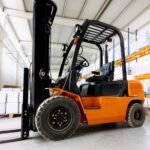
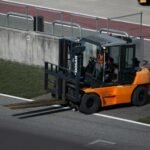
Sit-down counterbalance forklifts are the 'marathon runners' of the warehouse.
Operator Fatigue: For shifts involving long-distance travel (e.g., moving a pallet from one end of a 200,000 sq. ft. facility to the other), a sit-down model is essential to prevent leg fatigue and maintain focus.
Loading Docks & Ramps: Sit-down models generally have higher ground clearance and larger tires, making them safer and more stable for driving over dock levelers and in-and-out of shipping containers.
High-Capacity Lifting: When handling loads over 5,000 lbs (2.5 Tons), the stability of a sit-down chassis is unmatched.
4. Technical Depth: The Stability & Safety Factor
The 'Plug' Braking: Many stand-up models use 'plugging' (reversing the motor) for braking rather than traditional pedals. This requires specialized training to master.
Deadman Pedal: Stand-up units feature a safety pedal that must be depressed to move. If the operator jumps off in an emergency, the truck stops instantly.
Three-Point Entry: Sit-down models require stricter ergonomics for entry/exit to prevent knee and back injuries over time.
❓ Frequently Asked Questions (FAQ) - Google Search Targets
Q: Is a stand-up forklift harder to drive?
A: Yes, the learning curve is steeper. The multi-function joystick (controlling lift, tilt, and travel simultaneously) and the side-stance orientation require more 'muscle memory' than the automotive-style controls of a sit-down forklift.
Q: Which is safer for high-speed environments?
A: Stand-up models are often safer in crowded aisles because of the unobstructed rear visibility. Sit-down models are safer for outdoor or uneven surfaces due to their lower center of gravity and larger wheelbase.
Q: Can a stand-up forklift be used on a loading dock?
A: It is not recommended. The small, solid wheels and low clearance can cause the truck to get stuck on dock plates or vibrate excessively, leading to component failure.
🏆 Maoxiang’s Solutions: Tailored for Your Floorplan
At Maoxiang, we don’t believe in a 'one size fits all' warehouse. Our 2026 lineup is designed to solve specific spatial challenges:
Our Stand-Up Series: Features advanced AC Drive Motors and ergonomic padding, specifically designed for high-density Lithium-ion power, allowing for 24/7 operation in narrow-aisle environments.
Our Sit-Down Series: From our 1.5T Compact Electric to our 5T Heavy-Duty Diesel, we focus on seat suspension technology and 'Inching Pedals' for precise loading dock control.
Don't let your equipment dictate your warehouse layout. Let your layout dictate your equipment.