The Quick Answer
| Stand-Up Forklift | Reach Truck | |
|---|---|---|
| Aisle width needed | 2,600–3,100 mm | 2,800–3,200 mm |
| Max lift height (standard) | 4,000–5,500 mm | 8,000–12,000 mm |
| Max load capacity (typical) | 1,000–2,000 kg | 1,000–2,500 kg |
| Floor type | Smooth concrete | Smooth concrete |
| Rack type | Selective racking (front row) | Selective racking, some double-deep |
| Outdoor use | No | No |
| Price (new) | $4,000–$8,000 | $12,000–$22,000 |
If your lift height is under 6 m and your aisles are 2.8 m+, buy the stand-up. It's cheaper, faster in stop-start work, and the operator gets on and off in 3 seconds.
If your lift height is over 6 m or you need double-deep racking, buy the reach truck. The stand-up can't reach that high, and the reach truck's outrigger design gives you stability at height that a stand-up counterbalance doesn't have.
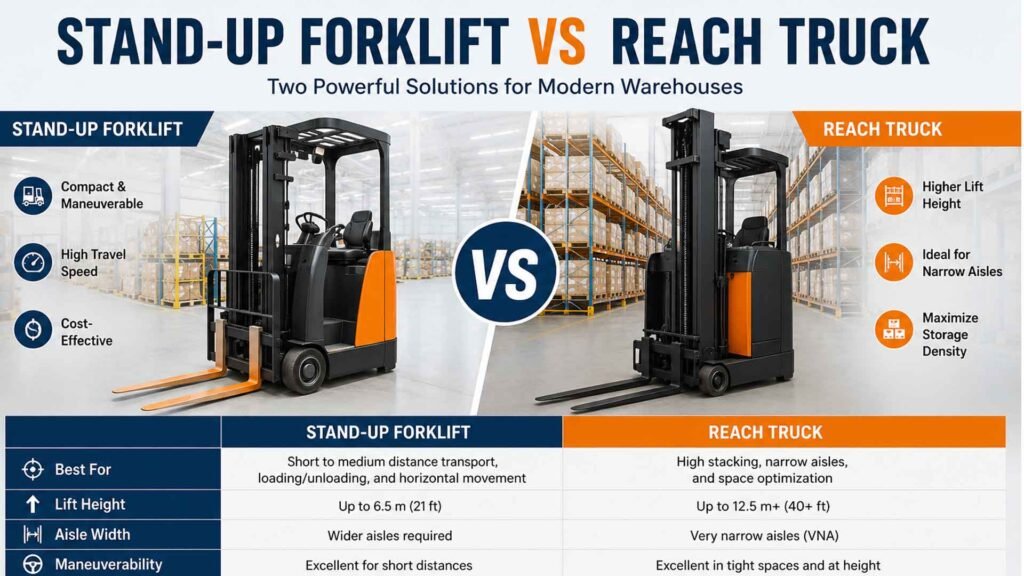
Stand-Up Forklift vs Reach Truck
The Physical Difference
Stand-up forklifts are counterbalanced trucks with the operator standing. The heavy battery sits under the operator or behind them as a counterweight. The forks stick out in front. The truck lifts by tilting the mast.
Reach trucks have two outrigger legs that extend forward past the operator, with the battery in the back as counterweight. The forks are mounted on a pantograph mechanism that 'reaches' forward into the rack. The truck lifts by extending the mast vertically, then reaching the forks forward.
Why this matters:
A stand-up forklift must drive up to the rack face to deposit a pallet. The chassis needs to fit between the rack uprights. The turning radius is determined by the counterbalance chassis.
A reach truck can park its outriggers under the bottom pallet, then extend the forks into the rack. The rack uprights don't need to accommodate the chassis — only the forks. That means narrower rack bays and higher rack height because the outrigger-and-pantograph design is more stable at elevation.
Aisle Width Comparison
| Truck Type | Right-Angle Stacking Aisle |
|---|---|
| Stand-up counterbalance | 2,600–3,100 mm |
| Stand-up counterbalance (3-wheel) | 2,400–2,800 mm |
| Reach truck — standard | 2,800–3,200 mm |
| Reach truck — moving mast | 2,600–2,900 mm |
| Stand-up + side-shifter | +200–300 mm to above |
The stand-up wins in tight aisles at ground level because it pivots more aggressively. But the reach truck wins at height because its outrigger-plus-pantograph design keeps the load stable without adding chassis width.
Real floor math:
In a 20 m wide building:
- Stand-up with 2.8 m aisles + 2.8 m rack bays = 3 aisles, 4 rack rows, ~20 pallet positions per row
- Reach truck with 3.0 m aisles + 2.4 m rack bays (narrower) = 3 aisles, 4 rack rows, ~24 pallet positions per row
The reach truck fits narrower rack bays because it doesn't need to drive the chassis into the rack. Same aisles, more pallet positions.
Lift Height — The Hard Ceiling
This is the biggest differentiator.
Stand-up forklifts: Typically max out at 5,000–6,000 mm. Some models reach 7,000 mm, but at that height the operator's visibility drops sharply and the counterbalance physics make the ride unstable.
Reach trucks: Standard models go to 8,000–12,000 mm. Some reach 14,000 mm. If you're building 5-tier racking, you need a reach truck.
| Rack Tiers | Typical Top Beam Height | Recommended Truck |
|---|---|---|
| 2–3 tiers | 4,000–5,500 mm | Stand-up forklift |
| 3–4 tiers | 5,500–8,000 mm | Either works, reach truck preferred |
| 5–6 tiers | 8,000–12,000 mm | Reach truck required |
| 6+ tiers | 12,000+ mm | Turret truck / VNA truck |
Duty Cycle — Which Fits Your Operation
Stand-up forklift wins when:
- Frequent dismount — Driver gets on and off to stage orders, load trucks, or hand-stack. A stand-up is step-on/step-off in 3 seconds. A reach truck has a slightly higher step-up.
- Short runs (<20 m) — Stop-start with short travel distance. The stand-up accelerates faster in the low end due to lighter chassis weight.
- Mixed floor-level tasks — Moving pallets from receiving to staging, staging to floor stack, dock to truck. No need for high lift.
- Budget-limited — A new stand-up forklift costs $4,000–$8,000. A reach truck costs $12,000–$22,000. If your lift height requirement is under 5 m, buy two stand-ups for the price of one reach truck and get more throughput.
Reach truck wins when:
- High rack storage (8 m+) — Stand-up can't do it.
- Long travel distances (>50 m) — Reach trucks are faster in top speed (12–14 km/h vs 10–12 km/h) and have larger wheels for longer runs.
- Double-deep racking — Reach trucks with double-deep pantograph access rear pallets. Stand-up counterbalance can't reach the second row.
- Narrow rack bays — Reach truck outriggers fit under the bottom pallet, so rack uprights only need to clear the fork width, not the truck chassis.
Operator Comfort
| Stand-Up Forklift | Reach Truck | |
|---|---|---|
| Position | Standing, facing forward/sideways | Standing or seated, facing forward |
| Entry/exit | 3 seconds | 5–8 seconds |
| All-day comfort | Leg fatigue after 6+ hours | Better for long shifts (weight on feet vs shoes) |
| Visibility at height | Poor above 4 m (looking up) | Better at height (operator sits lower, mast in view) |
Reality check: Neither is comfortable for 10-hour shifts. That's just warehouse work. But if your operators are driving more than 50% of the shift rather than dismounting, the reach truck is less fatiguing.
Cost Comparison (3-Year Total)
| Cost Item | Stand-Up Forklift | Reach Truck |
|---|---|---|
| Purchase price (new) | $6,000 | $18,000 |
| Battery (lithium upgrade) | $1,500 | $3,000 |
| Annual maintenance (year 1–3) | $1,200/year | $2,000/year |
| Tires (PU solid, 1 replacement) | $400 | $800 |
| Operator labor (1 shift, 3 years) | $135,000 | $135,000 |
| 3-year total per truck | $145,300 | $163,400 |
The reach truck costs more upfront but the per-pallet cost depends on throughput. If the reach truck handles 30% more pallets per hour (higher lift, longer runs, narrower bays), the cost per pallet evens out.
When You Need Both
Medium to large warehouses (10,000 m²+) often run a mixed fleet:
- Stand-up forklifts for receiving dock, truck loading, floor staging, and low-level picking
- Reach trucks for high-bay put-away, replenishment, and double-deep racking
The stand-up handles the high-frequency, low-elevation tasks. The reach truck handles the vertical storage. Each does what it's best at. Trying to run a single truck type for everything means either wasting vertical space (all stand-ups) or over-paying for lift height you don't always need (all reach trucks).
Maintenance
| Stand-Up Forklift | Reach Truck | |
|---|---|---|
| Motors | AC (2 moving parts) | AC (2 moving parts) |
| Mast | Single stage or duplex | Triplex standard |
| Reach mechanism | None (counterbalance) | Pantograph rollers + chains (+1 wear point) |
| Brakes | Electromagnetic or drum | Electromagnetic or drum |
| Wheels | 2 load + 2 drive | 2 load + 2 drive + 2 outrigger casters |
| Annual maintenance cost | $1,000–$1,500 | $1,500–$2,500 |
The reach truck has more moving parts (pantograph mechanism, outrigger wheels, triplex mast) and costs more to maintain. Not dramatically more, but noticeable over 5 years.
Decision Flowchart
What's your max lift height? ├── <5.5 m → Can you live with front-row access only? │ ├── Yes → Stand-up forklift │ └── No (need double-deep) → Reach truck └── >5.5 m → Reach truck
What's your aisle width? ├── <2.8 m → Stand-up (better turning) └── >2.8 m → Either (decide by lift height)
What's your budget per truck? ├── <$10,000 → Stand-up forklift └── >$10,000 → Compare both (reach truck may still win on lift)
What's your primary task? ├── Dock work / truck loading → Stand-up forklift ├── Put-away to high rack → Reach truck └── Mixed → Buy both
The Bottom Line
Stand-up forklift = cheap, nimble, good for ground-level and low rack work. $4,000–$8,000. If your building height is under 6 m and your aisles are tight, this is the right truck.
Reach truck = more expensive, taller lift, double-deep capable, stable at height. $12,000–$22,000. If your rack goes above 6 m or you need double-deep storage, reach truck is not optional — it's the minimum spec.
Buy the truck that matches your building height. If you're in a standard 8–10 m warehouse, the reach truck pays for itself in extra rack tiers within 18 months. If you're in a 5 m building with short runs, spend the savings on a second stand-up forklift and get twice the floor throughput.