The One-Paragraph Difference
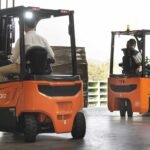
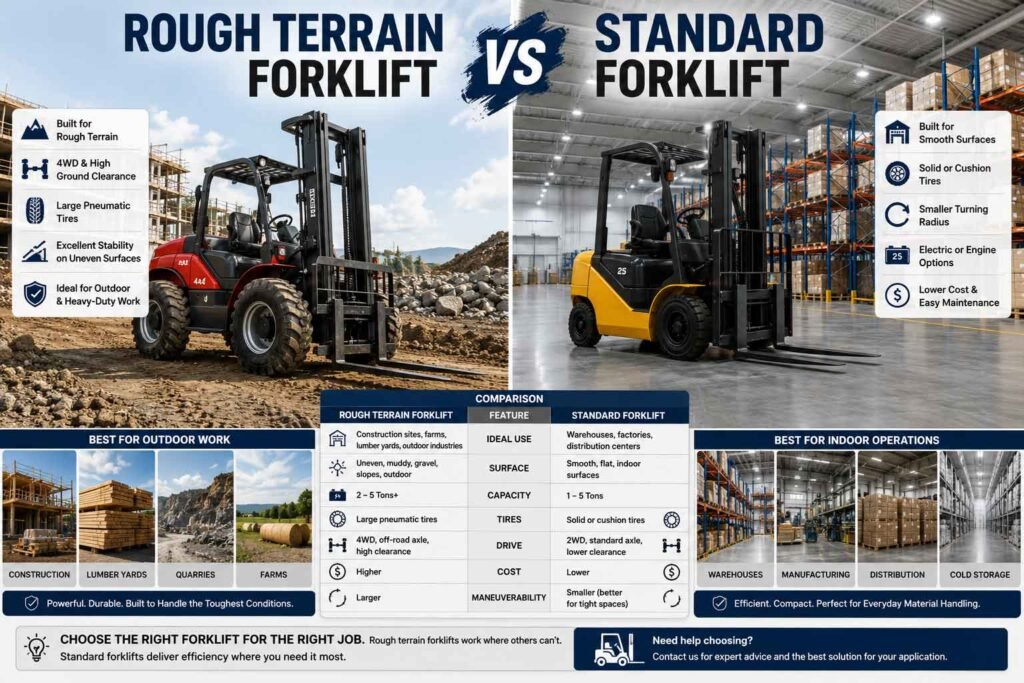
A standard forklift is built for smooth, hard surfaces — concrete floors, paved yards, loading docks. It has small cushion or solid tires, low ground clearance, and its stability depends on even footing.
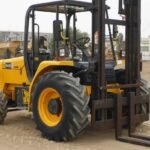
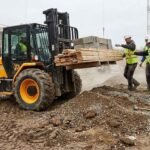
A rough terrain forklift is built for dirt, gravel, mud, and construction sites. It has large pneumatic tires with deep tread, high ground clearance, 4×4 drive, and a chassis that absorbs uneven ground.
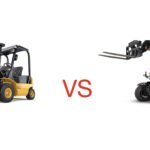
The same job on the wrong machine: A 2-ton standard forklift trying to move pallets across a gravel yard will sink, spin, and shake itself apart. A 4-ton rough terrain forklift trying to work in a 2.5 m warehouse aisle won't fit through the door.
Rough Terrain Forklift vs Standard Forklift
Side-by-Side Spec Comparison
| Spec | Standard Forklift | Rough Terrain Forklift |
|---|---|---|
| Typical capacity | 1–5 ton | 3–10 ton |
| Drive | 2-wheel (rear steer) | 4×4 all-wheel |
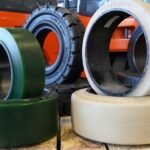
| Tires | Solid cushion or smooth pneumatic | Large pneumatic, deep tread |
| Ground clearance | 100–150 mm | 250–400 mm |
| Max grade (loaded) | 10–15% | 25–35% |
| Turning radius | 1,500–2,500 mm | 3,000–4,500 mm |
| Aisle width needed | 2.8–4 m | 4–6 m |
| Max speed | 15–20 km/h | 20–30 km/h |
| Power | Electric / Diesel / LPG | Diesel (almost always) |
| Floor requirement | Smooth concrete | Dirt, gravel, mud, sand |
| Typical weight | 3–8 ton | 6–15 ton |
| Price range (new) | $4,000–$50,000 | $12,000–$50,000 |
What Each Machine Is Built For
Standard Forklift — The Indoor Worker
Designed for:
- Warehouse racking (3–6 m lifts, tight aisles)
- Loading/unloading trailers at dock height
- Pallet handling on smooth concrete
- Multi-shift indoor operations
- Cold storage (electric models)
Breaks or fails when:
- Driven over gravel or dirt — tires spin, ground clearance is too low, the chassis bottoms out
- Operated on uneven ground — the load shifts, the truck rocks, stability disappears
- Used outdoors in rain/mud — traction drops to zero on wet surfaces
Rough Terrain Forklift — The Outdoor Worker
Designed for:
- Construction sites (materials over dirt, gravel, mud)
- Lumber yards and timber handling
- Mining and quarry operations
- Agricultural work (feed, hay, fencing)
- Outdoor storage yards (steel, pipes, concrete products)
- Pipeline and roadwork sites
Breaks or fails when:
- Driven into a warehouse — too wide for aisles, too loud, diesel exhaust needs ventilation
- Used on smooth polished concrete — pneumatic tires wear fast and mark floors
- Operated indoors at height — mast stability is compromised by the tall chassis
The 5 Questions That Decide
Question 1: What's under the wheels?
| Surface | Truck |
|---|---|
| Smooth concrete, sealed floors | Standard |
| Dirt, gravel, mud, packed earth | Rough terrain |
| Mixed (paved yard + gravel) | Rough terrain (pneumatic tires handle both) |
| Indoors + occasional outdoor | Standard with pneumatic tires, or standard electric |
Question 2: How high do you need to lift?
Rough terrain forklifts typically lift 3–4.5 m. Standard forklifts go 3–6 m, with high-mast models to 8 m.
If you need 5 m+ lift in a racked warehouse — standard forklift or reach truck, regardless of the floor.
Question 3: What are the aisles like?
| Aisle width | Truck |
|---|---|
| Under 3 m | Standard (or narrow aisle truck) |
| 3–4 m | Either |
| 4 m+ | Either (rough terrain needs this) |
| Unpaved 'aisles' between material piles | Rough terrain |
Question 4: What are you lifting?
- Palletized goods → both work
- Long loads (lumber, pipe, steel) → rough terrain with longer forks, or sideloader
- Loose material (gravel, sand) → rough terrain with bucket attachment
- Building materials to upper floors → telehandler, not either of these
Question 5: How many hours per day, and where?
- 8+ hours indoor → Standard electric (lowest operating cost)
- 8+ hours outdoor → Rough terrain diesel
- 2–3 hours occasional outdoor → Standard with pneumatic tires is enough
- 24/7 rough outdoor → Rough terrain, multiple units
The Cost Comparison (3-Year Total)
| Cost Item | 2-Ton Standard Electric | 3-Ton Rough Terrain Diesel |
|---|---|---|
| Purchase price | $8,000–$12,000 | $15,000–$22,000 |
| Fuel/power per year | $600–$1,200 (electricity) | $4,000–$7,000 (diesel) |
| Maintenance per year | $1,000–$1,500 | $2,500–$4,000 |
| Tires per year | $300–$500 (solid) | $1,500–$3,000 (pneumatic, off-road wear) |
| Operator training | Basic | Basic + off-road skills |
| 3-year total | $15,000–$20,000 | $35,000–$50,000 |
A rough terrain forklift costs roughly 2–2.5× more to own and run than a standard forklift of similar capacity. Buy it only if your site genuinely needs it.
The 'Standard with Pneumatic Tires' Middle Ground
Most buyers who think they need a rough terrain forklift actually need something in between: a standard counterbalance forklift fitted with pneumatic tires.
| Standard + Solid Tires | Standard + Pneumatic Tires | Rough Terrain | |
|---|---|---|---|
| Concrete floors | ✅ Best | ✅ Good | ⚠️ Marking, vibration |
| Paved outdoor yard | ⚠️ Poor | ✅ Good | ✅ Good |
| Gravel / packed dirt | ❌ No | ⚠️ Limited | ✅ Best |
| Mud / soft ground | ❌ No | ❌ No | ✅ Best |
| Price | Baseline | +$500–$1,000 | +$5,000–$10,000 |
| Indoor use | ✅ | ⚠️ (tires wear on concrete) | ❌ |
Rule: If your ground is firm but unpaved (packed gravel, compacted dirt), a standard forklift with pneumatic tires is the smart buy. If your ground is soft, rutted, or muddy — you need the real rough terrain machine.
Common Mistakes (We See These Every Month)
Mistake 1: Buying a rough terrain forklift because 'we might go on dirt someday.'
The operator now fights a 4 m turning radius in a warehouse every day, pays diesel fuel bills indoors, and can't fit the truck through the dock door. The 'someday' never came. They should have bought the standard and rented a rough terrain truck for the rare outdoor job.
Mistake 2: Buying a standard forklift for a gravel yard because 'it's cheaper.'
The truck sinks into gravel within a week. The operator spends half the shift winching it out. The transmission fails at 800 hours because the tires can't absorb the shock load. The 'savings' turns into a $6,000 repair and a second purchase — this time the right one.
Mistake 3: Assuming 4×4 means all-terrain.
4×4 helps traction, but it doesn't fix ground clearance, tire size, or chassis strength. A 4×2 rough terrain forklift with big pneumatic tires will outperform a 4×4 standard forklift in mud. Drive, clearance, and tires all matter — not just the drivetrain sticker.
Which One Should You Buy?
| Your situation | Buy |
|---|---|
| Warehouse, smooth floor, racking, dock loading | Standard electric forklift |
| Factory floor, pallets, 3–6 m racks | Standard electric or diesel |
| Paved yard + occasional gravel | Standard with pneumatic tires |
| Construction site, dirt and gravel | Rough terrain (3–4 ton for most jobs) |
| Lumber yard, long loads, unpaved | Rough terrain with long forks |
| Mining / quarry / heavy material | Rough terrain (5–10 ton) |
| Farm, hay and feed, muddy paddocks | Rough terrain or telehandler |
| Building materials to upper floors | Telehandler |
| 90% indoor + 10% outdoor | Standard (rent for the outdoor work) |
The Bottom Line
A rough terrain forklift is not a 'better' forklift. It's a different tool for a different ground. If your wheels roll on concrete all day — buy standard, save $10,000–$30,000 over three years, and don't look back. If your wheels roll on dirt, gravel, or mud — buy rough terrain, because the standard truck will cost you more in repairs and downtime than you saved in purchase price.
Still not sure? Send us your site photos — we'll tell you honestly which one fits. We've told more than one customer 'you don't need the rough terrain model' and saved them the money.
About the Author
Edward handles export sales at Hebei Maoxiang Technology, helping international buyers with forklift pricing, configuration, shipping, and export documentation. He has helped customers in 80+ countries find the right machine — and just as importantly, told them which machine they didn't need.
Hebei Maoxiang Technology Co., Ltd.
- Web: forkliftlift.com
- Email: sales@maoxiang-tech.com
- Standard forklifts: electric, diesel, LPG | Rough terrain: T30–T100 | Telehandlers | AGVs
- FOB Tianjin | CE certified | 20–35 day lead | 24/7 quote support