Where to Buy a Forklift
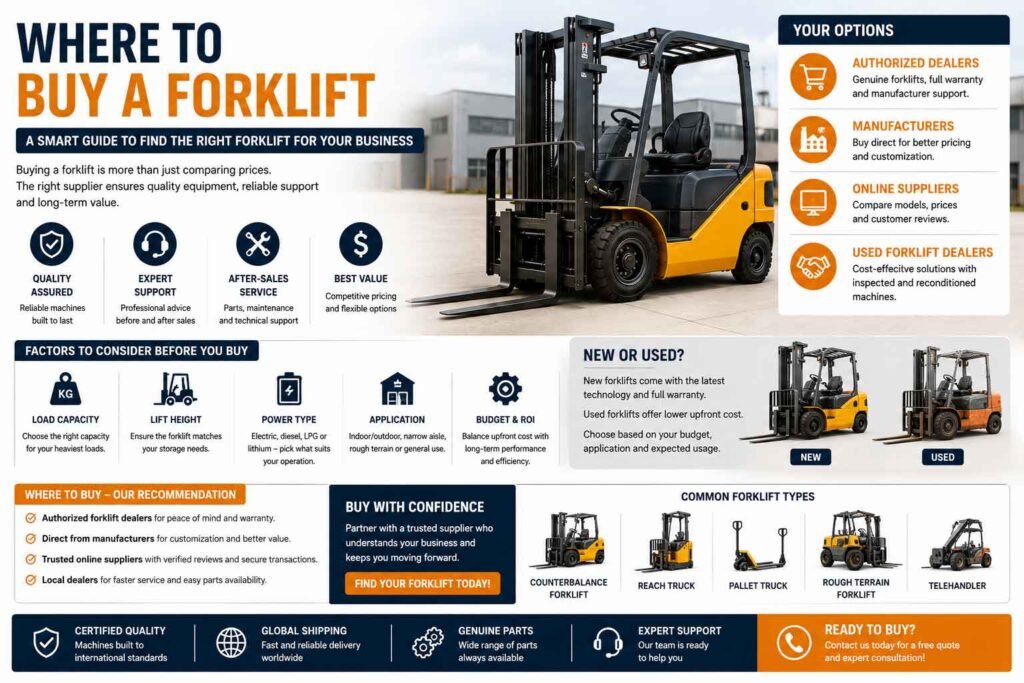
The Six Channels at a Glance
| Channel | Price vs Factory | Lead Time | Risk Level | Best For |
|---|---|---|---|---|
| Local dealer | +30–60% | In stock | Low | Need it now, want local service |
| Online marketplace (Alibaba, eBay) | +0–20% | 20–60 days | Medium | Price shoppers who verify carefully |
| Auction / liquidation | -30–60% vs new | Immediate | High | Cheapest, know exactly what you're doing |
| Rental company | +20–40% (buying used rentals) | In stock | Medium | Ex-rental fleet with service history |
| Broker / reseller | +10–30% | 10–30 days | Medium | Someone else does the sourcing |
| Factory direct (China) | Baseline (0%) | 20–35 days | Low (with verification) | Fleet buyers, planned purchases, budget-sensitive |
Channel 1: Local Dealer
How it works: You walk in, test drive, buy, and get local warranty and service. The dealer is a middleman — they buy from a manufacturer (often Chinese, Japanese, or Korean) and add their margin plus freight and inventory costs.
What you pay:
- 2-ton electric counterbalance: $10,000–$15,000 (dealer) vs $6,000–$8,500 (factory direct)
- 3-ton diesel: $18,000–$25,000 (dealer) vs $12,000–$16,000 (factory direct)
The markup breakdown: The dealer's price includes manufacturer margin + dealer margin (15–30%) + freight + inventory financing + local showroom costs. That's why it's 30–60% above factory price.
Pros: Immediate availability, local warranty labor, trade-in options, financing help. Cons: The markup. You pay for the showroom whether you use it or not.
Buy from a dealer if: You need the truck this week, you want a local company to sue if it breaks, or you're buying one unit and have no in-house maintenance.
Channel 2: Online Marketplace (Alibaba, eBay, etc.)
How it works: You find a supplier (usually Chinese factories or exporters), negotiate, pay a deposit, and the machine ships in 20–60 days.
What you pay: $5,000–$9,000 for a 2-ton electric (before shipping). Shipping adds $800–$2,500 depending on destination.
The Alibaba trap: Prices look amazing — then you discover the '2-ton forklift' is actually 1.5-ton with a 2-ton sticker, or the battery is a no-name brand, or the CE certificate is a screenshot from another factory.
How to buy safely on marketplaces:
| Check | What to Verify |
|---|---|
| Real factory (not a trading company) | Ask for factory video tour, verify with Google Maps |
| CE / ISO certificates | Request the certificate number, verify with the issuing body |
| Reference customers | Ask for 2–3 customers in your region, contact them |
| Battery brand | Demand the actual brand and spec — not 'compatible with' |
| Load test report | Ask for the test report for YOUR specific unit |
| Payment terms | Never 100% upfront. 30% deposit + 70% against documents (BL) |
| Inspection | Use a third-party inspection (SGS, Bureau Veritas) before shipping |
Buy online if: You have time (20–60 days), you're buying 2+ units, and you're willing to verify the supplier properly.
Channel 3: Auction / Liquidation
How it works: Companies go out of business, upgrade fleets, or liquidate. Auction sites (IronPlanet, Ritchie Bros, local auctions) sell used forklifts with no warranty, no return policy, and often no inspection report.
What you pay: 40–70% of new price. A 2-ton electric that costs $12,000 new sells for $4,000–$7,000 at auction.
The catch:
- No test drive before bidding (some auctions allow inspection days)
- No warranty, no support, no parts guarantee
- Condition unknown — batteries are usually near end of life
- You're competing with dealers who know the market better than you
- As-is, where-is. You buy the problem too.
Buy at auction if: You're an experienced buyer, you inspect the unit in person on inspection day, and you have a maintenance team. First-time buyers should skip auctions — the savings get eaten by repairs.
Channel 4: Rental Company
How it works: Rental companies (Sunbelt, United Rentals, Herc) sell their ex-rental fleet. You get a forklift with documented service history — usually better maintained than average used stock.
What you pay: $6,000–$9,000 for a 2-ton electric (3-year-old ex-rental). Plus the knowledge that 3 years of renters beat on it.
The advantage: Rental fleets are serviced on schedule because downtime costs the rental company money. You get service records.
The disadvantage: Rental units have high hours (1,500–3,000/year) and have been operated by dozens of different people — including the occasional renter who doesn't know what they're doing.
Buy from a rental company if: You want documented history and don't mind high hours. It's the 'safe used' option.
Channel 5: Broker / Reseller
How it works: A broker finds machines, buys them, and resells. They don't manufacture or rent — they trade.
What you pay: 10–30% above what they paid. The broker's value is sourcing: they know where the good used machines are and they handle the inspection.
The risk: Brokers vary wildly. A good broker adds real value (verified condition, honest history). A bad broker is an auction with a smile — no warranty, no inspection, 'buyer beware.'
Verify the broker: Ask for the machine's service records, the previous owner's name, and the serial number — then call the manufacturer with the serial number to verify its history.
Channel 6: Factory Direct (China)
How it works: You buy directly from the manufacturer — no middleman, no showroom markup. This is what we do at Hebei Maoxiang: you get the factory price, we handle shipping and export documentation, and the machine ships in 20–35 days.
What you pay (factory-direct baseline):
| Machine | Local Dealer Price | Factory Direct Price |
|---|---|---|
| 2-ton electric counterbalance | $10,000–$15,000 | $6,000–$8,500 |
| 3-ton diesel | $18,000–$25,000 | $12,000–$16,000 |
| 2-ton reach truck | $22,000–$30,000 | $14,000–$19,000 |
| 1.5-ton electric pallet jack | $2,500–$4,000 | $1,500–$2,500 |
Add shipping: $800–$3,000 depending on destination and container configuration. One 40ft container fits 2–4 counterbalance forklifts (knocked down or with masts tilted).
Factory direct is safe if you verify:
| Verify | How |
|---|---|
| Factory exists | Video tour, Google Maps, business license |
| Certifications real | CE number cross-checked, SGS reports |
| Specs match quote | Load test report per unit |
| Battery is branded | Battery label + spec in contract |
| Payment safe | 30% deposit, balance against shipping documents |
| Warranty in writing | Parts shipped within 48h, terms defined |
The Decision Matrix
| Your situation | Best channel |
|---|---|
| Need a forklift this week | Local dealer or rental company |
| One unit, no rush, budget matters | Factory direct |
| Fleet purchase (3+ units) | Factory direct (savings add up to a free spare truck) |
| First forklift ever, nervous | Local dealer (pay for the hand-holding) |
| Experienced buyer, wants a gamble | Auction |
| Wants documented history | Rental company fleet sale |
| Doesn't want to source themselves | Broker (verified) |
| Buying for a remote location (Africa, SE Asia, South America) | Factory direct (local dealers may not exist or add huge margins) |
The Real Total Cost (Don't Just Compare Sticker Prices)
| Cost Item | Local Dealer | Factory Direct |
|---|---|---|
| 2-ton electric forklift | $12,000 | $7,000 |
| Freight to your port | Included (often) | $1,500 |
| Import duties/tax | Included | $300–$1,500 (varies by country) |
| Inspection | Dealer's reputation | $500 (optional SGS) |
| Spare parts (first year) | Local stock | $300 (shipped, 48h) |
| Warranty claims (labor) | Local dealer labor | Parts shipped, local labor arranged |
| Total | ~$12,000–$14,000 | ~$9,300–$10,500 |
Factory direct still saves 20–35% even after freight, duties, and inspection. The dealer's advantage is speed and local labor — not price.
8 Questions to Ask Before Buying From Any Channel
- Can you show me the actual unit (video or visit)?
- What's the serial number — can I verify it with the manufacturer?
- Is the data plate present and matching the configuration?
- What's the battery brand, age, and remaining capacity?
- What exactly does the warranty cover — parts only, or parts + labor?
- How fast can you ship spare parts?
- Can you provide 2–3 customer references in my region?
- What happens if the unit arrives damaged or doesn't match spec?
If a seller hesitates on any of these — walk. A legitimate channel answers all eight immediately.
The Bottom Line
Where you buy a forklift determines 30–60% of the price. The same 2-ton electric that costs $12,000 at a dealer costs $7,000 from a factory direct — and the difference is the middleman's margin, not the machine's quality.
Buy local if you need it now or want local service. Buy factory direct if you have 20–35 days of lead time and want the best price — which is most buyers. Buy at auction only if you're experienced. And no matter the channel, verify the eight questions before you pay a deposit.
About the Author
Edward handles export sales at Hebei Maoxiang Technology, helping international buyers with forklift pricing, configuration, shipping, and export documentation. He has helped customers in 80+ countries navigate exactly these six channels — and most of them end up buying factory direct once they see the comparison.
Hebei Maoxiang Technology Co., Ltd.
- Web: forkliftlift.com
- Email: sales@maoxiang-tech.com
- Electric forklifts | Diesel forklifts | Reach trucks | Pallet jacks | Rough terrain | Telehandlers
- FOB Tianjin | CE certified | 20–35 day lead | 24/7 quote support