Choosing the wrong forklift tire for your warehouse floor can lead to faster tire wear, unstable handling, floor damage, higher maintenance costs, and reduced forklift efficiency.
The best forklift tire depends not only on load capacity, but also on the floor type, working environment, and operating conditions.
For example:
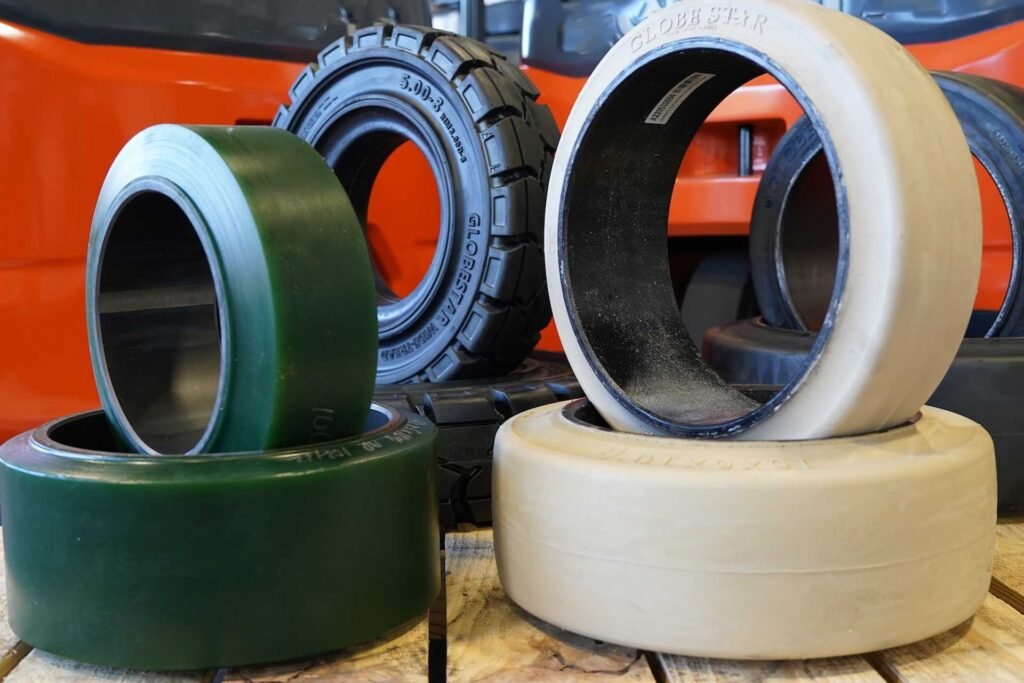
- PU wheels work well on smooth indoor warehouse floors
- Solid pneumatic tires are better for rough outdoor surfaces
- Cushion tires are ideal for flat concrete floors
- Pneumatic tires perform better on uneven ground and construction sites
Many forklift problems that operators blame on the forklift itself are actually caused by incorrect tire selection.
Before choosing a forklift, businesses should evaluate:
- Floor smoothness
- Indoor vs outdoor operation
- Ground moisture
- Ramp conditions
- Surface friction
- Debris and floor damage
Selecting the proper forklift tire can significantly improve safety, stability, energy efficiency, and equipment lifespan.
Why Forklift Tire Selection Matters More Than Most Buyers Realize
Many buyers focus only on:
- Forklift price
- Lift height
- Load capacity
- Battery type
But the warehouse floor has a major impact on forklift performance.
The wrong tire can cause:
- Excessive vibration
- Tire cracking
- Poor traction
- Increased battery consumption
- Steering instability
- Faster suspension wear
In some warehouses, tire selection directly affects:
- Operator safety
- Product damage
- Warehouse floor maintenance costs
- Forklift operating lifespan
Forklift Tire Selection Based on Floor Type
Smooth Epoxy Floors: Best for PU Wheels and Cushion Tires
Modern warehouses often use epoxy-coated floors because they are:
- Smooth
- Dust-free
- Easy to clean
- Ideal for high-density storage
For these environments, polyurethane (PU) wheels and cushion tires are usually the best choice.
Advantages of PU Wheels on Smooth Floors
PU wheels provide:
- Low rolling resistance
- Quiet operation
- High energy efficiency
- Precise steering control
This is especially important for:
- Reach trucks
- Order pickers
- Narrow aisle forklifts
- Electric pallet trucks
Because these forklifts rely heavily on floor smoothness for stability.
Uneven Concrete Floors Create Serious Problems for Electric Forklifts
Older warehouses often have:
- Cracked concrete
- Expansion joints
- Uneven surfaces
- Damaged floor sections
These floor conditions are difficult for electric forklifts using hard PU wheels.
Common problems include:
- Increased mast shaking
- Load instability
- Operator discomfort
- Higher vibration damage
- Faster wheel wear
Reach trucks are especially sensitive to uneven floors because:
- They have smaller wheels
- Higher lift heights
- Narrow chassis designs
Even small floor defects can reduce stability during lifting.
Outdoor Yards Require Pneumatic or Solid Pneumatic Tires
Outdoor operations usually involve:
- Gravel
- Mud
- Asphalt
- Broken concrete
- Wet surfaces
In these environments, pneumatic tires are often the best solution.
Advantages of Pneumatic Forklift Tires
Pneumatic tires provide:
- Better shock absorption
- Improved traction
- Higher ground clearance
- More stable outdoor handling
They are commonly used on:
- Diesel forklifts
- Rough terrain forklifts
- Telehandlers
- Construction forklifts
Cushion Tires vs Pneumatic Tires
One of the most common forklift tire questions is:
Which is better: cushion tires or pneumatic tires?
The answer depends entirely on the operating environment.
Cushion Tires
Best for:
- Indoor warehouses
- Smooth concrete
- Narrow aisles
Advantages:
- Smaller turning radius
- Lower forklift height
- Better maneuverability indoors
Disadvantages:
- Poor outdoor performance
- Limited shock absorption
- Sensitive to rough floors
Pneumatic Tires
Best for:
- Outdoor yards
- Uneven terrain
- Construction sites
Advantages:
- Better traction
- Improved operator comfort
- Handles debris and rough surfaces
Disadvantages:
- Larger turning radius
- Higher rolling resistance
- Less efficient indoors
Cold Storage Floors Require Special Tire Considerations
Cold storage warehouses create unique tire challenges.
Low temperatures can make some tire materials:
- Harder
- Less flexible
- More likely to crack
Moisture and ice also reduce floor traction.
For freezer operations, operators often prefer:
- Specialized cold-resistant compounds
- Anti-slip tire patterns
- Durable rubber formulations
Forklift tire performance becomes even more important when:
- Floors are slippery
- Visibility is reduced
- Heavy loads are handled at height
Forklift Floor Damage Is Often Caused by Tire Choice
Many warehouses blame forklifts for floor damage when the real problem is incorrect tire selection.
Hard tires operating on weak floors can cause:
- Surface cracking
- Coating wear
- Expansion joint damage
Heavy forklifts with small contact-area tires create high point pressure on warehouse floors.
This becomes a major issue in:
- High-density warehouses
- Automated storage systems
- Narrow aisle facilities
How Floor Conditions Affect Electric Forklift Battery Efficiency
Floor quality also affects energy consumption.
On rough floors:
- Rolling resistance increases
- Motors work harder
- Battery drain accelerates
Poor floors can reduce electric forklift runtime significantly.
This is especially noticeable on:
- Reach trucks
- Order pickers
- Electric pallet jacks
Smooth floors improve:
- Travel efficiency
- Battery life
- Operator comfort
- Equipment lifespan
Best Forklift Tire Types by Floor Condition
Smooth Indoor Warehouse Floors
Recommended:
- PU wheels
- Cushion tires
Best for:
- Reach trucks
- Order pickers
- Electric pallet trucks
Rough Concrete Floors
Recommended:
- Solid pneumatic tires
- Durable rubber compounds
Best for:
- Counterbalance forklifts
- Heavy-duty electric forklifts
Outdoor Gravel or Construction Sites
Recommended:
- Pneumatic tires
- Rough terrain tires
Best for:
- Diesel forklifts
- Telehandlers
- Rough terrain forklifts
Cold Storage Floors
Recommended:
- Cold-resistant rubber tires
- Anti-slip compounds
Best for:
- Electric forklifts
- Warehouse pallet trucks
How to Choose the Right Forklift Tire
Before purchasing a forklift, evaluate:
- Floor smoothness
- Indoor vs outdoor usage
- Surface moisture
- Ramp angles
- Floor load capacity
- Daily operating hours
The same forklift may perform completely differently depending on the floor condition.
That is why professional forklift selection should always include a floor analysis.
Conclusion
Forklift tire selection is not just about the forklift itself — it is about matching the tire to the actual floor condition and operating environment.
The wrong tire can reduce stability, increase maintenance costs, damage warehouse floors, and shorten forklift lifespan.
Whether operating on smooth epoxy floors, rough outdoor yards, uneven concrete, or cold storage environments, choosing the correct forklift tire can dramatically improve safety, efficiency, and long-term operating costs.
Before buying a forklift, businesses should evaluate both the forklift specifications and the warehouse floor conditions to ensure the best overall performance.