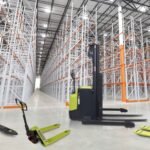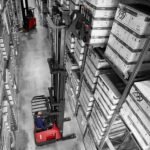
If your fleet has moved into a more automated facility — narrower aisles, fixed AGV routes, higher pick frequency — and tire replacement costs have crept up without an obvious explanation, the warehouse layout itself is usually the reason, not a drop in tire quality.
Electric forklifts and automated warehouse designs interact in a specific way that accelerates tire wear. Here's what's actually driving it, and what you can do about it.

The Core Mechanism: Repetition, Not Just Load
Traditional warehouses tend to have wider aisles, more varied traffic patterns, and a mix of turning angles depending on where a pallet needs to go. Tire wear is spread across many different contact points on the floor.
Automated and semi-automated facilities are designed for the opposite: maximum storage density, fixed travel lanes, and repeatable motion. AGVs follow the same programmed path every cycle. Human-operated reach trucks and narrow-aisle forklifts, working the same racking layout shift after shift, end up tracing nearly identical routes as well.
The result is that the same small patches of floor absorb the same turning stress, acceleration, and braking load thousands of times a week. Tire wear that would normally distribute across a large floor area instead concentrates into a handful of 'hot spots' — typically at:
- Charging station approaches
- Conveyor or pick-station intersections
- Turning points in narrow aisles
- Fixed staging and drop-off zones
Instant Torque Makes This Worse
Electric motors deliver full torque from a standstill, unlike internal combustion engines that build power more gradually. This gives electric forklifts their responsive, efficient feel — but it also means more shear force is transmitted to the tire contact patch during acceleration, especially during frequent stop-start cycles.
Lithium-ion powered trucks tend to accelerate even more aggressively than lead-acid equivalents, because the battery can sustain higher discharge rates without voltage sag. Operators often describe lithium trucks as feeling 'snappier' — that responsiveness is exactly what increases scrubbing at the tire surface, particularly on high-grip floor finishes like polished concrete or sealed epoxy.
Which Trucks and Wheels Are Most Affected
Reach trucks and narrow-aisle forklifts tend to show the most accelerated wear, for a combination of reasons:
- Small-diameter load wheels concentrate the truck's weight over a much smaller contact patch than a standard tire, so the same load produces higher localized pressure.
- Constant micro-steering in tight aisles means these wheels are almost never rolling in a straight line — they're continuously correcting, which is inherently more abrasive than straight-line travel.
- Mast extension shifts weight forward onto the front wheels when the load is raised, increasing contact pressure exactly when the truck is also maneuvering.
Polyurethane (PU) wheels, common on reach trucks, pallet jacks, and order pickers, run quiet and smooth but generate more heat under repetitive high-frequency use than rubber. Heat buildup softens the PU compound, which accelerates chunking and edge cracking — particularly where the wheel repeatedly crosses expansion joints or floor transitions.
Rubber tires, more common on counterbalance trucks, handle rough or uneven surfaces better but aren't immune either — on polished, high-grip floors combined with high motor torque, rubber can wear faster than expected too, since the compound is optimized for traction rather than low-friction rolling.
Floor Finish Plays a Bigger Role Than Most Buyers Expect
Many automated facilities favor polished concrete because it looks clean, reflects light well for AGV vision systems, and reduces dust. But a smoother, higher-friction floor surface increases tire scrubbing during every turn — the same steering input that would produce mild wear on a broom-finished or coated floor produces more heat and more material loss on polished concrete.
Combined with 16-24 hour operating schedules common in automated distribution centers, tires in these environments often don't get a real cooling-off period between shifts, which compounds heat-related degradation over time.
Warning Signs Worth Tracking
- Uneven wear side-to-side on the same wheel — usually points to a specific turning pattern or a recurring route
- Flat spots from repeated stopping in the same position (common at charging docks or staging zones)
- Edge cracking on PU wheels, typically starting near expansion joints
- Wheels running noticeably hot after short travel distances
- Replacement frequency climbing on specific trucks — usually the ones assigned to the tightest, most repetitive routes
If you're tracking tire replacement costs per truck, the trucks running fixed routes in narrow aisles or near charging stations will almost always show up first.
What Actually Reduces the Wear Rate
Vary the route where possible. Even small adjustments to charging schedules or staging locations — so trucks aren't crossing the exact same floor path every single cycle — spread the wear across a larger area.
Match wheel material to the actual floor and duty cycle. PU is the right call for quiet, smooth indoor rolling at moderate frequency; for high-cycle automated aisles, some fleets get better tire life from compounds specifically formulated for heat resistance, even at a modest cost premium.
Moderate acceleration curves where the controller allows it. Many electric forklift controllers let you soften the acceleration profile without materially affecting cycle times. A slightly less aggressive launch reduces peak shear force on the tire without slowing overall throughput in most narrow-aisle applications.
Address floor transitions. Poorly maintained expansion joints are a disproportionate source of wheel damage on small-wheel equipment. Filling, smoothing, or rerouting around damaged joints extends wheel life more than most fleet managers expect.
Rotate wheels and inspect on a fixed schedule rather than waiting for visible failure — by the time chunking or cracking is visible, the wheel has usually already been running inefficiently (higher rolling resistance, more heat) for some time.
The Bigger Picture
As warehouses trend toward higher density, tighter automation, and faster cycle times, tire wear shifts from a minor maintenance line item to a real operating cost that's easy to underbudget. It's common for facilities to focus heavily on battery performance and automation software while overlooking wheel and tire wear until replacement frequency becomes obvious in the maintenance log.
At Hebei Maoxiang, we spec wheel and tire options based on the customer's actual floor type and duty cycle rather than defaulting to a single standard configuration — a reach truck destined for a 20-hour automated pick operation on polished concrete has different wheel requirements than the same model running two shifts on a standard warehouse floor. If you're seeing tire life shorter than expected in a high-density or automated layout, the fix is often a wheel material and route adjustment rather than a different forklift altogether.