The Simple Version
A warehouse does three things:
- Receive — Take product off a truck, check it against the purchase order, put it somewhere
- Store — Keep it until someone orders it
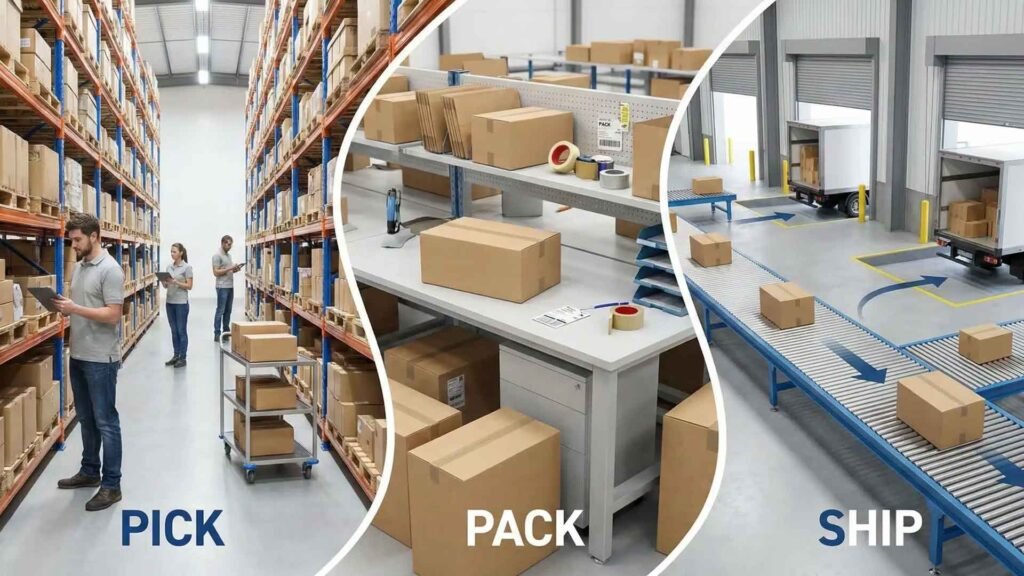
- Ship — Find it, pick it, pack it, put it on an outbound truck
Warehouse management is making those three steps happen with the least time, least labor, and fewest errors.
That's it. Everything else — WMS software, slotting optimization, automation, KPIs, labor tracking — is just tools to measure and improve those three steps.
If a warehouse manager can't tell you exactly how long each of those three steps takes, and what it costs, they don't have warehouse management. They have a building full of pallets and hope.
What Is Warehouse Management
The Five Core Processes
1. Receiving
The truck shows up. The driver has a bill of lading. Your job: verify what's actually on the truck matches what you ordered, inspect for damage, and book it into the system.
Good receiving:
- Truck appointment system (drivers don't show up at the same time)
- RFID or barcode scan on each pallet as it comes off the truck
- Real-time update to inventory — the system knows those pallets exist immediately
- Inspection checklist with photo capture for damaged goods
- Average time per truck: 30–60 minutes
Bad receiving:
- Paper log, entered into the computer at end of shift
- No inspection standard — drivers leave, you find damage later, and it's your problem
- Warehouse manager doesn't know what arrived until 6 hours after the truck left
- Average time per truck: 90–180 minutes
Equipment needed: Pallet jack or forklift at the dock, barcode scanner or RFID reader, dock leveler.
2. Put-Away
Moving pallets from the receiving dock to a storage location. This is where most warehouses waste the most time.
Bad put-away: The operator drives around looking for an empty spot. Finds one. Puts the pallet there. Writes the location on a piece of paper. At the end of the day, someone types those locations into the system. By then, nobody is sure which pallet went where.
Good put-away: The WMS assigns a specific location when the pallet is received. The operator follows the system instruction. Scans the location barcode to confirm. The system knows exactly where every pallet is, in real time.
Good put-away also uses slotting: Fast-moving SKUs go near the dock. Slow-moving SKUs go to the far racks. Bulky items go to floor stack. This isn't random — it's calculated to minimize travel distance.
Without good put-away, you spend 30–40% of your labor budget on forklift driving that should take 15%.
3. Storage (Slotting)
Where you put things in the rack matters more than how fast your forklifts are. A well-slotted warehouse runs 20–30% more efficiently than a poorly slotted one — with the same equipment and same people.
Storage strategies (by product velocity):
| Velocity | % of SKUs | % of Moves | Where to Store |
|---|---|---|---|
| A (fast movers) | 10–15% | 60–70% | Floor stack or bottom rack, <50m from dock |
| B (medium movers) | 30–40% | 20–25% | Mid-level rack, middle zones |
| C (slow movers) | 45–60% | 5–10% | Top rack, back zones, deep locations |
Pallet storage types:
| Type | Best For | Pallet Density |
|---|---|---|
| Selective rack | Mixed SKUs, high variety | 1 pallet deep, every pallet accessible |
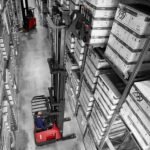
| Double-deep rack | Higher density, fewer aisles | 2 pallets deep, needs reach truck |
| Drive-in rack | Low SKU count, high volume per SKU | 4–6 pallets deep, LIFO |
| Push-back rack | Higher density, FIFO possible | 2–4 pallets deep per lane |
| Floor stack | Heavy, bulky, or fast-moving | No racking cost, limited height |
4. Picking
Taking product out of storage to fill customer orders. This is where 50–60% of warehouse labor goes. Every improvement in picking efficiency directly hits your bottom line.
Picking methods (in order of efficiency for small-medium warehouses):
| Method | Best For | Picks Per Hour |
|---|---|---|
| Piece picking (single order) | 1–10 lines per order | 60–100 |
| Batch picking (multiple orders at once) | Many small orders, same SKU overlap | 150–300 |
| Zone picking (each zone picks its items) | Large warehouses, many zones | 120–200 |
| Wave picking (coordinated zones) | High-volume, time-window based | 200–400 |
| Voice-directed picking | Hands-free, high accuracy | 180–250 |
| Goods-to-person (automated) | Small parts, high SKU count | 300–600 |
Picking accuracy: A 99% pick rate sounds good. In a warehouse shipping 1,000 orders per day, that's 10 wrong orders per day. At $50 average cost to handle a return + restock + re-ship, that's $180,000 in annual waste from picking errors.
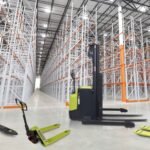
Equipment: Pallet jack (walkie) for pallet picks, forklift for heavy picks, barcode scanner for verification, conveyor or cart for staging.
5. Shipping
Packed orders move to the staging area, get loaded onto outbound trucks, and leave. The goal: the right truck gets the right pallets in the right order.
Good shipping:
- Staging area sorted by carrier route, not by dock door
- Pallet stretch-wrapped and labeled before staging
- Load confirmation scan — every pallet scanned as it enters the truck
- Truck departure photo (proof of what left your dock)
Bad shipping:
- Pallets staged wherever there's space
- Driver loads them in the wrong order (now pallets for the last stop are at the back)
- No scan at loading — if the customer claims a pallet didn't arrive, you can't prove it left
The Technology Stack
| Tool | What It Does | When You Need It |
|---|---|---|
| WMS (Warehouse Management System) | Tracks inventory, manages put-away/pick tasks, generates reports | 1,000+ pallet positions or 5+ employees |
| WES (Warehouse Execution System) | Real-time task optimization across multiple operators/AGVs | 10+ forklifts/AGVs, dynamic routing needed |
| Barcode / RFID scanning | Eliminates manual data entry, confirms every move | Any warehouse. Cheap, huge ROI |
| Voice picking | Hands-free picking with voice confirmation | High-volume picking, cold storage (gloves make scanning hard) |
| Slotting software | Analyzes velocity and optimizes SKU placement | 2,000+ SKUs or 20%+ travel waste |
| YMS (Yard Management System) | Manages truck appointments and trailer tracking | 10+ dock doors or 50+ trucks per day |
Don't buy any of this until you can answer: 'How long does each of the 5 core processes take, and what does it cost per unit?'
The 5 Numbers Every Warehouse Manager Should Know
| Metric | Definition | Good Benchmark |
|---|---|---|
| Inventory accuracy | % of locations where physical count matches system | 98%+ |
| Picks per labor hour | Total lines picked / total pick labor hours | 100+ (pallet), 60+ (case), 250+ (voice) |
| Dock-to-stock time | Time from truck arrival to inventory available for picking | 2–4 hours |
| Order cycle time | Time from order release to loaded on outbound truck | Same-day: <4 hours. Next-day: <18 hours |
| Cost per unit shipped | Total warehouse operating cost / total units shipped | $0.15–$0.50 (pallet), $0.50–$2.00 (case) |
If you don't track these, you don't have warehouse management. You have activity. Activity is not management.
Common Mistakes
Mistake #1: Buying WMS before fixing the process.
Warehouse has paper records, no barcode scanning, 8% inventory error. They buy a $30,000 WMS. Now they have $30,000 in software plus the same 8% inventory error, because the data going into the system is still wrong.
Fix: Barcode scanning + clean cycle count process first. Then WMS.
Mistake #2: Over-automating a low-volume warehouse.
1,000 ft² warehouse, 200 picks per day. Owner buys a $200,000 sortation system. Payback: never.
Fix: Automation ROI starts at about 1,500–2,000 picks per day per shift. Below that, people + pallet jacks are cheaper.
Mistake #3: Using the shipping dock as overflow staging.
Pallet sits on the dock for 3 days waiting for the truck. That dock space was designed for 30-minute staging, not 3-day storage. Now loading takes twice as long because you have to rearrange pallets first.
Fix: Dedicated staging lanes or floor-stack staging zones outside the dock area. The dock is for loading, not storing.
Mistake #4: Managing from the office.
Warehouse manager spends 6 hours per day in front of a screen. The floor runs itself — badly.
Fix: Warehouse managers should spend 60–70% of their shift on the floor. The screen work fills the gaps, not the other way around.
How Warehouse Management Connects to Forklifts
The forklift is the most expensive equipment cost in any warehouse. A typical electric stand-up forklift costs $4,000–$8,000 and runs 2,000–3,000 hours per year. At $15–$25 per hour fully loaded (operator + power + maintenance), a forklift costs more to operate in one year than it costs to buy.
Warehouse management decides:
- How far each forklift travels per shift (slotting quality)
- How many empty miles it drives (task interleaving)
- How often it sits idle waiting for instructions (dispatch process)
- How many forklifts you actually need (vs. how many you have)
Good warehouse management reduces forklift fleet size by 20–35% for the same throughput. That's where the real savings are — not in buying cheaper forklifts, but in needing fewer of them.
The Bottom Line
Warehouse management is not a software category. It's a process discipline:
- Know what you have (accurate inventory)
- Know where things should go (good slotting)
- Know what to do next (task orchestration)
- Know how long it took (measured performance)
- Know what it costs (cost per unit)
Software is a tool to enable this, not the thing itself. The thing itself is a warehouse manager who walks the floor, measures the process, and keeps asking 'why is this taking so long?' until the answer is 'it doesn't.'
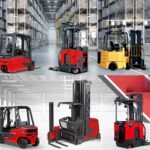
We build the equipment that makes warehouse management work — electric stand-up forklifts, pallet jacks, reach trucks, and AGVs for the movement side of the operation. If you're setting up or restructuring a warehouse, contact us. We'll help you spec the right equipment for your layout and throughput.
Hebei Maoxiang Technology Co., Ltd.
- forkliftlift.com
- Electric forklifts | Pallet jacks | Reach trucks | AGVs
- FOB Tianjin | 20–35 day lead | CE certified | 50+ countries served