The load center is the distance from the front face of the forks to the center of gravity of the load. Forklift capacity is rated at a specific load center, commonly 500 mm or 600 mm (24 inches). If your load's center of gravity sits further out than the rated load center, the truck can't safely lift as much as the headline capacity says. This guide explains how it works and what it means when you're buying.
If you've ever compared two forklifts with the same rated capacity and wondered why one struggles with loads the other handles easily, the answer is often the load center.
Load center mismatches are one of the most common and most avoidable mistakes buyers make when specifying a truck. Manufacturers rate capacity at a specific load center, not as a flat number that applies to every load you'll ever lift. Change the load center and the safe capacity changes with it.
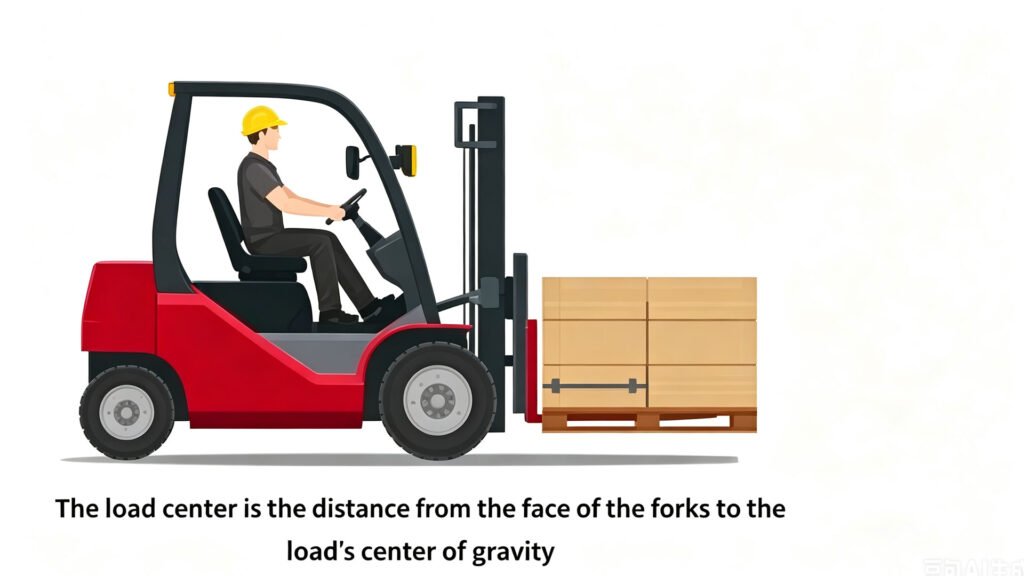
The Physics in One Sentence
A forklift is a lever. The load in front tries to tip the truck forward, and the counterweight at the back holds it down. The further forward the load's center of gravity sits, the more leverage it has against the counterweight, and the less weight the truck can safely lift.
That's why a forklift rated '2,000 kg at 500 mm load center' doesn't mean '2,000 kg, full stop.' It means 2,000 kg only if the load's center of gravity falls within 500 mm of the fork face. Push it further out, with a longer pallet, an oddly shaped load, or an attachment, and the same truck can safely handle less.
How to Estimate the Adjusted Capacity
A widely taught conservative rule of thumb is:
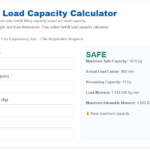
Adjusted capacity ≈ rated capacity × rated load center ÷ actual load center
For example, a truck rated 2,000 kg at 500 mm handling a load with a 600 mm load center: 2,000 × 500 ÷ 600 ≈ 1,670 kg.
Treat this as a conservative working estimate, not a guarantee. The manufacturer's load capacity chart for your specific truck is the only authority, and it may allow somewhat more than the rule of thumb gives. Never work from a figure higher than the chart.
Why This Trips Up So Many Buyers
Capacity ratings are quoted at a standard load center that differs by market and truck:
| 500 mm Load Center | 600 mm (24 in) Load Center | |
|---|---|---|
| Where it's common | Metric markets, including much of Asia and Europe | North America |
| Matching load depth | About 1,000 mm deep | About 1,200 mm deep |
| Effective capacity on a 1,200 mm-deep load (conservative estimate) | About 83% of rated capacity | 100% of rated capacity |
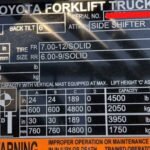
Some trucks, particularly heavier ones, use other load centers, so always read the data plate.
To find the load center your actual loads need, measure the load's depth in the direction of the forks and divide by two:
- 1,000 mm deep: 500 mm load center
- 1,200 mm deep: 600 mm load center
The same pallet can give different answers depending on which side the forks enter. A 1,200 × 1,000 mm pallet is 1,200 mm deep if forked from the short side and 1,000 mm deep if forked from the long side.
Here's the trap: many standard pallets are 1,200 mm deep, but many trucks are rated at 500 mm. If you buy a '2,000 kg truck rated at a 500 mm load center' and run 1,200 mm-deep loads, your conservative working capacity is about 1,670 kg, roughly 17% below the number on the spec sheet.
What Happens If You Ignore It
Consider a buyer who orders a 2.5-ton truck rated at a 500 mm load center for a warehouse running 1,200 mm-deep pallets, which have a 600 mm load center. On paper, the capacity is 2,500 kg. Using the conservative rule, the working limit is closer to 2,080 kg.
Load a 2,300 kg pallet onto that truck and it can still lift off the ground, but the rear wheels go light. On an incline or in a turn the rear end can lift, steering response drops, and the load can shift with no way to correct it. That is how tip-overs happen with loads that look well within capacity on paper.
The spec sheet wasn't wrong. It assumed a load depth that didn't match the actual pallets.
Important safety note: none of this means you can lift more than the truck's rated capacity by shortening the load center. A shorter load center reduces the tipping moment, but the truck's forks, mast, hydraulics, and tires are engineered around the capacity on the data plate, not beyond it. Under OSHA's powered industrial truck standard and ANSI/ITSDF B56.1, you never exceed the rated capacity shown on the data plate. If your actual load center is shorter than the rated one, treat the difference as a safety margin, not as permission to load heavier.
How Fork Length Ties Into This
The load center you need also affects the fork length you should run. As a rule, forks should extend at least two-thirds of the way under the load:
| Load Depth | Recommended Fork Length | Minimum Acceptable |
|---|---|---|
| 1,000 mm | 900–1,000 mm | 700 mm |
| 1,200 mm | 1,070–1,200 mm | 800 mm |
| 1,400 mm | 1,200–1,370 mm | 930 mm |
Forks that are too short let the load overhang the tips, which pushes the effective load center forward and eats into usable capacity even though nothing else about the truck has changed. Forks that are too long can strike the pallet behind in racking. For fork wear limits and inspection, see our forklift forks guide.
Attachments Move the Load Center Too
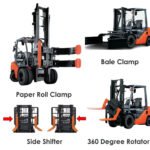
Any attachment mounted between the forks and the load, such as a side shifter, fork positioner, or clamp, adds its own thickness to the load center distance and adds weight at the front of the truck:
| Attachment | Added Load Center Distance | Typical Capacity Loss |
|---|---|---|
| Side shifter | 50–100 mm | 10–15% |
| Fork positioner | 100–150 mm | 15–25% |
| Paper roll clamp | 200–400 mm | 25–40% |
| Rotator | 200–500 mm | 30–50% |
These figures vary by manufacturer and attachment model, so always check the de-rated capacity on the attachment's own data plate rather than estimating. As a rough conservative guide near the 500–600 mm range, each additional 100 mm of load center costs about 14–17% of rated capacity, and the loss per 100 mm shrinks as the load center grows. The certified plate is what governs safe operation. See our guides to clamp attachments and boom attachments for more.
If you're specifying a truck that will run an attachment from day one, tell your supplier the attachment type up front. The truck should be rated for the actual working load center, not the bare-fork rating.
Buying Checklist
Before you finalize a forklift purchase:
- Measure your actual pallets or your heaviest, longest load, and calculate the real load center.
- Compare that number to the load center on the spec sheet, not just the headline capacity.
- If you'll run attachments, ask the supplier for the capacity plate figure with that attachment installed, not the base rating.
- Confirm fork length matches your load depth, not just the truck's default configuration.
- Ask for the full load capacity chart for the exact model, and check capacity at your required lift height too.
- Never plan to exceed the capacity on the data plate, even if your load center is shorter than rated.
The load center isn't a spec you can skip past to get to the 'real' number. For buyers moving standard pallets, it often is the real number: the one that determines whether the truck can actually do the job at your site.
If you're not sure which load center rating fits your operation, send us your pallet dimensions and typical load weight. We'll tell you which of our configurations gives you full rated capacity for your loads, instead of a de-rated one.