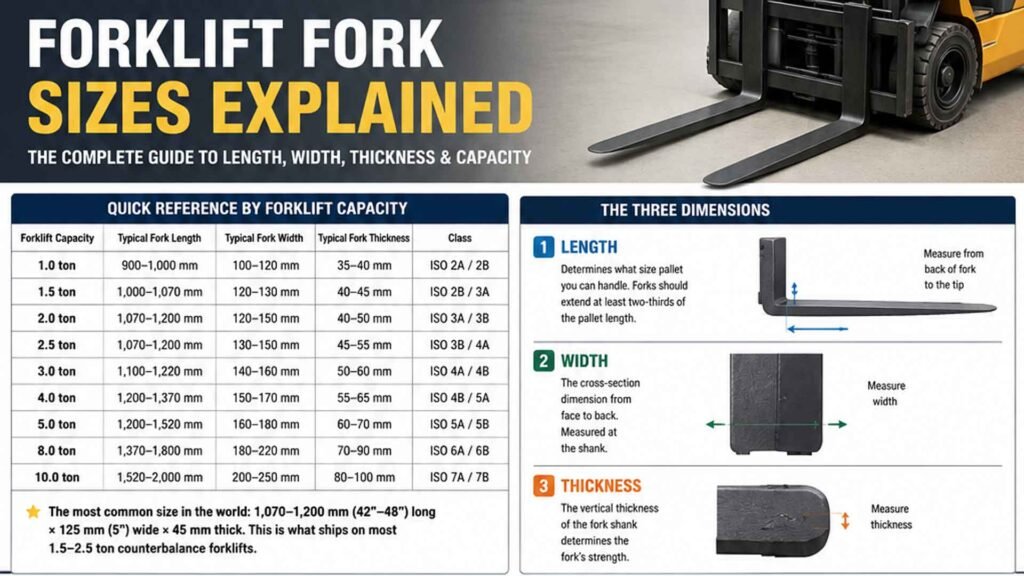
Quick Reference by Forklift Capacity
| Forklift Capacity | Typical Fork Length | Typical Fork Width | Typical Fork Thickness | Class |
|---|---|---|---|---|
| 1.0 ton | 900–1,000 mm | 100–120 mm | 35–40 mm | ISO 2A / 2B |
| 1.5 ton | 1,000–1,070 mm | 120–130 mm | 40–45 mm | ISO 2B / 3A |
| 2.0 ton | 1,070–1,200 mm | 120–150 mm | 40–50 mm | ISO 3A / 3B |
| 2.5 ton | 1,070–1,200 mm | 130–150 mm | 45–55 mm | ISO 3B / 4A |
| 3.0 ton | 1,100–1,220 mm | 140–160 mm | 50–60 mm | ISO 4A / 4B |
| 4.0 ton | 1,200–1,370 mm | 150–170 mm | 55–65 mm | ISO 4B / 5A |
| 5.0 ton | 1,200–1,520 mm | 160–180 mm | 60–70 mm | ISO 5A / 5B |
| 8.0 ton | 1,370–1,800 mm | 180–220 mm | 70–90 mm | ISO 6A / 6B |
| 10.0 ton | 1,520–2,000 mm | 200–250 mm | 80–100 mm | ISO 7A / 7B |
The most common size in the world: 1,070–1,200 mm (42'–48') long × 125 mm (5') wide × 45 mm thick. This is what ships on most 1.5–2.5 ton counterbalance forklifts.
standard forklift fork size
The Three Dimensions
Length
Fork length determines what size pallet you can handle. The rule: forks should extend at least two-thirds of the pallet length.
| Pallet Length | Recommended Fork Length | Minimum Acceptable |
|---|---|---|
| 1,000 mm | 900–1,000 mm | 700 mm |
| 1,200 mm (standard euro / US pallet) | 1,070–1,200 mm | 800 mm |
| 1,400 mm | 1,200–1,370 mm | 930 mm |
If forks are too short, the load center shifts forward and effective capacity drops. If forks are too long, they hit the pallet behind in the rack — or hit pedestrians / equipment in tight turns.
Standard lengths by region:
- North America: 42' (1,067 mm) or 48' (1,219 mm) — matches standard 48' pallet
- Europe: 1,000–1,200 mm — matches EUR pallet (1,200 mm)
- Asia: 900–1,070 mm — matches 1,000–1,100 mm pallets
Width
Fork width is the cross-section dimension from face to back. Standard widths by capacity class:
| Class Code | Width Range | Common on |
|---|---|---|
| ISO 2 | 100–130 mm | 1.0–1.5 ton |
| ISO 3 | 120–150 mm | 1.5–2.5 ton (most common) |
| ISO 4 | 140–170 mm | 3.0–4.0 ton |
| ISO 5 | 160–190 mm | 5.0 ton |
Width has no strict rule — it's determined by the forklift carriage class. You can mount narrower forks on a wider carriage (with shims), but you cannot mount wider forks on a narrow carriage.
Thickness
The vertical thickness of the fork shank determines the fork's bending strength. Thicker = stronger.
Thickness increases with:
- Higher load capacity
- Longer fork length (to prevent sag)
- Greater lift height (for dynamic loading at elevation)
- Lift truck with side-shifter (clearance needed for attachment)
Typical thickness by capacity:
- 1 ton: 35 mm
- 2 ton: 45 mm
- 3 ton: 55 mm
- 5 ton: 65 mm
If the fork is too thin for the load, it bends. A bent fork is a failed fork — it cannot be straightened and reused.
Carriage Class — What Your Forklift Takes
Forks are not universal. They mount on a fork carriage, and carriages come in standard classes.
| Carriage Class | Carriage Width (Hooks) | Max Load | Typical Fork Width |
|---|---|---|---|
| ISO 2 | 760 mm | 2,500 kg | 100–130 mm |
| ISO 3 | 880 mm | 5,000 kg | 120–150 mm |
| ISO 4 | 1,000 mm | 8,000 kg | 140–170 mm |
| ISO 5 | 1,100 mm | 12,000 kg | 160–190 mm |
MOST standard counterbalance forklifts (1.5–3 ton) use ISO 3A or 3B carriages.
To check yours: measure the distance between the two hook centers on the back of the fork. If it's approximately 880 mm, you have an ISO 3 carriage.
How to Measure Fork Size on Your Forklift
Step 1 — Length
Measure from the vertical face of the fork (where it meets the carriage) to the tip. Do not include the hook or the heel.
Step 2 — Width
Measure the horizontal width of the fork cross-section at the shank (the vertical section below the carriage hook). Don't measure the taper — measure the flat part.
Step 3 — Thickness
Measure the horizontal depth of the fork at the shank — from front face to back face.
Step 4 — Check the fork stamp
Every fork has a steel stamp on the side of the shank. It lists:
- Manufacturer name or logo
- Load capacity per fork (not per pair)
- Fork class / model number
- Serial number
- Year of manufacture
- Material grade
Example stamp: '5000 lbs @ 24' LC — 2 ton — ISO 3A'
Standard Fork Taper
Most forks are not uniform thickness along their length. The tip is thinner for easier pallet entry.
| Measurement | Typical |
|---|---|
| Shank thickness | Full thickness (45 mm on a 2-ton) |
| Tip thickness | 50–60% of shank thickness (~22–27 mm) |
| Taper length | 300–500 mm from tip |
The taper does not reduce fork strength — the bending stress is highest at the heel, not the tip. The taper only makes pallet entry smoother.
When Forks Need Replacement
Replace forks immediately if you see:
| Defect | Reject Criteria (OSHA / ISO 5057) |
|---|---|
| Crack | Any visible crack in any direction — do not use |
| Bend | More than 0.5% of fork length deviation from straight |
| Wear | Heel wear deeper than 10% of original thickness |
| Twist | Any visible twist along the fork length |
| Missing stamp | If the capacity stamp is illegible, the fork has no certified capacity |
| Worn tip | Less than 60% of original tip thickness |
Heel wear is the most common reason forks fail inspection. The heel (the curve where the shank meets the blade) rubs against the carriage and pallet stringers. After years of use, the thickness at the heel can drop below safe limits.
Checking heel wear: Use a fork wear gauge (U-shaped template). If the gauge drops over the heel gap, the fork is worn past safe limit.
Fork Options (Non-Standard)
| Option | When to Use | Effect on Size |
|---|---|---|
| Longer forks (+300–500 mm) | Handling oversize pallets or long loads | +capacity at short load centers, -capacity at full extension |
| Shorter forks (-200 mm) | Tight turning areas, small pallets | Less stability, less safe for standard pallets |
| Wider forks | Larger pallets, block stacking | Needs wider carriage (ISO 4 or larger) |
| Full-taper forks | Glass handling, delicate loads | Thin tip extends further back for gentle entry |
| Painted / marked forks | Clean room / food grade | No size difference, special coating |
| Fork extensions (bolt-on) | Occasional long loads | Adds 500–1,200 mm to effective length. Reduces capacity |
Standard Fork Size by Pallet Type
| Pallet Type | Size | Recommended Fork Length | Recommended Fork Spread |
|---|---|---|---|
| EUR (Euro) pallet | 1,200 × 800 mm | 1,070–1,200 mm | 300–400 mm |
| US standard (GMA) | 48' × 40' (1,220 × 1,016 mm) | 1,070–1,220 mm | 300–500 mm |
| US half pallet | 48' × 20' (1,220 × 508 mm) | 900–1,070 mm | 300–400 mm |
| Industrial / chemical | 1,200 × 1,000 mm | 1,200 mm | 400–500 mm |
| Asian standard | 1,100 × 1,100 mm | 1,070–1,100 mm | 300–400 mm |
The Bottom Line
Standard fork size for a 2-ton forklift: 1,070–1,200 mm long × 120–150 mm wide × 40–50 mm thick on an ISO 3 carriage. But always check the fork stamp and measure your actual pallet length before ordering replacements.
If you're buying a used forklift, inspect the forks for heel wear and check the stamp. If the forks are damaged, missing stamps, or heavily worn, budget $400–$1,200 for a replacement pair.
We supply replacement forks and full forklifts with factory-standard fork sizes. Fork length, width, and thickness matched to your carriage class and application.
Hebei Maoxiang Technology Co., Ltd.
- Web: forkliftlift.com
- Electric forklifts | Diesel forklifts | Reach trucks | Parts & attachments
- FOB Tianjin | CE certified | 20–35 day lead